For my first post, I’m sharing a letter @NVIDIA signed on why open models matter.
AI will transform every industry, power every company, and be built by every country.
Open models strengthen safety and cybersecurity, accelerate innovation and diffusion, and enable sovereignty.
The world needs both frontier closed models and frontier open models.
https://t.co/AUKzoQ5Ikb
“I met my younger self for Coffee today. I lit a cigarette, he left the table.”
- Stephen Okpelle
Stephen Okpelle’s short verse reflects the bittersweet reality of growing older, losing innocence, and becoming someone your younger self might struggle to recognize. The cigarette serves as a powerful symbol of adulthood’s burdens, disappointments, and coping habits, creating a painful contrast between the innocence of youth and the weight of lived experience.
Beneath the words, a softly lit painting shows an elderly man sitting alone opposite an empty chair, with two cups of coffee and a burning cigarette between them. The scene captures a haunting sense of loneliness and reflection, as though the man has just watched his younger self walk away, leaving him to confront the distance between who he once was and who he has become.
I'm increasingly despondent about how binary the AI debate has become in the US. Either you're naively pro-AI, happy to see massive data center build-out and a handful of frontier model companies become central to everything we do online, or you want to pause research, stop the build-out, and discourage people from using AI.
Almost nowhere do I see people talking about the need for decentralized AI. To me, this is the only safe way forward.
There's an underlying truth to both sides of the naive debate.
The pro-AI camp is right that refusing these technologies leaves enormous consumer welfare gains on the table. An individual using an AI agent to interact with companies and governments can stand up for their own interests rather than accept whatever terms or bureaucracy they're offered without a practical means of negotiating. And refusing to advance AI research would have enormous national security and competitiveness consequences as adversaries develop technologies that could exploit our increasingly vulnerable infrastructure.
The anti-AI camp is right that a world where everyone uses the same handful of inference providers for their most intimate affairs rapidly looks like a corporate panopticon. Ask yourself whether you really want every self-driving car to have a corporate kill switch. Sure, we could just regulate and trust giant inference providers, as we've done with Big Tech companies like Google. But the stakes are much higher when these companies sit at the center of virtually all our computing, and increasingly our physical infrastructure. Email and cloud storage were just the beginning.
Both of these positions can be true. And their synthesis points toward a third way.
We should be supercharging AI development and adoption while encouraging sovereign AI: systems in which individuals have meaningful control over the models, data, and infrastructure providing their inference.
An important distinction is between training models and providing inference. Frontier training may require enormous concentrations of capital, energy, and compute. That doesn't mean the companies that train models must also control how people use them. Even the most capable models should be runnable independently of their creators.
People should be able to keep their data locally and run models on hardware they control whenever feasible, especially where independence matters for safety, as with self-driving cars and home security systems. They should have access to open-weight models they can inspect, modify, and run without anyone's permission.
Where cloud computing is necessary, we need genuine competition among providers that respect user privacy and autonomy. But competition isn't enough. We should develop technical and protocol-based guarantees that limit what even a dominant provider can learn about or do to its users.
Technologies pioneered in cryptocurrency could play a significant role. Zero-knowledge proofs could help verify that computations were performed correctly; homomorphic encryption could enable computing on encrypted user data without revealing it to providers; and blockchain-based protocols could coordinate decentralized computing resources and enable new forms of user ownership. These technologies are at different stages of maturity, but point toward privacy and user control guaranteed by system architecture rather than a company's privacy policy.
Perhaps users could even own part of the infrastructure providing their inference, sharing in its value rather than merely providing valuable data to someone else's business.
There's no reason AI's enormous promise should require surrendering control over our digital lives to a handful of corporations. We can have rapid AI progress and individual technological sovereignty. Indeed, I think the latter is essential if we want the former to be a lasting benefit to humanity.
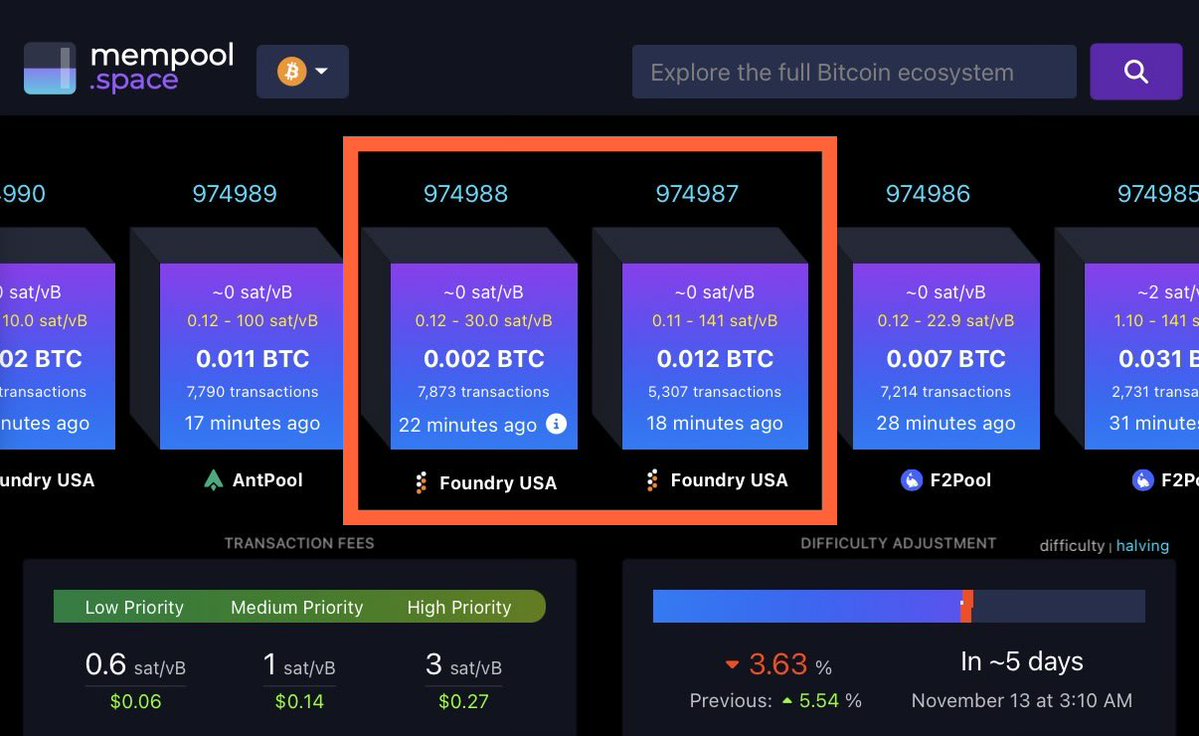
why does block 974,988 show “22 minutes ago” while the block before it, 974,987, shows 18? mempool dot space and my own dashboard both show it, and neither is wrong. the timestamp inside a block is set by the miner, not by the network
Everyone should read the Bitcoin whitepaper. Once you're deep enough down the rabbit hole you should go read the original email thread in which it was announced. You'll recognize many criticisms that are rehashed to this day.
https://t.co/aWajP0L8NJ
Made Bitcoin 100x harder to crack for a quantum attacker. Stupid simple: force it to solve 100 keys instead of one within 10 min block time.
No fork, no new opcodes, no direct-to-miner relay.
Multisig was designed to distribute trust, we reuse it to multiply the computational work required to forge a Bitcoin spend.
Runs on Bitcoin Core today.
1/
NEW: WHAT HAPPENS TO SATOSHI’S #BITCOIN?
This week, @nic__carter lays out his best case for an orderly salvage of abandoned BTC before a quantum attacker gets there first.
We discuss:
⚡️ Why AI worries him more than quantum
⚡️ How he grades the core dev response
⚡️ The end of cryptography's golden age
Watch ⚡️
LIVE: BFM293 w/ @erikcason⚡️
“We need to apply Bitcoin’s crypto-anarchism to AI ASAP”
We discuss:
🔸AI as next propaganda machine
����Local AI, self-custody for data
🔸Digital panopticon, KYC, social credit
🔸Open source as freedom infrastructure
🔸Bitcoin + AI = One single story