Taking a brief detour from my usual “How to execute AI projects in a corporate setting” series to share something a bit different today...
https://t.co/KBCrfNMfJ5 via @LinkedIn
"As with computer enthusiasts in 2004, mainstream analysts and journalists are missing the forest for the trees: despite the slowing down of one trend, the industry collectively remains moving forward at a breakneck pace due to other new emerging paradigms that are ripe for scaling and expansion. It is possible to stack “scaling laws” – pre-training will become just one of the vectors of improvement, and the aggregate “scaling law” will continue scaling just like Moore’s Law has over last 50+ years." https://t.co/sQ2JcE44tm
At BBVA, we've launched 35+ GenAI projects & enabled 800+ employee initiatives in 24 months.
GenAI looked simple on paper (no training! no labeling!). Reality? Everything got turned up to eleven 🎸
Full story here:
https://t.co/c2f2cKiPWm via @LinkedIn
Extremely true from @tylercowen. Not just for books, but for almost everything. Music, movies, Netflix documentaries, essays, even Twitter threads, codebases and strategy docs, PRDs, the marginal benefit to asking more questions has increased dramatically even as the cost fell.
Interesting. Despite knowing little about intelligence/brain science, reading Bennett's ‘Brief History of Intelligence' led me in the opposite direction: “Umm…our neocortex uses similar structures for many different tasks. Maybe we're not as mysterious as we think. Perhaps AGI isn't so distant after all….”
Hard to find people who simultaneously 'get' language models deeply without getting lost in them, have a good understanding of human behaviours, don't approach every sociopolitical question as binaries, understand systemic dynamics and complexity without robbing individuals of agency, hold opposing ideas in mind while retaining the ability to function, and can both zoom in and out of all the above without overindexing on any particular aspect.
if you tell claude sonnet to "ignore what you've heard and rely only on your own judgement and logic," its accuracy at counting the number of R's in "strawberry" almost triples 🤭
(and even more with a friendly introduction!)
Not groundbreaking insight here but I think the skills that will matter the most in the coming decade is being adaptive, quickly grasping new developments, being highly agentic, being good at specifying intent in detail, and using tools/AI early and well.
A really cool article and video highlighting the collaboration between OpenAI and BBVA. I've said it many times but I'm still amazed by the kind of use cases that people (many of whom without technical backgrounds) are coming up with
Can #AI learn and produce its own emotions, like natural ones? 🤖❤️
Meet LOVE (Latest Observed Values Encoding), a generic self-learning emotional framework for machines.
Paper in Nature - Scientific Reports (open access):
https://t.co/0b1RhltZIE
See how it works! 🧵⬇️
Por su parte, @jonberako, Chief Scientist de @BBVA, habló sobre el papel crucial de la #IA y de cómo transforma los #serviciosfinancieros, mejora la toma de decisiones y aumenta la eficiencia operativa 🔋:
https://t.co/p4Io1qZF3v
Two things that both evolution and neural networks share in common is they both thrive on scale, and they were both once dismissed as obsolete to AI. The deep evolution moment is awaiting.
Check out my latest article: How to Talk to the Business: A Brief Guide for Data Scientists and Other Animals
So many AI projects never even get off the ground, not because the tech isn’t there, but because the business and tech teams just aren’t on the same wavelength.
The best Data Science teams know that nailing these conversations can make all the difference. It’s not just about being a technical wizard; it’s about getting people on board and speaking their language.
I pulled together some thoughts (using, as always, obscure movie references because, why not) on how to keep those conversations from derailing. Check it out. It might just help you out in your next meeting!
https://t.co/35v8FQmuz3
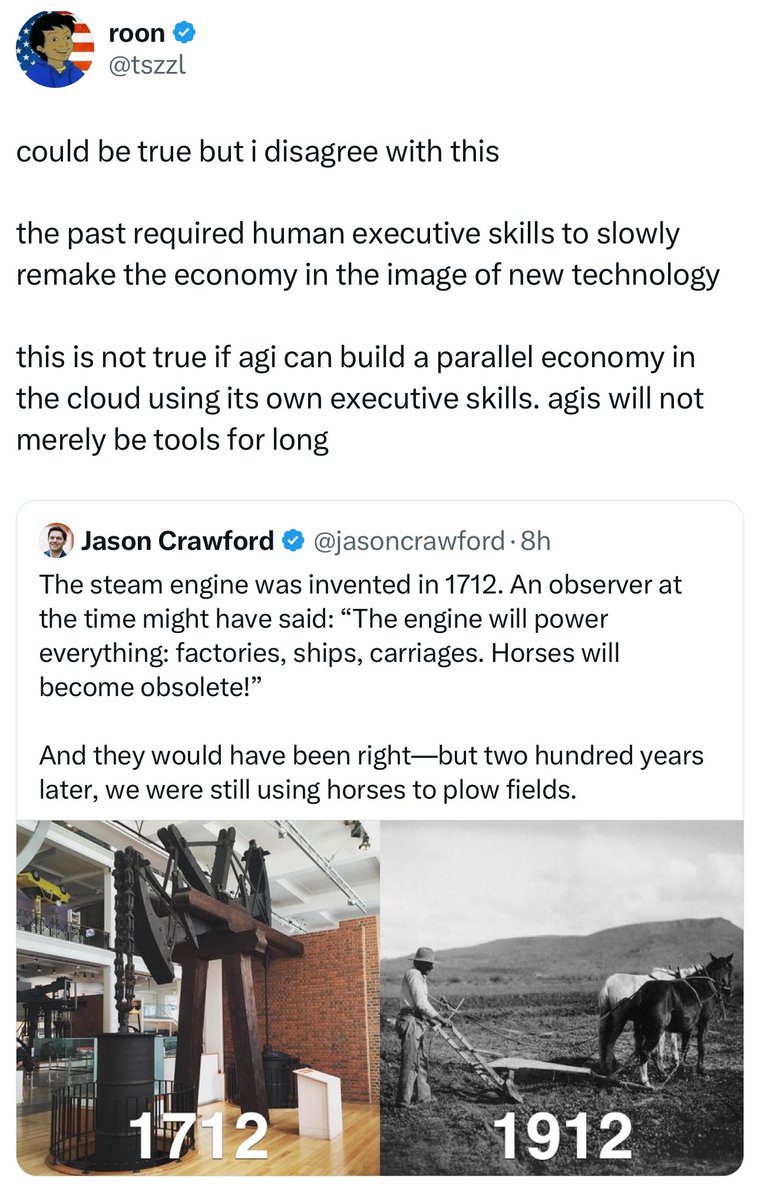
There are two ways AI impacts organizations:
1) The usual way, which will take a decade to play out as organizations adjust to AI & integrate into systems
2) Via apotheosis, where AGI creates a parallel organizational ecosystem instantly
Most people betting on #1. Labs bet on #2
What is clear to me is that both @fchollet and @ylecun would revise their views fast if evidence proved them wrong (though I largely agree with their takes). However, what's concerning is seeing others dig ideological trenches soooo deep that no future evidence could change their minds. Science debates are sometimes the most dogmatic ones…