I run Independence Institute @i2idotorg, host Devil's Advocate on @PBS12_CO and YouTube @IITV3, columnist @DenverGazette, gab on @630KHOW @KOAcolorado @710KNUS
There are few things more satisfying to watch than socialists getting mugged by reality.
The Sundance Film Festival is invading my hometown of Boulder early next year. Sundance drew 85,000 attendees last year in Park City, Utah. Boulder’s hotel room inventory is about 2,900. #copolitics
If you’ve ever wondered what happens when Hollywood’s anti-capitalist elite collide with basic supply and demand, we’re about to find out.
When things don’t go as planned, the planner-class doubles down on its religion: more planning. When restrictions, rules, permits and fees don’t produce the desired outcome, more restrictions, rules, permits and fees are needed.
Sundance is an event for and by well-heeled, artsy, socialist elites. So, Boulder is perfect. Colorado progressives can role-play a modern-day Gertrude Stein offering finger sandwiches at a salon of the country’s professional virtue signalers.
But where will the elite stay?
No room at the inn
I’m guessing Robert DeNiro’s concern for the downtrodden won’t tempt him to bunk at the homeless shelter. Jane Fonda won’t crash with the Women Studies majors in some CU dorm room.
Looking online, I see rooms at the Hotel Boulderado during the film festival list for $10,357 a night, then drop to $279 a night after Sundance.
Fortunately, Hollywood’s A-list can always retreat to Boulder’s luxury accommodations: the Comfort Inn at the very edge of town, with a few beds at over $800 a night. Better hurry. George Clooney and entourage are rumored to be eyeing them.
This is not a problem if attendees who preach the forced sharing of wealth are willing to share a hotel room with 28 other people (yes, that math is correct).
Keep in mind, many hotel rooms have two beds, so that’s fewer than 15 people per bed. You could get that number down even more if lesser celebrities sleep on the floor.
The most enjoyable line from a recent Gazette story: “Boulder’s hotels, meanwhile, have committed to making 70% of their room inventory available during the festival at affordable rates, according to Visit Boulder…. The organization is promoting a ‘host with heart’ approach and has published a guide with suggested prices for property owners.”
Is there anything more precious than the NPR gentry ignoring reality and arbitrarily “suggesting” prices between private parties?
There is something delightfully progressive about believing supply and demand can be defeated with positive thinking and a price guide.
‘Hosts with hearts’
Anyway, the most they suggest the owner of a four-bedroom house rent it for is $15,000 for 11 nights. Making all the homes I found on Airbnb renting for up to $175,000 for 11 nights, well, not exactly “hosts with hearts.”
Might surprise you, but you just can’t rent out your home or even a room on sites like Airbnb in leftist cities without government paperwork. You need a stranger’s permission to have people you choose stay in your own damn house.
Invite your friend to stay for the week? Perfectly legal.
Let him hand you $100 to help cover groceries and utilities? Government paperwork.
Have him buy you dinner every night or give you a Picasso? Back to no problem.
It’s said the city has issued about 600 short-term rental licenses. Not nearly enough for the Sundance rush.
What’s the solution? A new and different permitting scheme, of course.
Enter the fresh-and-improved Festival Lodging Rental License for your place, but only when the city authorizes a “Special Festival Event.” To be a “host with a heart,” the city’s privileged must officially sanction the party your guest might attend.
In the endless meetings of planners poring over spreadsheets and debating how to accommodate Hollywood, did anyone raise a hand and ask, “Maybe we should just end the rental-license requirements and let people do what they want with their homes?”
Mugged by reality
The poetry of all this is when Tinseltown’s “capitalism is evil” crowd comes together to fawn all over each other, it will be in a town that’s overflowing in black-market housing.
When 85,000 festivalgoers arrive looking for 2,900 hotel rooms and some 1,000 legal home rentals, the market will do what markets always do: find a way.
The irony is delicious. A festival filled with people who spend their lives warning us about the evils of capitalism may only function because of an underground economy.
Nothing says “capitalism is evil” quite like desperately searching Craigslist for a place to sleep.
It makes no sense to be a Republican in Colorado. Or a Democrat for that matter. Yes! Quit the party. #copolitics
On the day I turned 18, even before I bought my first legal 3.2 beer (remember 3.2 beer?), I went to the courthouse and registered to vote (remember registering to vote?). I joined the Republican Party.
Even at 18, I knew not affiliating with a party diluted the power of my vote.
Sure, everyone gets to vote in November. But one vote among millions isn’t nearly as powerful as a vote in a primary.
Back then, unaffiliated voters were locked out of primaries. Republicans voted in Republican primaries, Democrats in Democratic primaries.
The smaller the electorate, the more your vote mattered.
As a Republican primary voter, my ballot was one of only a couple hundred thousand. As a delegate to the Republican state assembly, my vote was one of only a few thousand. At the county assembly it was one of hundreds. At my neighborhood caucus, I was one of fewer than 10.
At one point, my vote represented more than 10% of all votes cast. That’s leverage.
Rise of the unaffiliateds
Then came Proposition 108 in 2016, which I voted against.
Now those smug, sanctimonious “independents” get both a Republican and Democratic primary ballot and can choose which one to return.
Yet my desire to leverage my vote never changed. So I became unaffiliated.
And like most Colorado voters, I never looked back.
We unaffiliateds get to vote in either primary. This year I’ve decided to return a Democratic ballot.
To my fellow independents, isn’t it nice having choices? Those poor schmucks still clinging to the romance of party affiliation, shackled to organizations that long ago wandered past the hey-guys-let’s-not-get-crazy zone, don’t have the freedom we do.
The still-affiliated can enjoy the purity of party membership while checking voicemail on their flip-phone, insulting Democrats by fax and waiting for next week’s TV Guide to arrive.
To those still registered with a party, investing in Beanie Babies while wondering where the local Radio Shack moved, let me explain why I left.
First, I live in the People’s Republic of Boulder.
If I were still a Republican, I’d have almost no choices in the primary election. Only three of the 15 races on my Republican ballot are contested. Eight races have no candidate at all.
No Republicans in Boulder has finally trickled down to no Republicans running for office.
And unless you’re in complete denial, which has become a permanent condition among many Colorado Republicans, you know absolutely none of the Republican candidates on my Boulder ballot are going to win in November.
That includes, sadly, Barbara Kirkmeyer, the only sane Republican running for governor.
Now, if you live in a conservative part of the state where there are meaningful local races and candidates who can actually win, maybe returning a Republican ballot makes sense.
But here’s the point: you don’t have to be a Republican to do that anymore.
The only temptation I have to return a Republican ballot is to help Kirkmeyer win the nomination.
Yes, she’ll lose to the Democratic nominee in November. Those in denial don’t need to flood my inbox explaining how me saying so will somehow cause that loss — message already received.
But Barbara won’t embarrass the party. She won’t frighten suburban voters. And marginally speaking, she’d help Gabe Evans and a handful of legislative candidates who actually have a shot.
Primaries decide elections
I’ve weighed that consideration against another reality.
The winners of the Democratic primaries for governor and attorney general will almost certainly be the winners in November.
The primary is the election.
Democrats should probably leave their party, too. Why voluntarily surrender half your primary choices?
Why chain yourself to a party label when Colorado law now lets you shop both aisles?
The only remaining reason to stay registered with a party is if you actively participate in caucuses and assemblies and want to help place candidates on the primary ballot without petitioning on.
If you’re registered with a party but never attend caucuses, you’re simply limiting your options under the current rules.
Me, I’m returning a Democratic ballot. Not because I’m a Democrat. But because that’s where my vote has the most influence.
And the prospect of a Colorado run by Democratic Socialists Phil Weiser and Jena Griswold is terrifying enough to make me spend it there.
Reminder: Current CO Attorney General and gubernatorial candidate Phil Weiser signed onto an amicus brief in this case arguing that the government should be allowed to jail marijuana users for up to 15 years if they also own a gun. SCOTUS just ruled 9-0 against that #copolitics
About @lynn_bartels
Colorado’s political decline seems to correspond with the decline of local news coverage. #copolitics
I won’t go so far as to suggest causation, but there’s certainly a correlation between the fall of local news and the fall of Colorado’s freedoms and economy.
We used to have an army of local political reporters. The kind who knew where the bodies were buried because they helped dig them up. They had experience, dogged determination, and a professional hatred of getting scooped by the competition.
They understood that the real political intrigue wasn’t in Washington, D.C; it was in the thousands of governments scattered across Colorado.
Lynn Bartels was their field general.
She was the ace political reporter for the Rocky Mountain News until its collapse and then she moved to The Denver Post before it morphed into a newsletter. (The Post is so skinny these days, I don’t know how many copies to buy to line a birdcage.)
Bartels reported on me off and on for decades, and she could be rough. It wasn’t personal. It was her job to go after anyone involved in politics. We became friends. How could we not? She never took herself too seriously, always took her reporting seriously, and laughed at my adolescent jokes.
She claimed she turned me into a star by reporting on me during my days on the RTD Board in the 1990s. I claimed I turned her into a star reporter by creating so much RTD dysfunction for her to write about.
And thus began a decades-long friendship built largely on insulting each other and laughing.
Get this: both newspapers had full-time reporters assigned exclusively to the RTD beat, covering one of the largest and most wasteful governments in Colorado.
The longest laugh I ever got from her came when she was complaining about a drought in her sex life. “What are you complaining about?” I asked. “You f— someone every time your name is on a byline.”
I would also tease her that reporters are genetically incapable of performing simple math. I even gave her a yellow traffic sign that read: “CAUTION: Journalists Doing Math.” She hung it proudly in her cubicle and would occasionally call me to double-check the numbers in a story.
She was one of the army of great people there for me when my daughter, Parker, died. While the “CAUTION: Journalists Doing Math” eventually came down from her cubicle, Parker’s picture never did.
But in her soul, Lynn is a political reporter. There was nothing she loved more than catching politicians in their hypocrisy. When she retired, you could almost feel the collective relief from the elected class.
Lynn is one uppity, stubborn lady and a genuine piece of Colorado history. She has never been intimidated by a politician, special interest group, or industry.
She is unshakable.
All of which means she has the skills to stare down the cancer she has been battling for some time.
And like all of us who watch helplessly as someone we care about fights for life and dignity, I don’t really know what to do to help.
When my daughter Parker was fighting a ravenous cancer, Lynn wrote about it with compassion. She made me feel a little less alone. People who never met Parker got to know her, at least a little.
So that’s why I’m telling you about Lynn.
She spent a career making sure the rest of us weren’t alone when government lied, cheated, wasted money, or abused power.
Now it’s our turn.
Lynn, you are not alone.
(Note the picture of the most beautiful little girl on Lynn's cubicle.)
Dick Lamm was Colorado’s longest-serving governor, at 12 years in office (a close second goes to Roy Romer). And during those three terms, he slowly drifted to the right. #copolitics#cogov
Not because he became a Republican or even a conservative. He never did.
He simply spent enough time governing to become less impressed with government.
Lamm entered office as a reform-minded Democrat. He sponsored our abortion-up-to-moment-of-birth law years before Roe v. Wade. He led the effort to kick the Winter Olympics out of Colorado.
He championed environmental causes, social liberalization, and all the optimistic good-government ideas fashionable in the 1970s.
Then reality happened.
A funny thing occurs when you’re governor. Every interest group eventually wants something from you. Every program costs more than advertised. Every solution creates two new problems. Every promise runs into arithmetic.
By his third term, Lamm sounded increasingly different from the young governor who first arrived in office. He became obsessed with runaway health care costs, unsustainable spending, population growth and the uncomfortable reality government cannot provide everything to everyone forever.
The left didn’t change. But Lamm did.
Or more accurately, governing changed him.
Which brings me to Jared Polis.
Like Lamm, Polis entered office as a progressive reformer, despite his self-stylized image of a business-friendly libertarian. He embraced unattainable renewable energy mandates, universal preschool, expanded government programs and a host of causes beloved by Colorado’s activist class.
And of course, he oversaw the exponential advance in Medicaid enrollment which is now dooming the state budget.
But now, as his second and final term winds down, I’m seeing something kinda familiar.
He’s starting to act just a little less like an activist and more like a governor.
Just this year, Polis vetoed legislation making it easier for unions to organize, despite enormous pressure from organized labor and lefties. It was the second year in a row he rejected the measure.
He vetoed legislation targeting so-called “surveillance pricing,” arguing the proposal was overly broad and could undermine legitimate uses of technology and consumer discounts. Progressives were furious (but then again, enraged is their normal operating speed).
He vetoed legislation imposing new requirements on social media companies and rejected other measures regulating emerging technologies and business practices.
Most tellingly, he has spent the last two years trying to rescue Colorado from its first-in-the-nation AI regulations after warning they could create a complex compliance nightmare and chill innovation.
Sidenote: Polis wouldn’t have had to spend two years trying to fix a horrible AI law if he didn’t sign it into law in the first place.
None of this is conservative. It’s gubernatorial. There’s a difference.
Legislators get rewarded for passing bills.
Governors get blamed for the consequences.
Is it possible the farther a politician gets from campaigning and the closer he gets to governing, the more likely he is to discover every regulation has a cost, every mandate has a victim, and every ideological crusade eventually lands on somebody’s payroll?
Lamm learned that lesson. Polis appears to be learning it too.
Which raises an interesting question: what if Polis could run for a third term?
Colorado’s term limits prevent us from finding out. But it’s a fascinating thought experiment.
A third-term Polis might be less interested in pleasing activists and more interested in protecting his legacy.
A more fun thought experiment would be what eight years of Gov. Polis would look like if Republicans, not the current democratic socialists, controlled the legislature.
He would have lowered the flat income tax, something he campaigned on, and the avalanche of anti-business, anti-gun, anti-free speech bills would have never reached his desk in the first place.
The best symbolism of a maturing Polis was his signature on a public letter (along with business leaders) complaining about the state’s legal and regulatory leviathan is hurting Colorado’s viability.
Now the difference between Lamm and Polis is if Polis were Lamm he’d also admit he caused the problem in the first place.
Polis made Colorado’s economic downfall happen by not standing up to his out-of-control party. Perhaps in years to come he will, like Lamm did after leaving office, publicly admit his poor judgement.
Jared can’t have Dick Lamm’s third term, but he can have his integrity.
Maybe he's killed people, he won't say. Maybe he'll kill TABOR.
Victor Marx was for rent control, before removing the comment from his website. And on TABOR he said “Any discussion about funding has to be honest about TABOR’s limits."
https://t.co/lXkQbuiVQd #copolitics#cogov
I am personally responsible for helping overpay socialists to make Colorado unaffordable, overregulated and one windstorm away from a power blackout. I failed you. #copoltics#coleg
Colorado legislators already get automatic inflation raises. You know, just like your job (I’m assuming the sarcasm bled through that one).
No private-sector worker has that kind of protection forever. Even union jobs eventually meet reality. Ask Spirit Airlines employees.
And that’s the problem.
What happens when lawmakers no longer depend on the private sector for most of their livelihood? They stop understanding the people they supposedly represent. They get disconnected.
And has Colorado ever had more of a disconnected team of politicians?
Part-timers
It wasn’t that long ago legislators made around $17,000 for their 120 days of meddling under the Gold Dome. The idea was simple: take a few months away from your regular job to represent your community.
Back then, lawmakers lived in the same economy as the rest of us because they worked in it.
Today legislators make more than $50,000 for their 120-day session, plus a hefty per diem ranging from $99 to $193 a day. That means many are pulling in at least $500 a day to pass laws making Colorado steadily less affordable.
But can you really put a price on outlawing ketchup packets after giving illegal immigrants Medicaid during a budget crisis?
And when legislators say they work year-round, understand the translation. They call it citizen “engagement.” The rest of us call it campaigning. Paying them our tax dollars to do so is the ultimate pro-incumbent scam.
Naturally, all people want more money. Politicians are no different. They just have more power than you do.
Now, they couldn’t just openly vote themselves a raise. That looks bad. Elections, optics — all that nonsense. Also, that would be direct, transparent and honest. They wouldn’t know how to do it.
The commission
So they did what politicians always do when they want a predetermined outcome without their fingerprints. They created a commission.
I know. I served on it. The then House minority leader is a friend and pressured me to be on it. Then she quit the legislature to save her own sanity (I’ll get even with you, Rose Pugliese! Payback is a b****, lady).
The Independent State Elected Official Compensation Commission — how Soviet sounding can you get? Along with the Senate minority appointee, we were basically the only two members who thought maybe performance should factor into compensation.
Tiny detail: the commission was supposedly making “recommendations.” Except they really weren’t recommendations at all.
Recommendations are given to people who later decide how to act on something. But the law creating our little salary-washing operation was designed so if the legislature did absolutely nothing, our “recommendations” automatically became law.
That’s the game — no “action” required.
Create a commission. Fill it with people who will give you what you want; in this case to recommend raises. Structure the law so lawmakers don’t have to vote for the raises. Then let “taking no action” become the action.
If you’re getting flashbacks to “The Sting,” that’s understandable.
My idea was we recommend the legislature cut their legislative session from 120 days to 90 days, but keep their salary the same. That would be a huge raise per day worked and free up another month a year to make money in the real, like their constituents.
Lots of states have 90-day sessions or less, and some, like Texas, have 90-day every other year.
The commission dismissed my idea.
Another member proposed tying some portion of compensation to state performance. Not exactly commission sales, but at least some accountability for affordability, economic growth, or fiscal stability. Not quite working on commission, but definitely a bonus structure.
That idea didn’t fly either.
Back-door pay raise
Instead, the commission embraced government’s oldest salary justification: “Other governments are doing it.”
So beyond their automatic inflation increases, legislators now get another 6% raise they never had to publicly approve.
The next governor gets an 11% bump.
The state treasurer gets 28% more.
And the attorney general gets a staggering 45% increase.
While we sit in a budget shortfall of their own “hey let’s put everyone including illegals on Medicaid” making, they get rewarded for it. So if you were giving them your annual employee review based on performance, would they get this raise?
Really? This much hullabaloo over Tina Peters?
We enjoy being distracted by the silliest things, don’t we? Our governor’s commutation of Peters’ sentence is just that — a silly thing. #copolitics#coguv
Just as it was nonsensical for the “Free Tina Peters” crowd to act like she was Martin Luther King Jr. in a Birmingham jail, the temper-tantrum against Gov. Jared Polis’ reasonable action is equally puerile.
Tina Peters is guilty of serious crimes, and for those crimes she should be seriously punished. She is not a hero. She is not a truth teller. She did not prove elections were stolen.
In fact, her actions were an insult to the sanctity of our elections. And unlike what we do with most crime in Colorado, we actually wanted her punishment to deter others from doing it.
In trying to prove the system was rigged, she unwittingly provided evidence in the other direction. She tried to tamper with an election. She got caught. She paid a price.
But the punishment simply did not fit the crime.
No election outcome changed. No office changed hands. No voter was disenfranchised. Hell, kids shoplifting candy cause greater real-world injury than Tina did.
This is her first conviction of any crime, and it’s a nonviolent offense at that.
Meanwhile, there have been car thieves, fentanyl dealers, rapists, attackers and even killers who served less time than Ms. Peters. Yet the very people under the Gold Dome who passed laws making sure those criminals served less time than Peters are now squawking loudest about her early release.
‘Deeply’ disappointed
The entertaining part is they see no contradiction in passing laws treating real criminals one way while censuring Polis for basically following the logic they themselves created.
Not only has the Democratic Central Committee officially denounced Jared, dropping down on him all the weight of a feather, but the Colorado County Clerks Association wrote a…wait for dramatic effect…strongly worded letter expressing they were “deeply” disappointed. One has to do something truly evil to earn the “deeply.”
Shall we be honest? What Democrats are truly disappointed in is losing crazed MAGA mascot Tina Peters as a daily reminder to voters that Republicans can still out-crazy Walmart shoppers on Black Friday.
But what they forget is Colorado’s GOP will continue playing Three Stooges long after Tina is released. Maybe even more so.
It makes no sense the left’s wacko wing is piling on Polis. Tina Peters in the news only helps progressive candidates. And Polis’ commutation guarantees Tina gets nothing but airtime.
Forget Nelson Mandela’s release. The coming “Tina is finally free” celebrations will keep the Tina-palooza raging through election season. The media will breathlessly cover every irrelevant rally, interview and Tina sighting.
And voters will be continually reminded there are Trump supporters and election deniers walking among us. Maybe walking by our kids in the park or even sitting next to grandma at church.
Selective outrage
And if Democrats truly believed Polis’ commutation represented some moral collapse, you’d expect similar outrage over his other commutations.
Curiously, not so much.
As Cory Gaines pointed out in his must-read Substack, “Colorado Accountability Project,” the media might be too busy going Tina 24/7 to mention Polis also commuted the sentence of police shooter Brandin Kreuzer.
Polis commuted Kreuzer’s sentence on National Law Enforcement Memorial Day because, you know, poetry.
During a crime spree, Kreuzer fired at two Douglas County deputies from his car, hitting one.
Polis justified the commutation by citing a law that didn’t exist at the time of sentencing but now would allow a judge to impose less prison time. According to Polis, the judge surely would have reduced the sentence. Apparently our governor is now clairvoyant.
Besides that, Kreuzer helped people while in prison.
Polis didn’t speak to the victim, Deputy Todd Tucker, who had the perfectly reasonable reaction:
“I’m glad he’s helped people while he was in prison. Good for him, but it shouldn’t weigh on getting out of prison after trying to kill two police officers,” Tucker said. “I mean, I’ve been helping people for 30 years.”
Odd Democrats didn’t censure Polis for freeing a cop-shooter (Um, that was sarcasm, by the way).
Enjoy Tina Time.
Another week, another column about Colorado’s ruling class treating democracy like a state trooper treats the speed limit. It’s for other people. #copolitics#coleg
I swear, I want to write about literally anything else — aliens, sports, lab-grown meat, Bigfoot opening a vape shop in Pueblo.
But Colorado’s legislature has never been more abusive to the citizenry, or hypocritical.
To save time, I won’t rehash the endless “No Kings,” “Trump is destroying democracy,” “our sacred duty is protecting democracy, so be happy you have us” self-promotion constantly ejaculated by Colorado’s ruling class.
But, for the sake of argument, let’s pretend every word of it is true. Let’s assume President Donald Trump wakes every morning and convenes a joint special-forces meeting to steal democracy in Colorado.
If democracy is truly hanging by a thread, then surely Colorado’s Democrat majority is heroically defending it. I mean, they say that’s their job one, next to banning ketchup packets (Senate Bill 146, seriously).
Which leaves me confused.
Because from my tiny little “just-a-citizen” brain perspective, they seem to spend an awful lot of time removing voters’ power, hiding meetings, dodging taxpayer consent and nullifying ballot initiatives.
Maybe I’m missing the advanced theory of democracy taught only in elite government seminars and overpriced Aspen retreats.
Take Senate Bill 150. It strips away two-thirds of RTD’s publicly elected board seats and replaces them with appointees.
Silly me. I thought democracy involved electing people.
But apparently true democracy is when insiders choose insiders to protect the public from the dangerous unpredictability of… the public.
Then there’s House Bill 1326, which exempts the all-powerful Public Utilities Commission from open meetings laws.
Again, I’m sure there’s a sophisticated democracy-enhancing explanation for this.
Perhaps democracy works best when the public cannot actually watch government decisions being made. Sort of a “trust us you peasants” model of self-government.
House Bill 1418 puts a “fee” on games young people play online.
Now, if it walks like a tax, quacks like a tax and drains your wallet like a tax, a normal person might call it a tax. But by labeling it a “fee,” lawmakers can dodge asking voters for permission.
Which is convenient. Because asking permission from citizens can really slow down democracy.
Even more amazing, this fee appears large enough that under existing law it should require voter approval anyway. Yet lawmakers are still trying to skip the vote.
Apparently democracy is strongest when elections are treated as optional.
Then there’s Senate Bill 135, which takes your TABOR refunds. At least this one goes to the ballot. But the ballot language will say the money goes to education.
In reality, only a small fraction actually does.
Maybe I’m old fashioned, but using misleading ballot language to convince voters to surrender their money feels less like defending democracy and more like a used car salesman turning back the odometer on a lemon.
Now comes the cherry on top, House Bill 1430, filed in the final chaotic moments of the session. Its purpose is beautifully simple: invalidate a citizen initiative that might appear on the ballot this fall. Kill what voters might vote for before they vote on it.
I always believed democracy meant if voters approve something at the ballot box, government respects the outcome. Isn’t that what the anger against Trump and Tina Peters is all about?
Here’s the backstory: Colorado used to dedicate sales tax revenue from automobile parts and accessories to roads. Which honestly seems reasonable, given roads are where cars generally go (Man, if I could still get away with a drunk driving joke, this would be a perfect spot).
But the legislature ended that sensible funding stream. We don’t really do road funding anymore. I don’t need to convince you of that. Instead, we currently do incentives for front-end alignment shops.
Now there’s a potential citizen initiative that might restore that road-funding mechanism. Maybe it makes the ballot. Maybe voters approve it. Maybe they don’t.
That’s how democracy is supposed to work.
But HB-1430 essentially says, “That’s cute. Your vote still won’t matter.”
If voters approve returning the road funding, with 1430 lawmakers will reduce road funding by the exact same amount.
Thankfully, Colorado is governed by people who understand democracy far better than voters do.
Thank God Colorado’s one-party rulers are here to save democracy from the voters.
State lawmakers are adding themselves and many other government officials in CO to the list of “protected persons” who, for safety reasons, can get their home addresses and other personal information removed from public records posted on the internet.
https://t.co/ykc0UOtvfe
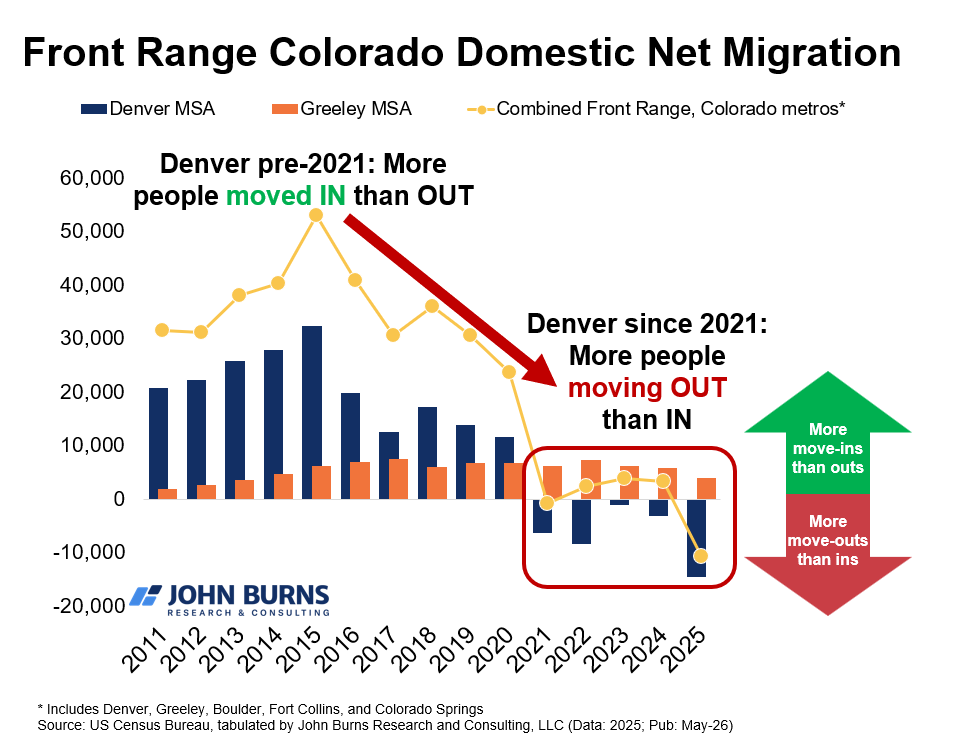
More signs that Aurora Highlands is in trouble. This house sold for $1 million in 2024 and is up for a short sale for $600,000 today. And I still am not sure that price is right :/ https://t.co/BR2FZ8sDQb
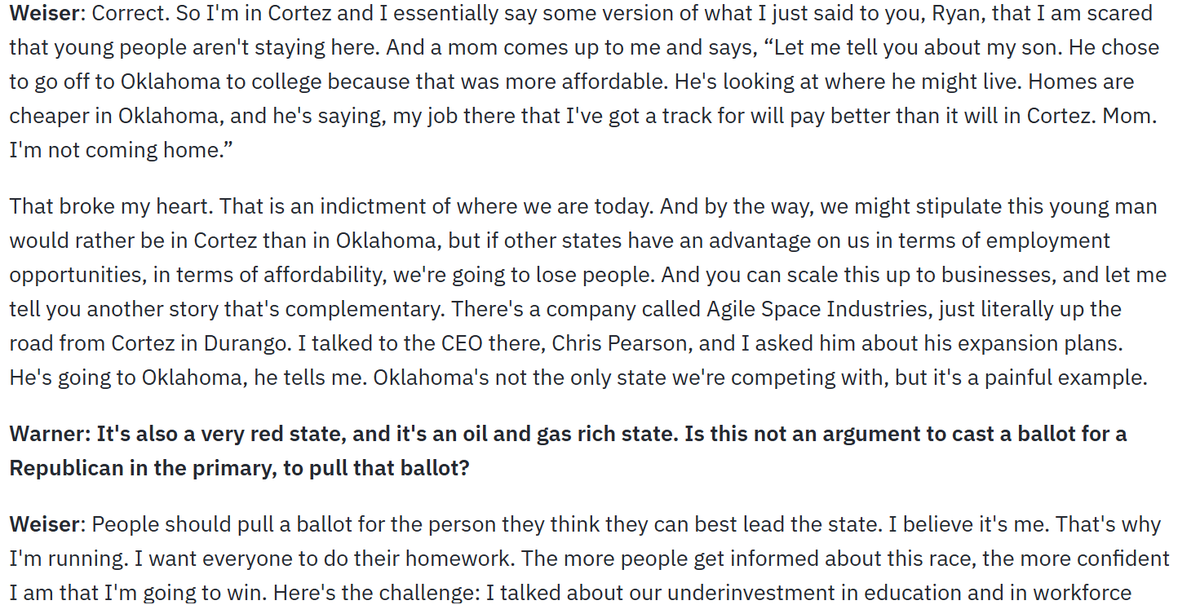
Weiser: "People I talk to, from individuals to businesses, say it's too expensive in CO and they're moving to red states."
CPR: "Isn't that an argument to vote Republican?"
Oof.
We the people of Colorado no longer control our own state constitution. I found this out the hard way. #copolitics#coleg#cogov
In Colorado, a government for, by, and of the people is a fib.
We lowly citizens no longer have much of a say in altering our own state constitution. Even though that seems to violate the whole meaning of our constitution in the first place.
Like the US Constitution, Colorado’s constitution contains a Bill of Rights making clear we are the ones who empower the state government, not the other way around.
Check out the first two of these rights:
First — All political power is vested in and derived from the people; all government, of right, originates from the people…
Second — The people of this state have the sole and exclusive right of governing themselves, as a free, sovereign and independent state; and to alter and abolish their constitution…
Did you catch that? We the people have the sole and exclusive right to alter our constitution. It used to be true, too.
We used to alter our constitution through the initiative and referendum process.
Without that process, we would not have limits on governmental power. Laws reining in the legislature could never pass a vote by those same politicians. They’d never vote for open meetings laws, term limits, the Taxpayer’s Bill of Rights, ethics laws, and so much more.
Recently, when the legislature arrogantly exempted themselves from open meetings laws, it started a chain reaction I’ve never witnessed in all my decades in politics.
Independence Institute, which I run, helped bring together nearly 50 highly diverse organizations that are usually at each other’s throats. We all shared a common concern: government in Colorado is turning opaque.
Open records are getting harder to access, open meetings are closing. The “people’s” work is being hidden from the people.
And when I say organizations from all over the political spectrum worked together, I’m not exaggerating: Independence Institute, the ACLU, Heidi Ganahl’s conservative Rocky Mountain Voice, the progressive Colorado Times Recorder, Colorado Public Radio, League of Women Voters, Colorado Press Association, Colorado Broadcasters Association, Common Cause, Colorado Black Women for Action, and many, many more.
‘
Over a year-and-a-half of work we crafted a constitutional reform based on what many other states already have, called “Right to Know.” It’s simple: a fundamental right for the people to access public records and government deliberations, with reasonable exceptions.
But you won’t see this proposed amendment on your fall ballot.
The normally sober state Title Board voted 2–1 to block it. The appointees of Secretary of State Jena Griswold and Attorney General Phil Weiser voted against you being able to vote on governmental transparency.
Were they ordered to do so? I’ll let others speculate.
Their argument was that your “right to know” the affairs of government isn’t a single subject, and only “single subjects” may go to the ballot.
Legislators’ bills must also have a single subject. The difference is they get to decide for themselves whether a bill qualifies. By contrast, we “the people” must get permission from an unelected board. A set of rules for them; a different set for us.
The powerful Title Board said our amendment was too broad.
I countered that the state constitution is supposed to contain broad amendments. That didn’t matter.
Our team pointed to existing rights guaranteed by Colorado’s constitution, like freedom of speech, religion and the right to keep and bear arms. I asked if we were bringing one of those rights as a citizen initiative today, would it pass “single subject” muster as they now interpret it?
They essentially said no.
By their interpretation, such basic rights as freedom of speech or religion might be too broad and vague to be considered a single subject.
We considered appealing the Title Board’s bizarre decision to the Colorado Supreme Court, but on the advice of lawyers from across the political spectrum, we decided not to.
The high court has shown little interest in expanding the public’s right to know what’s going on in their judicial branch.
So now, hiding behind the “single subject” rule, altering our constitution to include fundamental rights — like speech, religion, or even a right to know the affairs of government — can be denied to the very people who are supposed to be the government.
Some things you can’t make up.
“Cuando un hombre de negocios comete un error, él sufre las consecuencias. Cuando un burócrata comete un error, usted sufre las consecuencias”
Ayn Rand