UX, design, actual dedication to the craft will take center stage in this next moment
Actually make something people want. Software and coding won't be the gating factor. It is the ability to be a polymath and smart/effective in many domains together that creates great software.
This is all to say that you make sure incentives, hiring and decision making around maintaining or increasing quality to be and remain the best product in your space.
If you hire people with the craft and taste and give them space, connect them with users, they will produce something of quality & fit more often than not.
When product management is void of metrics and frameworks, it quiets the minds and meetings and focus turns inward “are we doing the right thing” “is this good?”. If you saw the users light up, if your intuition tells you yes, then probably it is the right thing.
To me that is the product management worth practicing.
Probably a host of reasons:
- pm/teams make decisions based on a/b testing/data
- engineers and designers are not listened or contribute to the product direction
- teams are incentivized by “y metric go up” so vision arguments are not listened
- hiring those people who say “we launched x, y metric went up 2%” because quality or vision harder to interview
- multiple layers of management and hiring massive teams where any vision there might be gets diluted away
- product development process is framework driven/overly complex where mental pm energy goes to running it, meetings, not focusing on the product
- founders/execs focus on timelines and launch dates, not quality output
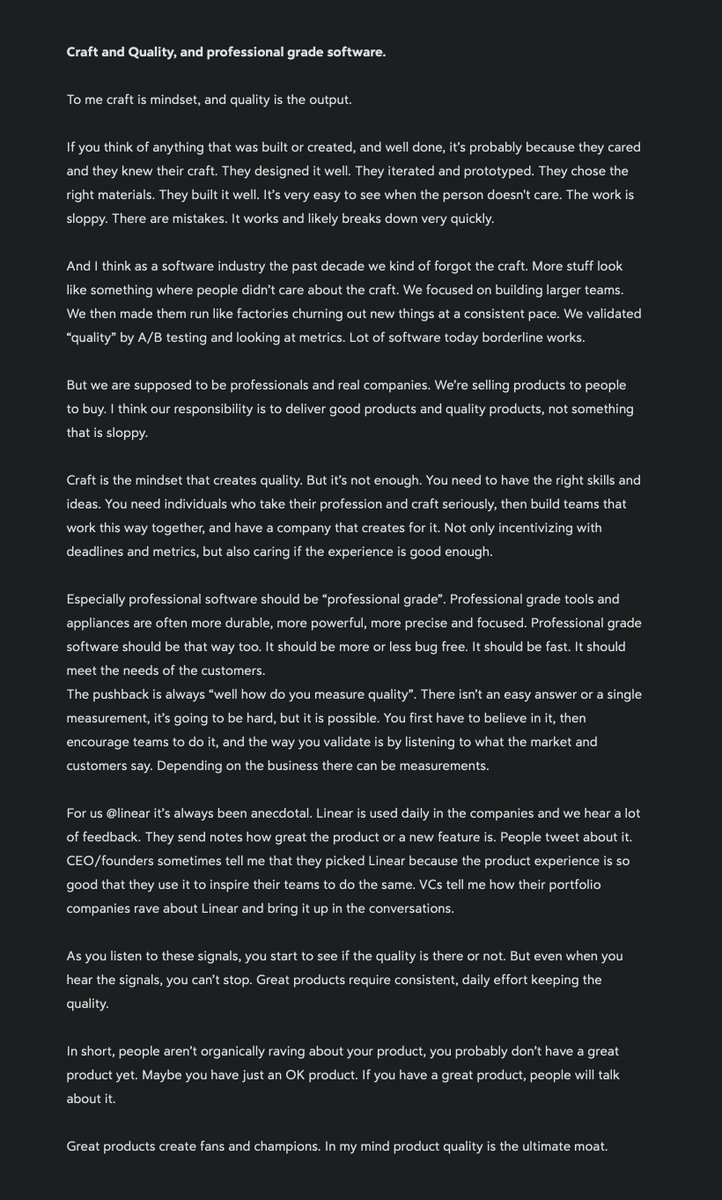
Essentially great work and quality is hard to measure so organizations give up on it.
What replaces is different kind of motions that supposedly do something towards greatness but whole organization mostly just a phoning in/acting product management instead of truly focusing on building great products.
At @linear basically trying to do the opposite of all these things :)
Someone on your team says: “Our goal should be to move Metric X up Y% this half.” Your inclination is to nod, say “Cool” and get on with the actual building.
But pause!
The goals you agree to determine what you build. So consider them carefully and ask the following:
Really enjoyed @joulee's writing on leadership in her recent newsletter. "It is these two ingredients — burning frustration and effervescent hope — that form the cocktail of leadership." 👏
https://t.co/DGToKdDSSN
Shoutout to all the tools behind this. @figma for design. @CodePen for code sketches. @jittervideo for video. @nextjs and @tailwindcss for site setup and styling. @vercel for hosting. Thanks for helping software creators turn imagination into reality.
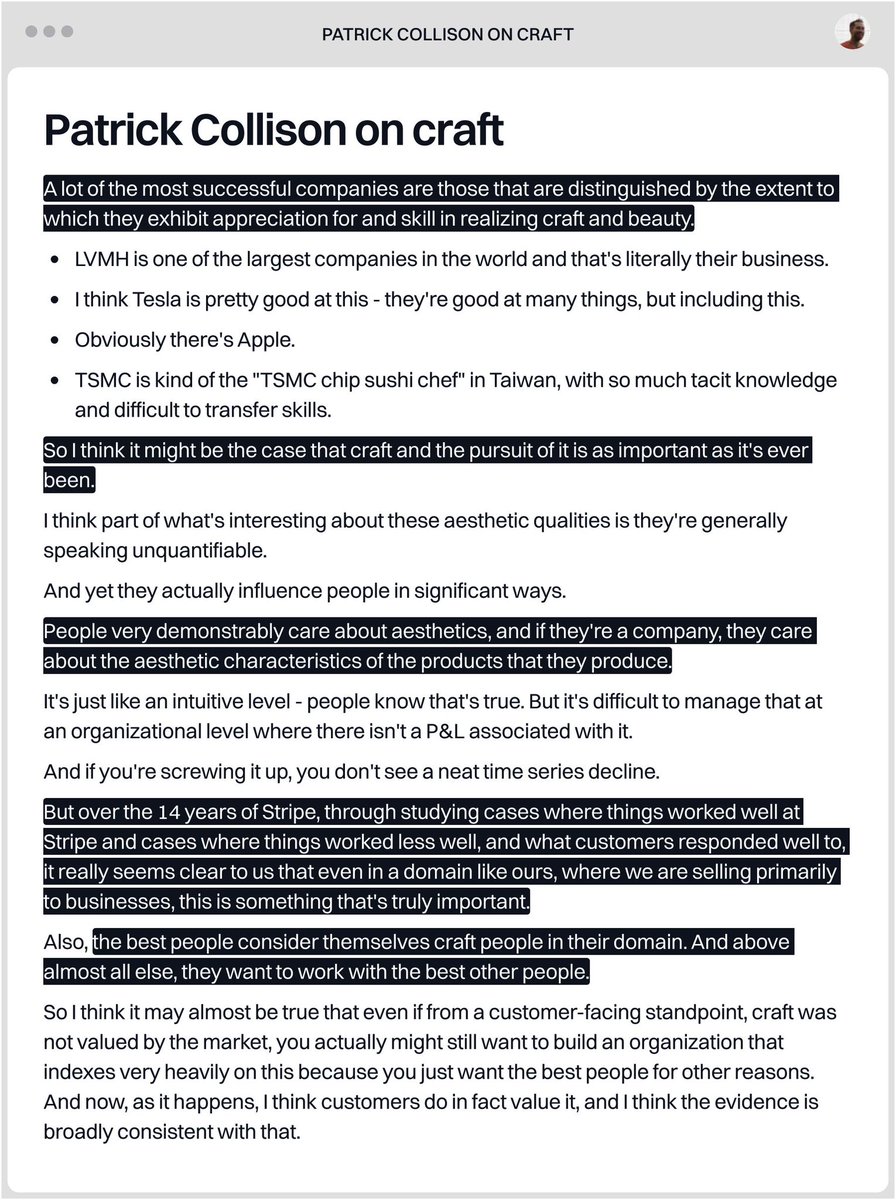
Patrick Collison on the importance of beauty and craftsmanship when building products
“If Stripe is a monstrously successful business, but what we make isn’t beautiful, and Stripe doesn’t embody a culture of incredibly exacting craftsmanship, I’ll be much less happy. I think the returns to both of those things in the world are really high. I think even beyond the pecuniary or financial returns, the world’s just uglier than it needs to be… One can do things well or poorly, and beauty is not a rivalrous good.”
Patrick believes a commitment to craftsmanship and beauty played an important role in Stripe’s success:
“My intuition is that more of Stripe’s success than one would think is downstream of the fact that people like beautiful things—and for kind of rational reasons because what does a beautiful thing tell you? Well it tells you the person who made it really cared… And so if you care about the infrastructure being holistically good, indexing on the superficial characteristics that you can actually observe is not an irrational thing to do.”
Quality without a name
As companies grow, they often have a hard time with quality, and usually just give up on it. Main reason is that quality is something which cannot be easily measured or defined. As the companies scale, the way they operate or make decisions, are based more on measurements. They start flying with the dashboard instead of flying by looking out of the window because the former is easier to do in scale.
Christoper Alexander opens his book Timeless Way of Building, that in order to build with a timeless way, we first need to find the “quality without a name”.
What he is saying is that quality exists, it can be experienced and perceived, but it cannot be described by words. A town, place, or building that just feels good and natural.
You can spec that a door needs hinges and locks that function, but we all have experienced a wide range of very smoothly working, quality doors, and very janky working, bad quality doors.
Usually the quality doors happen because someone took the care to first build the door and all of its parts, and then install the frame and the door correctly, and kept it maintained over the years. Measurement like number of doors installed or times the door is used never gives you anything about how good it is.
This throws off many people in the tech world, where often things are seen as binary and belief that the world or anything can be reduced to mathematical formulas. It’s almost as if you have to stop thinking for a minute, and just focus on the experience.
The only way I know to promote quality in companies is to keep reminding people about the quality and why it matters. Most of us are in the retention business. We like to see our customers stick around, build trust and loyalty. Quality of the product, and customer is one the key drivers of that - yet many companies forget that.
So how to promote it? You can give examples of previous quality things the team has built, show other products or show your way of looking at things. When something feels quality, it often feels natural and you may even feel positively surprised. Quality is so rare generally that people are often surprised by it.
Quality rarely happens as an accident, it usually means someone is willing to go further building something that necessarily. At least, someone has to be motivated and allowed to do it, not forced to solely focus on some measurements.
Quality, brand and culture are some of those intangible things you need to create as a company founder.
Maxim: All companies should be data-driven.
Reality: You can manipulate most data to tell a biased story by narrowing the data set or delivering a persuasive interpretation. One of many reasons why data-informed > data-driven. Driver bias isn't insignificant.
There is a popular Apple Pie Position, which goes:
“If you don’t measure it, you cannot improve it”
This belief is often harmful on early-stage teams.
This is more accurate:
“If you don’t measure it, you cannot prove to some people that you improved it”
Impact vs. Optics
Implications:
1) You need leaders who have good taste. Without good taste, everything becomes an exercise to “prove it conclusively”, which slows teams down
2) As an org grows, it becomes increasingly hard to hire / retain enough people with good taste. Plus, because optics are now more important in such orgs, people end up having to do all sorts of useless work to prove the unprovable
3) Such orgs can maintain (and hopefully grow) existing mature products (because mature products lend themselves well to management by extensive measurement). But these orgs struggle to produce new products and make them successful. These orgs tend to be uninspiring and, for some people, boring
4) When you go from such an org to a smaller team or company, you must adjust your approach. If you yourself don’t have good taste, you must first build awareness of that and hire / listen to people who do have good taste
5) In all cases, understand that there is a difference between *evaluating* how something is going and *measuring* how it is going. In some cases, you can simply evaluate without performing crazy contortions to measure. Of course, such evaluation requires good taste and judgment
6) If you find yourself feeling upset by any of these words, consider perhaps that you might have tied too much of your identity to a certain way of operating and want to remain convinced that yours is the only right way
7) If, after considering this, you still don’t feel any differently, that’s okay. Not everything will resonate with everyone at all times. Maybe come back to this idea in a few years and see how it feels then
P.S.
Some people proudly repeat the “if you can’t measure it, you can’t manage it” quote, not realizing that they are actually mis-quoting Deming, who actually said the exact opposite:
“It is wrong to suppose that if you can’t measure it, you can’t manage it – a costly myth.”
🙂