Creating Time & Space With Middle (Dot) Lane Drive
Three examples leading to goals from last night where puck carrier attacks middle ice/dot lane before kicking the puck out side.
Driver then continues to drive THROUGH the opposition strong side D to create time and space for the puck carrier
Additionally, this indecision for the WSD in regards to his read and coverage
“All the old school three man cycles we learned in mite, squirt and peewee - it’s extinct.” In his 2022 #TCSLive presentation, @umichhockey coach @BrandonNaurato shares this puck support game to work on breaking down defensive structure. WATCH: https://t.co/IgKFKRQvGD
Couple of activities to work on this:
6v4 Possession Game
- O's can pressure 2v3 on one side while the other O's defend the slot line
- X's can make direct passes across the ice to their support, but in the event they are pressured, back turned, etc and cannot, they can use a rim out to break that pressure and change sides
3v4 Weakside Support
- Game is played 4v4, but the offence is constrained to 3 players on the strong side with the puck. Supporting player (this can be interchangeable) must stay on weak side
- Gives defending team overload opportunity on the strong side
- In the event no direct pass is available, the offence may elect to rim the puck to the weak side support player
- Offensive team can change sides as often as they like, but must always keep one player on the weak side
- Can give points for successful sides changes, weakside shooter goals (extra pts)
- Variations: no constraints on defenders, additional offence can support weak side in anticipation
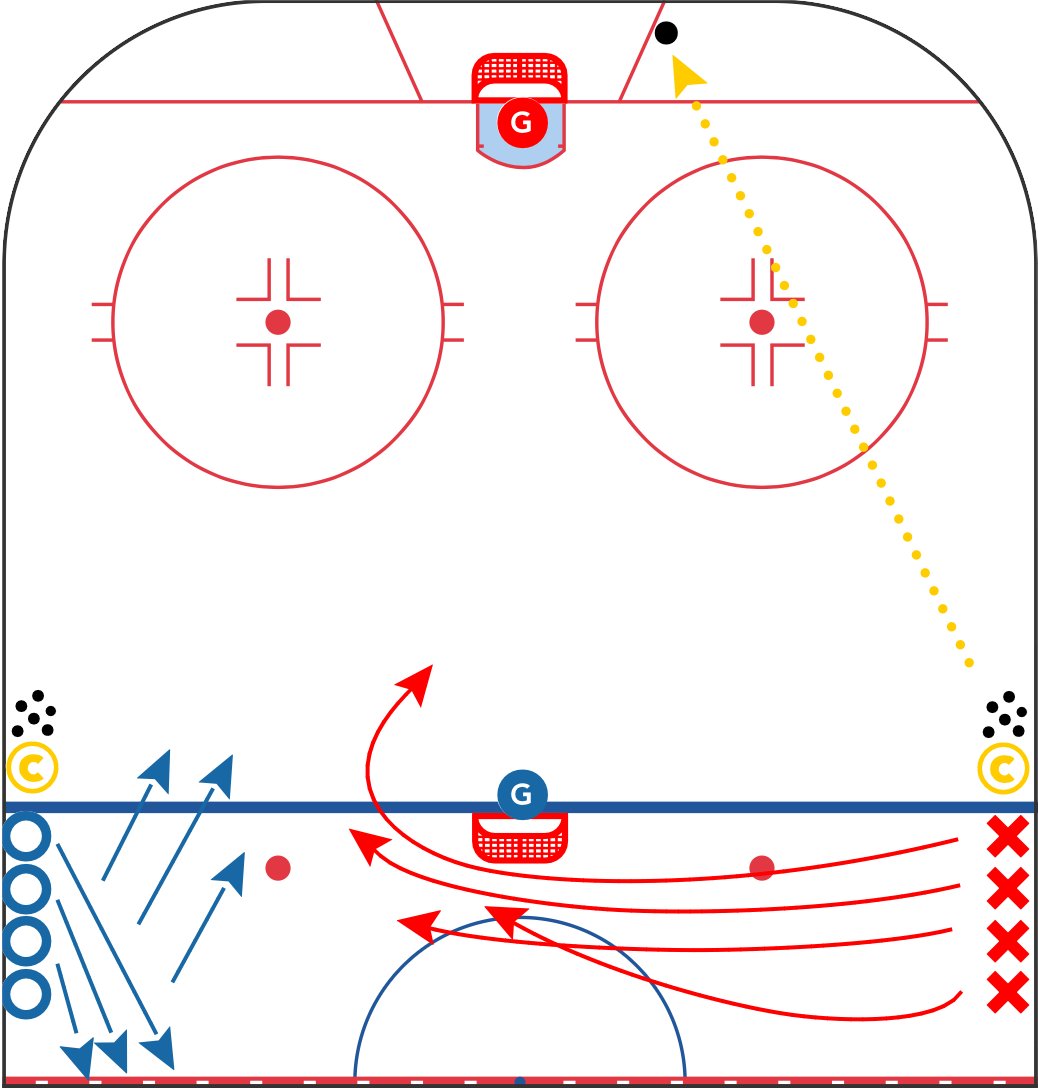
A favourite practice activity of mine to work on this is the 3v4 Forecheck/Breakout game ("stolen" from a Dan Muse presentation)
The puck is placed into open space for the four breakout players to retrieve, execute a breakout, and attack in transition. Meanwhile, the three forechecking players attempt to create a turnover and counter attack
To emphasize the quick-strike principle and playing fast off changes of possession, the forechecking team is awarded bonus points for shots within “X” seconds of a turnover, and triple points for goals scored within that same time frame. Goals scored after the time window are worth one point. Conversely, the breakout team earns extra points for completing clean zone exits leading to chances/goals within a designated time frame
There are many ways to manipulate the constraints to target specific concepts. One variation I’ve found valuable is allowing the forechecking team to place the puck themselves, instead of the coach. This makes the retrieval far less predictable for the breakout group and forces the forecheckers to work on strategic puck placement. To add even more pressure/game specificity, the breakout players round the net and pressure the puck carrier who is placing the puck
KIDS: When you lose the puck, how hard are you willing to work to get it back?
As a coach, I want you to make plays. I want you to be creative. I want you to play with no fear of making mistakes. The only stipulation I have is that when you try to make a play and you turn it over, you have to work like hell to get it back.
Here's a great example from a team that MAKES A LOT OF PLAYS. Tampa turns it over in the Ozone and then watch the effort from the players to get it back. Hounds. They create another turnover and then get rewarded in transition.
Coaches, amazing clip to show your teams!!
COACHES: Attack right away off won faceoffs on the power play.
Teams will go aggressive off the draw, particularly with their top 3 players towards the point and the flanks. Not being in structure right away after the draw with an aggressive mindset leaves them vulnerable to being spread out opening up seams and room near the net.
On these two goals, Minnesota finds the seam down low and Dallas attacks with a shot quickly.
Great job!!
Curious about how NTDP conducts a practice?
You guessed it—lots of Small Area Games and plenty of repetitions! 🏒🔁
Join U18 Head Coach Nick Fohr as he shares his insights today!
https://t.co/a9sCY3W5Xc
"One of the most dangerous plays in the offensive zone is when the player with the puck climbs, the D comes in and this player rolls over the top." Check out this #TCSLive presentation from @pdxwinterhawks' Mike Johnston!
WATCH: https://t.co/Am0FYvELc1
@FanDuelSN_NOR@HockeyDayMN Please don’t say Hockey Day Minnesota was in Roseville - it was CoVID and there were 0 games played - you literally broadcast the previous years events !!!!!!!!!
COACHES: This is a great clip from the Flyers on modern ozone play. A couple highlights of positive things they do here:
-They change sides multiple times and go low to high/high to low in the zone. This spreads out the opponents dzone coverage opening up ice particularly in the middle.
-Everyone is moving! Movement is way harder to defend than standing still.
-Weakside D activation. The weakside D activating allowed them to keep possession of the puck after the initial shot and then get the rebound for the goal.
-Positionless hockey. The goal was scored off a shot from a defenseman in the slot and then another defenseman getting the rebound right at the net front.
Great job by Philly!!!!
My guy @jasondemers5 has some thoughts on how defencemen should defend 2-on-1's......and how they definitely should not.
The numbers on what makes a 2-on-1 successful and how D can improve their odds of shutting them down. @NHLMedia
Playing fast isn’t about skating harder, it’s about thinking earlier. Structure gives players predictable support, but it’s communication that brings that structure to life. Great story & video from Coach Shaun Earl. https://t.co/tb6lHrTdh5