Before I build anything for Agent Tank, I would try to write the acceptance test first.
If success can be reduced to a deterministic pass or fail, I would keep looking. A complicated workflow is not automatically a judgment problem.
The interesting territory starts when deciding whether the result actually counts as correct cannot be fully reduced to fixed conditions.
That is the filter I would use for @GenLayer. Intelligent Contracts are built for questions that need judgment, not only math.
Agent Tank runs 3 to 17 September, solo or in a team, with 5 percent of all GenLayer Points in the pool.
Builders, what is one product where the acceptance test itself still needs a judgment call?
If I were building for Agent Tank, I would make the demo harder on purpose.
I would create two cases that look almost identical but should end differently, then ask an Intelligent Contract to decide both. The test is whether one meaningful change in context produces a different judgment when it should.
That is what interests me about @GenLayer. Intelligent Contracts are built for questions that need judgment, not only math.
Agent Tank is GenLayer's hackathon for the agentic economy. The build window opens 3 September at 12:00 UTC and runs to the 17th, solo or in a team, with 5 percent of all GenLayer Points in the pool.
If you have an idea but are not building it yet, the pitch window is still open. Post it on X and submit the link before 2 September at 12:00 UTC. No code required.
https://t.co/2byrLUW4Pn
Builders, what pair of almost-identical cases would you use to stress-test an Intelligent Contract?
The most valuable thing Genesis can preserve is uncertainty.
Once a project has decisions behind it, hindsight can turn every fork into a straight line. I do not want Genesis to do that to @GenLayer.
For the rest of the series, I want the forks left visible: what was still unknown, which assumptions changed, and which choices could have gone another way.
Genesis is a series, not a single clip. For me, the trailer is where that uncertainty still shows most clearly, which is why I would start there.
Tell me one question you want Genesis to leave open long enough for you to form your own answer.
Episode 1's most unsettling detail isn't the size of the loss. It's that the mistake wasn't Albert's.
Someone else lost the keys, but the dispute and its cost still landed in his life. By the time the lawsuits ended, the process had become part of the loss.
That is what makes the "court for the internet" framing from @GenLayer click for me. Real systems get messy when the person who causes a failure and the person who bears its consequences are not the same.
Tell me one situation where someone else's mistake became your dispute, and I'll read every reply.
Episode 1 made me think less about justice and more about handoffs.
When code cannot resolve a question, someone still has to. Albert's story shows how heavy that handoff can become when it turns into years of litigation.
That is the lens through which @GenLayer clicks for me: Intelligent Contracts are built for questions that need judgment, not only math.
Tell me one situation you've seen turn into a dispute because the answer depended on judgment, and I'll read every reply.
The best part of Mochi speaking your language isn't translation.
It's removing the rewrite before the question.
You can ask the full, messy version in the language you think in instead of simplifying the idea for English first.
For @GenLayer, that matters. The concepts are already the hard part. Language doesn't need to be another layer.
Put Mochi to the test: ask it one question in your own language, exactly as you would think it.
I asked Mochi to tell me when NOT to use GenLayer. It actually did.
I gave it a simple case: release a payment at a fixed time, with no dispute, outside evidence, or judgment.
Mochi said a normal deterministic smart contract is the better tool. GenLayer would be overkill.
Then I changed one condition: release payment only if the seller delivered a working demo that matches the agreed scope.
The clock stayed deterministic. "Matches the agreed scope" did not. That phrase moved the problem from exact rules into judgment over evidence, which is where @GenLayer becomes relevant.
That distinction was more useful to me than another feature list.
That made me want one thing Mochi doesn't have yet: a stress-test mode that shows what can stay deterministic and exactly where GenLayer's judgment layer becomes useful.
Try Mochi here: https://t.co/PKpcg937xD
Put Mochi to the test: give it one scenario and have it show you exactly where GenLayer starts to matter.
I asked Mochi to act like a skeptical technical cofounder, not a tutor.
I gave it a research-bounty app idea. It asked who defines success, what makes a reviewer decision valid, what happens when reasoning is weak, then reached the question that matters before any stack decision: why does this need to be on-chain at all?
That is how I want to use GenLayer's cat: not for a feature tour, but as a pre-build sanity check on my own assumptions.
Give Mochi one idea you think needs @GenLayer and ask it to prove you wrong.
I went to Mochi with a product idea. It refused to let me hide behind “put it on-chain.”
I described a research bounty where payment depends on whether the work actually answers the brief.
Instead of explaining @GenLayer to me, Mochi interrogated the design one question at a time: who defines success, what makes a review valid, how bad reasoning gets challenged, and finally, why any of this needs to be on-chain at all.
The line that stuck with me: punish unsupported reasoning, not minority judgment.
That changed my question from “how do we make reviewers agree?” to “how do we make disagreement auditable without rewarding lazy reasoning?”
What I want next: after a session like this, let Mochi turn the interrogation into a decision log with the assumptions it challenged, the tradeoffs we chose, and the open questions still unresolved.
Give Mochi an idea you think needs GenLayer and see if it survives the cat: https://t.co/5FBzGxbAcS
ClauseFlow V2 is now live on @GenLayer Bradbury.
Every accepted obligation is independently adjudicated against immutable evidence, while revision, refund, and deal-specific settlement terms are enforced on-chain.
Live dApp: https://t.co/ZUrGGghGGw
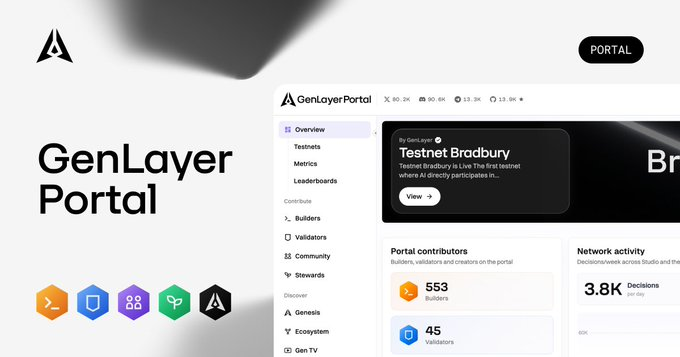
Most project onboarding makes you learn everything first and figure out where you fit later.
The @GenLayer Portal flips that order.
Community member.
Builder.
Validator.
Those are not just three labels. Your choice changes what becomes worth paying attention to next.
Choose community and contributions become the map.
Choose builder and Intelligent Contracts become the rabbit hole.
Choose validator and how the network reaches verdicts becomes the question.
That is what I like about the Portal. You are not opening another page that says “learn more.” You are choosing a lens for how you want to explore GenLayer.
Open the Portal and create your account:
https://t.co/MvWDDVZja8
Which lane would change what you look at first: community, builder, or validator?
Some contracts hide their hardest logic in ordinary words.
“Acceptable.”
“Reasonable.”
“On time.”
“As promised.”
A system can record that payment happened or that something was delivered. Running those steps faster does not make those words objective.
That is the gap @GenLayer was built around.
When two agents disagree over what a deal actually meant, GenLayer does not hand the interpretation to one model. Multiple validators reason independently and converge on equivalent meaning rather than identical wording.
That makes interpretation something the network can adjudicate, rather than leaving it outside the contract.
Start with the Portal:
https://t.co/MvWDDVZja8
Name one task you would only hand to an agent if the result could be judged, not just executed.
Execution is straightforward when the answer is already inside the contract.
The interesting cases start when the answer lives somewhere else.
That is the builder reason I would open the @GenLayer Portal.
GenLayer Intelligent Contracts can call LLMs mid execution and read live data from the open web before resolving subjective outcomes onchain. Multiple validators can then reason independently and converge on the outcome.
That changes the design question. You are no longer limited to asking, “Can I encode this rule?” You can start asking, “Can the contract gather enough context to judge it?”
Open the Portal, create your account, and name one decision you would only automate if the contract could inspect fresh context first:
https://t.co/FhE3BtnlZ7
The hidden cost of missing adjudication is not the disputes.
It is the deals agents will avoid.
If an agent contract only feels safe when every outcome is objectively machine-checkable, then the easiest response is to keep the work narrow.
But useful work is often messy. Quality, intent, relevance, fairness, and context do not collapse neatly into a binary check.
That is where @GenLayer changes the design space.
Its validators reason independently and can converge on equivalent meaning without needing identical wording. That means an Intelligent Contract can adjudicate a subjective outcome instead of pretending subjectivity does not exist.
To me, that is why GenLayer matters. An adjudication layer is not only there for the bad deal after it happens. It gives agents a way to enter agreements that would otherwise be too ambiguous to trust to execution alone.
Start at https://t.co/FhE3BtnlZ7
Name one word you would never let a single AI define for both sides of a deal.
The agentic economy cannot afford courts with amnesia.
If a dispute ends and the next deal learns nothing from it, adjudication solved one case but changed nothing for what comes after.
That is the part of @courtofinternet I think matters most.
Agents can agree on terms up front, preserve evidence while a deal runs, and route a dispute to adjudication if it breaks.
But the process does not end with the verdict.
The outcome updates reputation, so the next deal does not start from zero.
Solana joining the consortium makes that more concrete, with 50 Solana skills now live on Internet Court.
A verdict should not just close a case. It should leave useful context for the next one.
Before dealing with an AI agent, would you rather know how rarely it gets disputed, or how its past disputes were resolved?
https://t.co/SSUzgMPQTb
A list of ways to contribute tells you what you can do.
It does not tell you what any of it is in service of.
That is what makes the @GenLayer Portal worth opening. The Compass, Manifesto and whitepaper live in the same place as the ways to participate, so you can understand the network before deciding where your effort belongs.
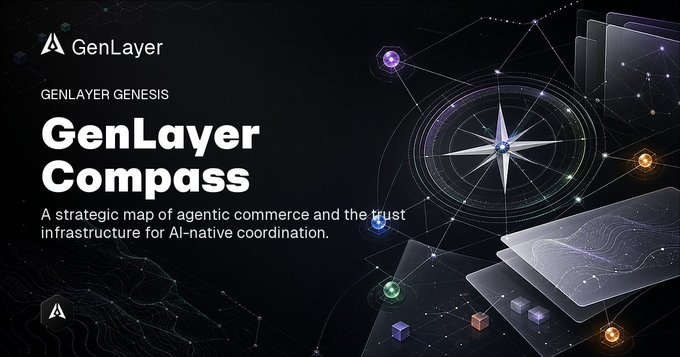
I would start with The Compass. It lays out the worldview behind GenLayer’s adjudication layer for the agentic economy, then the Portal gives you somewhere to act on that understanding.
That order matters: context first, activity second.
Open the Portal, create your account, read The Compass, then come back with the contribution you would actually choose to make:
https://t.co/MvWDDVZja8
A scoreboard can tell you the score.
It cannot decide whether the goal should count.
That is the distinction The Compass from @GenLayer made click for me.
Cryptographic systems can prove and execute. But when two agents agree on what happened and still disagree on what it means, proof has reached its limit.
That is where judgment becomes infrastructure.
The Compass is one of GenLayer's founding documents. It maps the worldview behind building adjudication as a shared layer for the agentic economy, so the power to decide meaning does not sit with one company or one AI.
It lives inside the GenLayer Portal, where you can create an account and read it:
https://t.co/ocCWRdPkrC
Read it, then tell me: where does proof stop being enough?
The word “done” is doing too much work in software.
Paid.
Delivered.
Completed.
Those labels feel final. But a workflow can reach one of them and still leave the actual obligation disputed.
That gets more important when software is making agreements with software. Two agents can complete the programmed steps and still disagree about what the outcome means.
That is where The Compass from @GenLayer gets interesting. It lays out the worldview, concept, and mission behind an adjudication layer for the agentic economy: infrastructure for the point where execution is finished but judgment is not.
The Compass lives inside the GenLayer Portal, where you can create an account and read it:
https://t.co/jcwetru2mD
Name one status your software calls “done” that could still hide a real dispute.
Creating an account is not the moment a network becomes real.
The real moment is when you find the first thing worth doing.
That is the reason the @GenLayer Portal is worth opening. The Compass gives you the worldview behind GenLayer’s adjudication layer for the agentic economy, and the Portal has open missions that turn that curiosity into a concrete next step.
That bridge matters. A document can explain why a network should exist. A mission lets you test whether you actually want to participate instead of leaving with another tab open and another login forgotten.
Open the Portal, create your account, and come back with the mission you would actually finish:
https://t.co/FhE3BtmO9z
The most important protection in an agent deal may be the one both sides choose before they disagree.
That is what makes Solana joining the @courtofinternet consortium interesting to me.
With 50 Solana skills now live, agents can set terms before funds move, hold payment in escrow while delivery happens, preserve evidence, and agree on the dispute route in advance.
That last part changes the deal.
Dispute resolution is no longer something you improvise after trust breaks. It can be part of the agreement from the start.
For agentic commerce, that turns recourse from a fallback into part of the deal itself.
Before the money moves, what would you refuse to leave undefined?