Several people encouraged me to share a post I made on LinkedIn, here on X
I wrote this from the heart, about someone I had the privilege of working closely with for years.
No agenda. Just a side of Jensen I hope doesn’t get lost in the noise.
As the days pass, my heart grows heavier.
I have worked at NVIDIA for nearly eight years. I have never worked for anyone quite like @JensenHuang , and I doubt I ever will.
Much has been written about his extraordinary vision and the company he built. But there is another side to Jensen that I have had the privilege of witnessing. And I am only speaking to what I have personally witnessed.
I have watched him stand behind researchers, founders, and startups when few others would. Companies struggling to survive, ideas that seemed too early, people whose ambitions exceeded their resources. He saw possibilities most of us could not yet comprehend. And he committed his time, attention, and NVIDIA’s resources to helping them succeed. Some of these companies might not exist today without him.
His capacity for long-term thinking is extraordinary. Sometimes it took me years to appreciate the implications of something he had recognized almost immediately. Few could match his ability to connect technology, markets, and people.
My own journey at NVIDIA has not always been easy. Through difficult organizational transitions and moments of uncertainty, Jensen’s guidance and willingness to stand behind my work helped me persevere.
But what I will remember most is his humanity.
My sister, has been fighting an unforgiving battle with brain cancer. When her condition deteriorated during her visit to California, our family faced unimaginable circumstances: devastating medical decisions, overwhelming hospital expenses, and the possibility of losing her far from home.
Despite everything on his shoulders, Jensen found the time to care. He helped my family through circumstances that seemed impossible. And he took the time to meet my sister.
The photograph here is one I will treasure for the rest of my life.
When he told me, “I am proud of you. Treasure this time together,” I understood something about leadership that no professional experience could have taught me.
What I will miss most professionally is the extraordinary combination of vision, conviction, curiosity, and personal commitment he brought to everything. His ability to see around corners, to challenge conventional thinking, and to bring an entire ecosystem along with him.
Organizations evolve, leadership changes, and new chapters begin. But the influence of someone who has shaped so many people, ideas, and possibilities endures far beyond any role or title.
Jensen built far more than NVIDIA. He helped build an ecosystem of researchers, entrepreneurs, engineers, and companies whose futures became intertwined with his vision.
I do not know what comes next. I only know how grateful I am to have worked with him, learned from him, and experienced his kindness when my family needed it most.
Thank you, Jensen. For your guidance, for believing in people and ideas long before the rest of us understood them, and above all, for your extraordinary humanity.
🚨 THE US REGULATORY SYSTEM JUST BROKE
In 48 hours, SpaceX goes public at $1.77 TRILLION - the biggest IPO ever
I've been trading for over a decade, and I have never seen them rewrite the rulebook like this
Nasdaq, MSCI, and the biggest brokers in America all bent their own rules for ONE private company
That doesn't happen by accident
Let me show you exactly what they did:
First, Fidelity dropped its minimum account size from $500,000 to $2,000
A 99.6% cut
Think about that:
The most exclusive door on Wall Street, thrown wide open to millions of small investors - days before the biggest debut in history.
Ask yourself one question
Why do they suddenly want YOU in?
Because somebody needs people to sell to.
SpaceX reserved 30% of the deal for retail
THREE TIMES the normal share
And even then, most people didn't get a full allocation.
So to grab more at Thursday's open, they're dumping everything else TODAY to raise cash.
That's half of the selling you're seeing.
The other half? The smart money front-running July.
Here's the trick:
SpaceX doesn't join the Nasdaq 100 on day one.
It joins 15 days later, because Nasdaq cut its own waiting period from 3 months to 15 days
Just for this.
The moment it joins, every QQQ fund on Earth is FORCED to buy.
$22–27 billion in automatic buying.
Translation: imagine 50 buses all forced to pull into the same gas station on the same morning.
The funds know the stampede is coming.
So they're selling now to free up cash for it. Retail selling. Institutions selling. At the exact same time.
THAT is your selloff.
Now here's the part nobody will say out loud:
When the most connected money on the planet builds a $1.7T exit door and hands the keys to the smallest investors in the market…
That's NOT generosity
That's distribution at the top.
We've seen this movie twice:
➮ 2000 Dotcom
➮ 2021 SPAC mania
Insiders cash out at insane valuations while the crowd chases the hype.
The math ain't mathing.
So you've got two choices in the next 48 hours:
Chase the most expensive IPO in history at the open…
Or read the prospectus and realize you might BE the exit.
The next few days will be INSANE, but don't worry - I'll break down every move as it happens, like I always do.
Like it or not, I called every major top and bottom of the last decade publicly. I'll call this one too.
Many people are going to wish they followed me before June 12, 2026.
Soon, you'll understand why.
🚨 Anthropic just showed a 28-minute workshop on how to actually do prompts for Claude.
Taught by the people who built it.
Free to watch. No signup. Pure gold
I've seen $300 courses that don't cover what they teach in the first 8 minutes.
Watch it and bookmark it now.
At both the 1988 & 1992 Olympics, speed skater Dan Jansen was the favorite to win the 500- & 1,000-meter races.
He didn't medal at either—the media was brutal:
“Jansen Chokes Again”
“Greatest Choke in Sports History”
“The Buffalo Bills of speed skating”
So his agent called the performance psychologist Dr. Jim Loehr, and said,
“Would you consider working with Dan Jansen?
It turned out: hours before the 500-meter race at the '88 Olympics, Jansen received a phone call and learned that his 27-year-old sister died unexpectedly.
“He's been struggling, mentally,” Jansen's agent told Loehr. “If we can get his head right, he'll be an Olympic champion. If we can’t, he'll go down as the greatest choker in sports history.”
“I know about Dan’s story,” Dr. Loehr replied. “I’d love to work with him.”
So Jansen started working with Loehr leading up to the 1994 Winter Olympics in Lillehammer, Norway.
During their first meeting, Loehr learned that Jansen hated the 1,000-meter event. “He felt like he was a fast muscle twitch kind of a guy,” Loehr explains. “He thought of himself as a sprinter. So he loved the 500 and hated the 1,000.”
Loehr started attending Jansen's training sessions, and after watching Dan skate over and over and over again, he became convinced that Dan's best shot at winning a gold medal was not in the 500, but in the 1,000.
“You need to change your mindset,” Loehr told Jansen. “You need to change the story you tell yourself about the 1,000. If you change that story, I believe it can change your life.”
Jansen kept a daily training log—“From now on,” Loehr told him, “on the top of your training log, I want you to write, ‘I love the 1,000.’”
“But,” Jansen said, “I hate the 1,000.”
“I know,” Loehr said. “But we’re going to recondition the way you think and feel about the 1,000.”
So for 2 years, at the top of his training log, Jansen wrote, “I love the 1,000.”
“And before Lillehammer,” Loehr said, “Dan came to me and said, ‘You know, I’m actually starting to like the 1,000. I think I might even like the 1,000 better than the 500.’”
At the games in Lillehammer, in the 500, Jansen slipped and finished 8th.
Before the 1,000 (four days later)—which Jansen knew would be the last time he ever skated competitively—“We created a mindset,” Loehr said. “and the mindset we created was—instead of a gold medal or a world record or anything else—think about what a gift the sport of speed skating has been to you. Think about the joy it's brought you.”
With that mindset, Jansen lined up for the 1,000-meter event at the 1994 Winter Olympics in Lillehammer.
With that mindset, he not only won his first Olympic gold medal, he set a new world record time in the 1,000.
Takeaway 1:
There's a paradox known as “the backwards law.”
It comes from the philosopher Alan Watts, who writes in his book The Wisdom of Insecurity:
“I have always been fascinated by the law of reversed effort. Sometimes I call it the 'backwards law.' When you try to stay on the surface of the water, you sink; but when you try to sink, you float.”
With that mindset Dr. Loehr helped him create before the 1,000, Jansen said, “I stopped thinking so much about a gold medal.”
When Jansen stopped thinking so much about a gold medal, paradoxically, he won a gold medal.
Takeaway 2:
In his work with hundreds of world-class performers, Dr. Loehr spent many years listening to the stories people tell themselves. He would even have athletes wear microphones and articulate out loud everything that they said to themselves during competition.
“And I began to realize that what really matters, in a really significant way, is the tone and the content of the voice in your head,” he said.
“The power broker in your life is the voice that no one ever hears. How well you revisit the tone and content of that voice in your head is what determines the quality of your life. It is the master storyteller, and the stories we tell ourselves are our reality.”
Jansen changed the story he told himself about the 1,000, and, as Loehr told him it would, it changed his life.
- - -
“The mind is a funny thing.” — Dan Jansen
Follow @bpoppenheimer for more content like this!
Steve Jobs was the single largest individual shareholder in Disney and it all started with this $5 million check.
The year was 1986 and Steve Jobs was in exile from Apple.
The company that would one day become Pixar was called Graphics Group. Graphics Group was owned by Star Wars creator George Lucas.
George Lucas was getting divorced and needed to sell off some assets.
Steve Jobs agreed to give George Lucas $5 million and invest another $5 million in the company.
This was not the first time Steve Jobs had expressed interest in the technology behind Graphics Group.
When he was still at Apple, Jobs tried to get Apple’s board to buy the company.
They turned him down.
This is Steve explaining why he was interested in acquiring Graphics Group:
“These guys were way ahead of us on graphics, way ahead. They were way, way ahead of anybody. I just knew in my bones that this was going to be very important."
Steve would eventually invest $54 million of his own money in Pixar.
After several years of failing to sell The Pixar Image Computer, Pixar decided to go all in on making films.
After years of poor sales and rising expenses they were short on cash. To solve this problem Steve signed a deal to produce 3 animated films for Disney.
The first of these movies was Toy Story —the world’s first computer animated feature film.
Now here is where this story gets really interesting:
Steve decided to capitalize on the publicity of Toy Story’s release and take Pixar public at the same time.
Toy Story was released on November 22, 1995.
Pixar went public on November 29, 1995.
Steve's two partners — Ed Catmull and John Lasseter — did not want to go public.
They thought it was too early. They wanted to do a few more films first.
Then Steve laid out his strategy and told them what was likely coming from Disney.
Steve said let’s assume Toy Story is a big success (it was —grossing over $370 million).
When that happens the CEO of Disney — Michael Eisner — will realize he inadvertently created a rival for Disney Animation.
Pixar only had to make two more films for Disney and then they’d be free to do as they like.
Steve said Eisner’s next move would be to try and renegotiate with Pixar and keep Pixar close to Disney.
Steve said if they went public and had more money they’d be able to negotiate better terms with Disney.
Steve wanted a 50/50 split with Disney on returns. In order to request this Pixar had to be able to put up 50% of the production costs.
Going public would allow Pixar to afford this.
The time is now Steve said: "This is our moment."
And he was right. Toy Story was a massive success and Pixar's IPO raised $140 million -- the biggest IPO of 1995.
A few months later Eisner approached Jobs and said he wanted to keep Pixar as a partner.
Eisner accepted Steve’s 50/50 deal.
This partnership wasn't going to last. Steve Jobs and Michael Eisner couldn’t get along.
A few years later negotiations broke down completely and Pixar started looking for other partners.
Then Michael Eisner got fired. The new CEO of Disney was Bob Iger.
When Bob Iger found out he was going to be the next CEO he called his daughters first.
The next person he called was Steve Jobs.
He told Steve he valued Pixar and wanted to make a deal. This is Bob explaining why he felt Disney needed to buy Pixar:
“Michael [Eisner] didn’t understand that Disney’s problems in animation were as acute as they were. That manifested itself in the way he dealt with Pixar. He never felt he needed Pixar as much as he really did. Every negotiation needs to be resolved by compromises. Neither one of them [Eisner and Jobs] is a master of compromise.”
How did Bob Iger realize how badly Disney needed Pixar?
By watching a parade at Hong Kong Disneyland
Iger realized that the only characters in the parade that had been created in the past decade were Pixar’s:
“A lightbulb went off. I’m standing next to Michael [Eisner], but I kept it completely to myself, because it was such an indictment of his stewardship of animation during that period. After ten years of The Lion King, Beauty and the Beast, and Aladdin, there were then ten years of nothing.”
Bob begins to negotiate with Steve to buy Pixar and does something very unusual:
He tells Steve how badly Disney needs Pixar.
Even more surprising this tactic worked. This is how Steve reacted:
“That’s why I just loved Bob Iger. He just blurted it out. Now that’s the dumbest thing you can do as you enter a negotiation, at least according to the traditional rule book. He just put his cards out on the table and said, ‘We’re screwed.’ I immediately liked the guy, because that’s how I worked too. Let’s just immediately put all the cards on the table and see where they fall.”
Disney purchased Pixar for $7.4 billion in Disney stock.
And Steve Jobs went from the single largest shareholder in Pixar to the single largest individual shareholder in Disney.
My friend Lik fought for years to make sure small businesses are not bullied by big retail landlords in Singapore. And now a new law is passed protecting tenants. Bravo.
In 1985, Nike held a 24-hour shoe design contest.
Nike was struggling. Their stock dropped 50%. They had to lay off people. Adidas, Converse, & Reebok were all selling more shoes.
So in a panicked attempt to find creative talent, Nike held a shoe design contest.
The winner was
A corporate architect named Tinker Hatfield.
"Two days after the competition," he said, "I wasn't even asked—I was told that I was now a footwear designer for Nike."
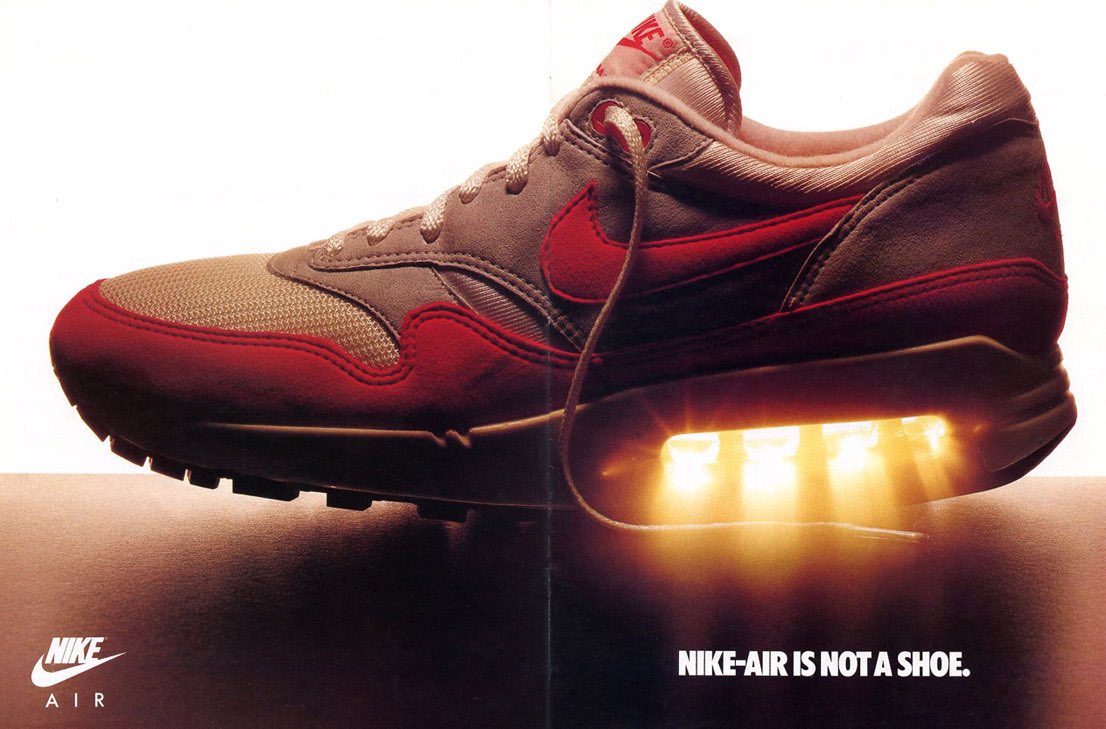
As he got to work on his first official shoe design, he thought about a building he had studied in architecture school: The Centre Pompidou in Paris.
The Centre Pompidou is an inside-out building, meaning that the structural, mechanical, and circulation systems are all exposed.
“That building,” Tinker said, “was describing what it was to the people of Paris. And I thought, ‘Well why not do that with a shoe? Let’s cut a hole in the side and show what’s in the shoe.’”
So Tinker designed an inside-out shoe:
The Air Max 1.
The Air Max 1 was a massive success, and it steered Nike's design direction from then on.
"To this day," Tinker says, "Phil Knight says I saved Nike."
Takeaway 1:
Had he not studied that building in Paris, Tinker says, he couldn’t have created the Air Max.
Creativity, he says, is a function of the “library in your head."
“When you sit down to create something...what you create is a culmination of everything you’ve seen and done previous to that point.”
Takeaway 2:
Tinker Hatfield went to architecture school and then he was a corporate architect for 4.5 years. Then, literally overnight, he became one of the best shoe designers in the world.
This makes me think of a counter-intuitive discovery made by psychologist Charles Spearman in 1904.
Before Spearman, the natural assumption was that the more you specialize in one thing, the worse you’ll be at other things.
Instead, Spearman discovered "the positive manifold" phenomenon.
He found that different abilities tend to be positively correlated. That the expertise gained through specialization is transferrable. That the cognitive and creative abilities cultivated as an architect could positively correlate with being a shoe designer.
- - -
"Creativity is a function of the previous work you put in." — Robert Greene
Follow @bpoppenheimer for more content like this!
Even with the pandemic surging to its worst wave yet, food lines stretching for miles, and the prospect of a disaster relief bill nowhere in sight, the Dow jumped 400 points today and hit a 30,000 milestone for the first time ever.
The stock market is not the economy.
Just woke from a dream so real, i spent hours syncing back to reality. It was my JC years, behind in grades and exams from everyone else. That feeling of inadequacy and insecurity. Compared to all other shiny happy people. So strange how it still felt so real
Over the past few months, I’ve spent a lot of time listening to music with my family. I wanted to share some of my favorites from the summer—including songs from some of the artists at this week’s @DemConvention. Hope you enjoy it.