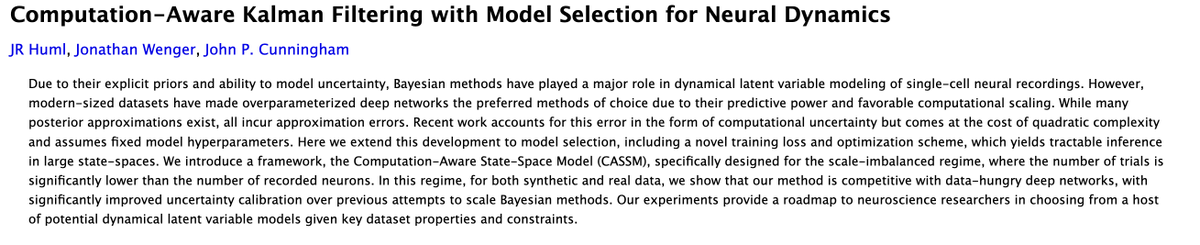
Pumped to announce our new paper has been accepted in the Proceedings of the 2nd International Conference on Probabilistic Numerics. We tackle scalability issues in predicting neural activity with Bayesian state-space models, completed during my PhD at Columbia! Links below
@FrancoisChauba1 I think this has a nonzero chance of being true in general, but I think it might already be true depending on the domain. In neuroscience this definitely seems to be the case already, possibly very dependent on the underlying data structure
Introducing ZUNA1.1, a far more flexible version of our open EEG foundation model and a further advancement toward noninvasive thought-to-text.
It reconstructs, denoises, and upsamples messy real-world EEG. Apache 2.0, available free in the Zyphra Cloud EEG Playground🧵
Introducing ZUNA1.1, a far more flexible version of our open EEG foundation model and a further advancement toward noninvasive thought-to-text.
It reconstructs, denoises, and upsamples messy real-world EEG. Apache 2.0, available free in the Zyphra Cloud EEG Playground🧵
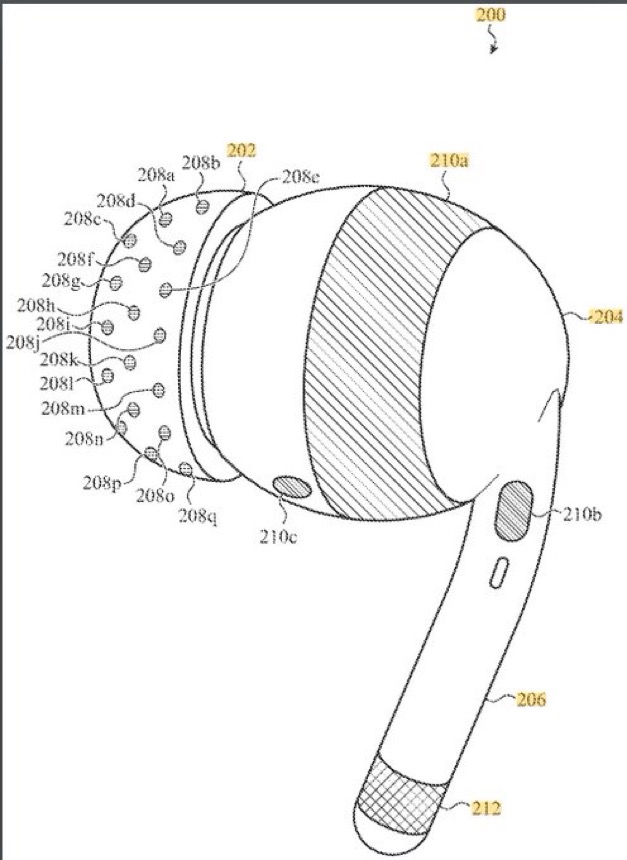
Apple's newest patent turns your AirPods into an EEG device that also reads muscle movement, eye movement, and heart rate.
Neuralink has performed four human brain implants. Apple has hundreds of millions of AirPods in active use.
Steven Hotelling is on the inventor list for patent US20230225659A1. He's the engineer who productized multi-touch for the original iPhone. Apple puts Hotelling on things it plans to ship.
The design packs 17 electrodes around a single ear tip. Ear-EEG has existed in academic research since 2011, and startups like NextSense (spun out of Alphabet X), Neurable, and IDUN already ship consumer ear-EEG products today.
Apple's innovation is dynamic electrode selection.
Here's the constraint that killed ear-EEG as a consumer product for 15 years. Every human ear canal is shaped differently. A fixed electrode placement that reads clean EEG from one person reads noise from the next. Your own ear canal changes shape across a day based on temperature, jaw position, and how the bud seated when you put it in. Every prior ear-EEG product required either custom molds or tolerance for garbage data.
Apple's patent uses more electrodes than are ever needed simultaneously and runs an AI model that scores each one in real time on impedance, noise level, and skin contact quality. It picks the best subset for this person, in this ear, right now. Reference and active electrodes get reassigned on the fly. A weighted algorithm combines the surviving signals into one optimized waveform.
Competitors tried to solve this with better electrodes. Apple solved it with redundancy and silicon.
The roadmap is already visible. AirPods Pro 3 shipped a photoplethysmograph in the ear tip for heart rate. In November 2025, Apple Research published PARS, a self-supervised model that learns EEG patterns from unlabeled data and sidesteps the regulatory bottleneck of annotated clinical datasets. The PPG sensor is the dress rehearsal. The EEG sensor is the feature.
Sleep staging. Seizure detection. Stress classification. Focus state. The clinical applications get through the FDA. The interface applications change computing.
Neuralink needs a surgeon. Apple needs a firmware update.
Sad to see @USMNT lose today but it was a blast watching them have their best Cup in almost 25 years. Congrats to Belgium, lots of great soccer left to play
In the future, frontier models will mostly all be given away by the chip and hardware makers. It makes their hardware more useful and drives sales. We will do it if others don't.
Open source weights are merely one part of the stack. I predict that when the government and frontier labs discover that model restrictions won’t work (in about 6-8 months), then they’ll try to start rationing compute in the US like we do with China
feels like the most noteworthy paper about continual learning in quite some time? most other work branded as such is essentially fancy RL-flavored context distillation, this is some real physics of language models shit
@kabir_j25 Try overfitting a small dataset on various model sizes, see how the loss scales. Stability and trainability are key. Also toy problems are great, if you simulate the data you can peek at the true answer (latent space/denoised data, etc)
Pumped to announce our new paper has been accepted in the Proceedings of the 2nd International Conference on Probabilistic Numerics. We tackle scalability issues in predicting neural activity with Bayesian state-space models, completed during my PhD at Columbia! Links below