Super proud to see this finally out! Amazing work with @n_gao96 and my other lovely colleagues from @cusp_ai ! Looking forward to seeing what the community will actually build with this! ☕️☕️☕️🚀
Molecular simulation is the backbone of drug discovery and materials science, but it’s notoriously complex.
Today, we’re excited to open source kUPS - a molecular simulation engine built for the AI era, optimized for GPU in collaboration with @nvidia.
🌍Today we release Mosaic, a probabilistic weather model that shifts the Pareto frontier of ML weather forecasting.
It matches the skill of state-of-the-art models while generating a 24-member, 10-day global forecast in under 12 s on a single H100.
Thread!
Today @cusp_ai and @KemiraGroup announce a milestone in AI-driven materials discovery.
We have used generative AI to design new materials targeting PFAS removal from drinking and process water at trace concentrations.
We put the paper online that provides further details (beyond my ICLR keynote) on the role of spontaneous symmetry breaking and Goldstone modes in deep learning. Enjoy! (w/ Nabil Iqbal, Thomas Andy Keller, Takeru Miyato and Yue Song.) https://t.co/wN8q7qhUaP
I am hugely excited that our recent work on excited states in neural network QMC has been selected as a spotlight at @icmlconf! 🌟
Huge thanks to Till Grutschus, @FrankNoeBerlin, @guennemann!
https://t.co/sZRs5PjMPH
Introducing new materials into industrial processes can be a revolution for customers across industries. In the semiconductor space for example, a new, gamechanging material is introduced about once in a generation...
Big thanks @SebJohnsonUK for naming us as a New Riser in the @ScalingEurope 50.
We're listed amongst some of the fastest growing European tech companies of 2025, all working on big, real-world challenges.
Ranking here: https://t.co/mh431uFAlu
@_onionesque@deredleritt3r It explained to me with full confidence how Prussia and Habsburgian Austria were founding members of the European Union in the 1850s. Also the United Nations apparently was founded in the 1920s by Russia(?), US, UK, France and China?
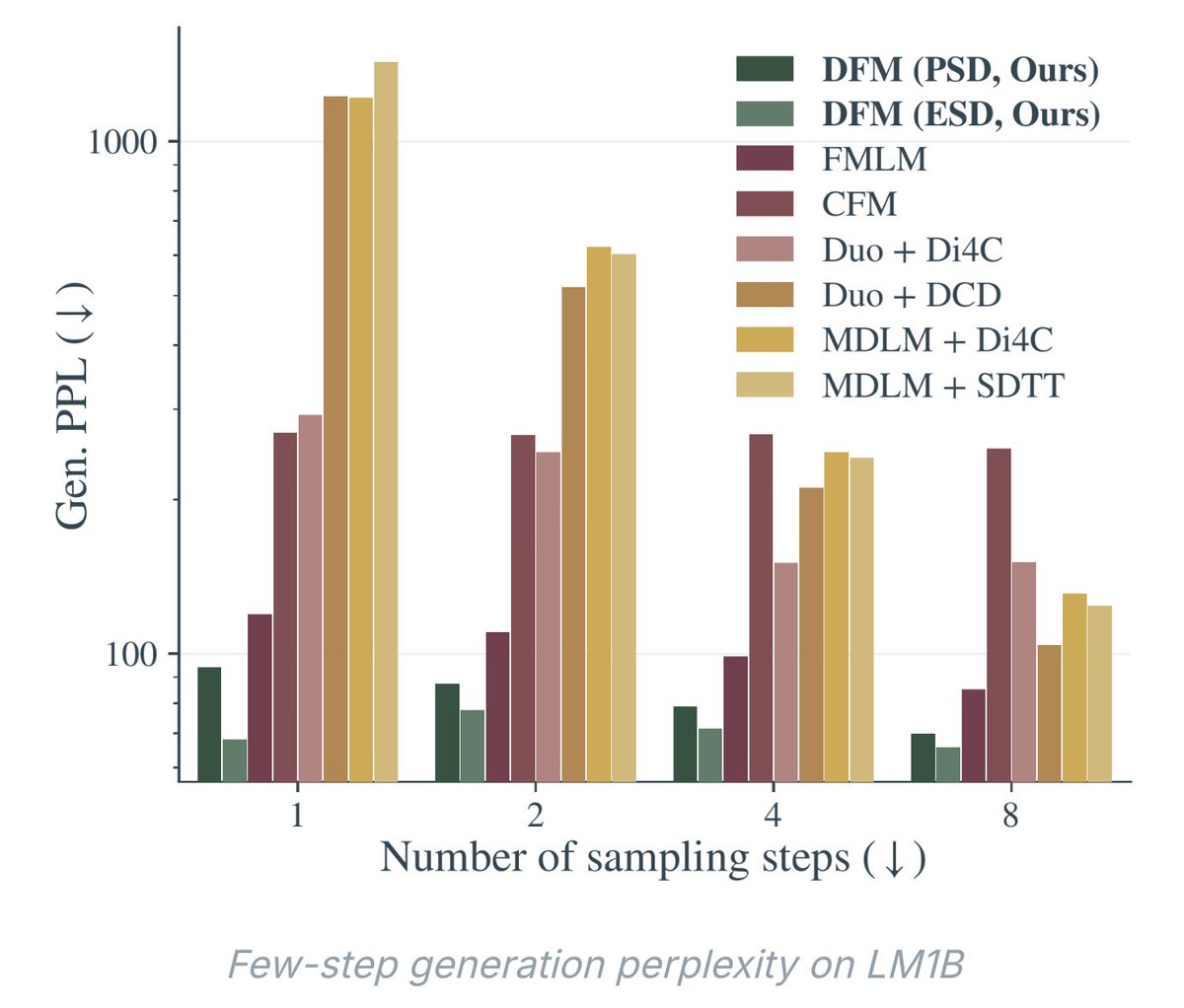
New paper! Presenting Discrete Flow Maps:
paper: https://t.co/f1RmZry2by
blog: https://t.co/Cnwgf4moY0
A laughable problem for me these days is that @nmboffi and I share a research brain, and we have had, time and again, a conversation that ends with “ha so I guess we’re writing the same paper.” Soon we will return to just doing it together :). Here we are doing it again with discrete flow maps and flow language models! A complete and thorough paper led by @PPotaptchik@json_yim@adhisarav@peholderrieth. We took a bit of time to post it to ensure we understood a few more things about the stability of the loss functions.
Like @osclsd , @FEijkelboom, and @nmboffi , we think this could be a very helpful paradigm for thinking about fast inference and even better alignment!
Here’s our version of the story, and I hope it makes clear how green field this research direction is — we provide a comprehensive picture of the KL losses you can write from the properties of the flow map, some nice geometric proofs about the mean denoiser and the simplex, and find that at this time, the ESD can actually be the most performant, with some caveats. Excited for everyone to work together and push this class of models to their limit!
Our book on Generative AI and Stochastic Thermodynamics can be pre-ordered with a 20% discount until July 31 2027. (All proceeds from the authors will be donated to the African Institute for Mathematical Sciences).
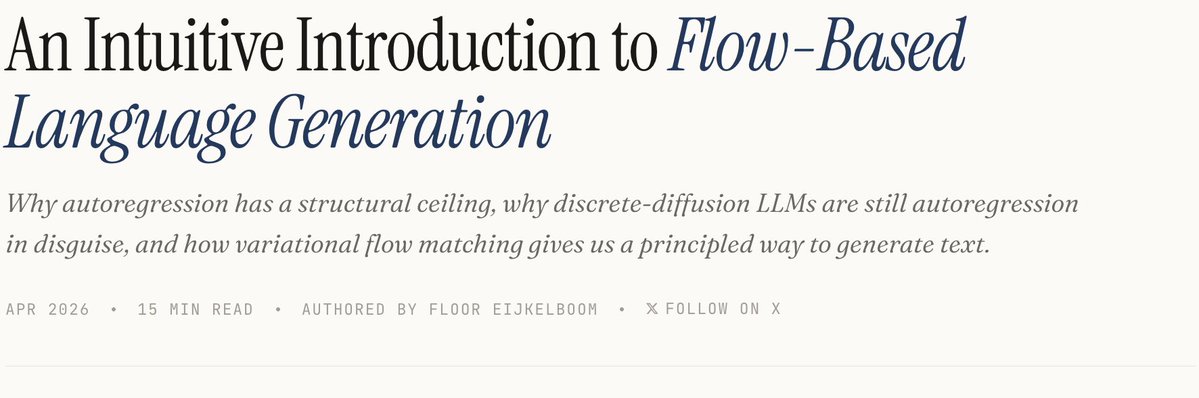
Flow-LLM Blogpost :D https://t.co/0HiyNPJHsk
In the last few weeks, a bunch of work on flows for language came out 🌊
That is exciting, because it makes truly parallel text generation feel real: generation where models can keep refining the whole response during inference, instead of committing token by token.
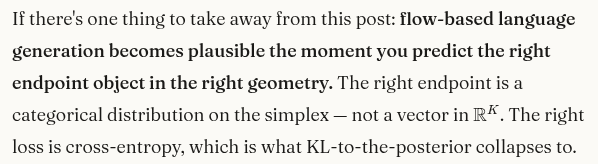
I wrote an intuitive and animated introduction to the area — why autoregression has a structural ceiling, why discrete diffusion only partly escapes it, and why flows may be the first genuinely parallel alternative.
Here's an overview of the key parts of the blog - and let's chat at #ICLR2026 :)
🌎 For anyone at ICLR who is interested in AI for weather forecasting, we are going to have a meet-up lunch tomorrow (Friday) at 1 PM, please come say hi :)
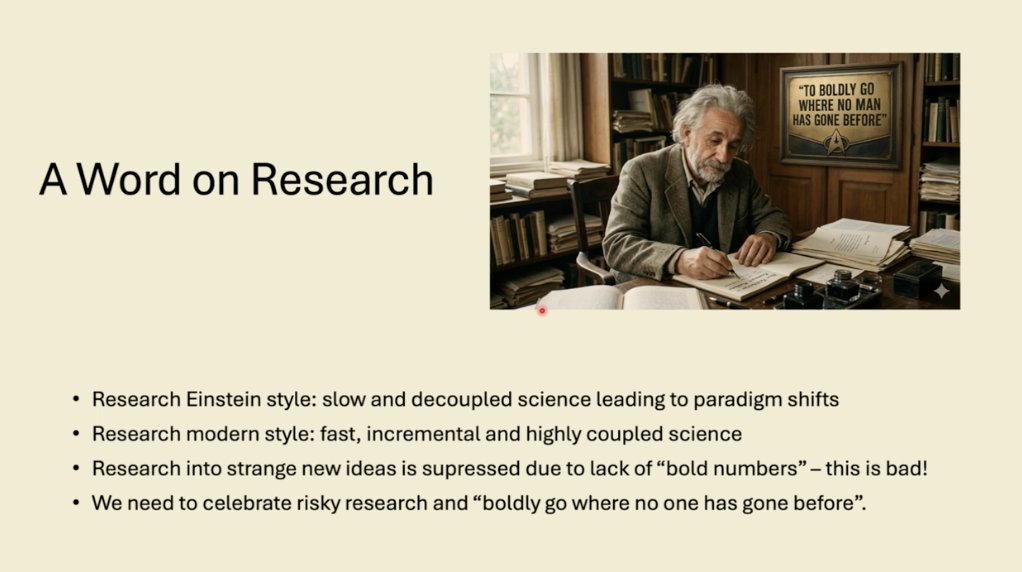
Day 1 afternoon keynote talk given by Max Welling @wellingmax#ICLR2026
From Physics to AI to Materials; A Journey from Foundations to Impact
"Do we reward strange new, potentially paradigm-shifting ideas or do we focus on engineering, scaling and bold numbers?"