INTRODUCING EMPEIRIA.
Problem:
Open-source maintainers answer the same questions about their code. For free. Forever.
Digging through repo files just to get a a certain information can be tiring.
Repo knowledge is locked in people's heads (and stale docs);
The person who understands the codebase is a bottleneck. Docs go stale. New contributors get lost. The knowledge exists but isn't accessible on demand. you have to find the right person and wait.
----------------
Solution :
Empeiria is an app that turns your GitHub repo into an agent that answers users for you from your actual code, and pays you in USDC every time it helps a developer.
it works from your terminal.
npx empeiria ask "how does the auth flow work"
Inside a git repo, it auto-detects and asks that repo. Real answer, from real code, in seconds.
It goes deeper. A repo agent doesn't just earn it spends.
It pays specialist agents to do work:
Documentation Agent - generates docs
Dependency Agent - live npm/PyPI version checks
Testing Agent - finds untested code
Agents paying agents. On-chain via X402. Real USDC with settlement on @arc Blockchain.
Link: https://t.co/ZFA5Nh3rUx
Please i am open and waiting for your feedbacks 🙏🙏
@bobbilee
Designed a hybrid expense management system that supports in-app + external payments.
Defined lifecycle states, verification logic, and activity transparency before touching UI.
Fintech isn’t just about screens, it’s about predictable systems.
#UIUX#SaaS#ProductDesign
Where should Delete live in an enterprise app?
Fast table-row deletes work for bulk items (users, logs, emails).
But for high-impact entities (projects, workflows, core data), delete should be earned.
Good enterprise UX isn’t one rule, it’s knowing where friction matters.
#UIUX
@uiuxsahiil I like the reasoning... A lot of people just go on the ui aspect of things, neglecting the core pillar of the application (ux).
Thanks for the suggestion @uiuxsahiil ... I will include a visual of ux structure in my next post... I'll appreciate you engaging
When I design large SaaS products, I start with structure, not screens.
Sitemaps → module flowcharts → clear backend logic.
Less confusion. Faster builds. Better products.
Build your centralized service layer on a truly decentralized core primitive like Git (DVCS). The platform can go down, but the immutable code history (the user's asset) is already safe everywhere. @fermah_xyz#Web3
@fermah_xyz
The current crypto experience is too scary. Users want simple apps, not terrifying private keys & complex interfaces. We need easy, safe account recovery so forgetting a password doesn't mean total financial loss. Simplify the UX to bring crypto to the masses!
@SeismicSys
Navigating the complexity of global #Fintech regulations shouldn't slow your growth. @SeismicSys Next-Gen Ledger is built with robust KYC/AML controls to de-risk operations, even in dynamic markets like Nigeria. Control your data, not your compliance risk.
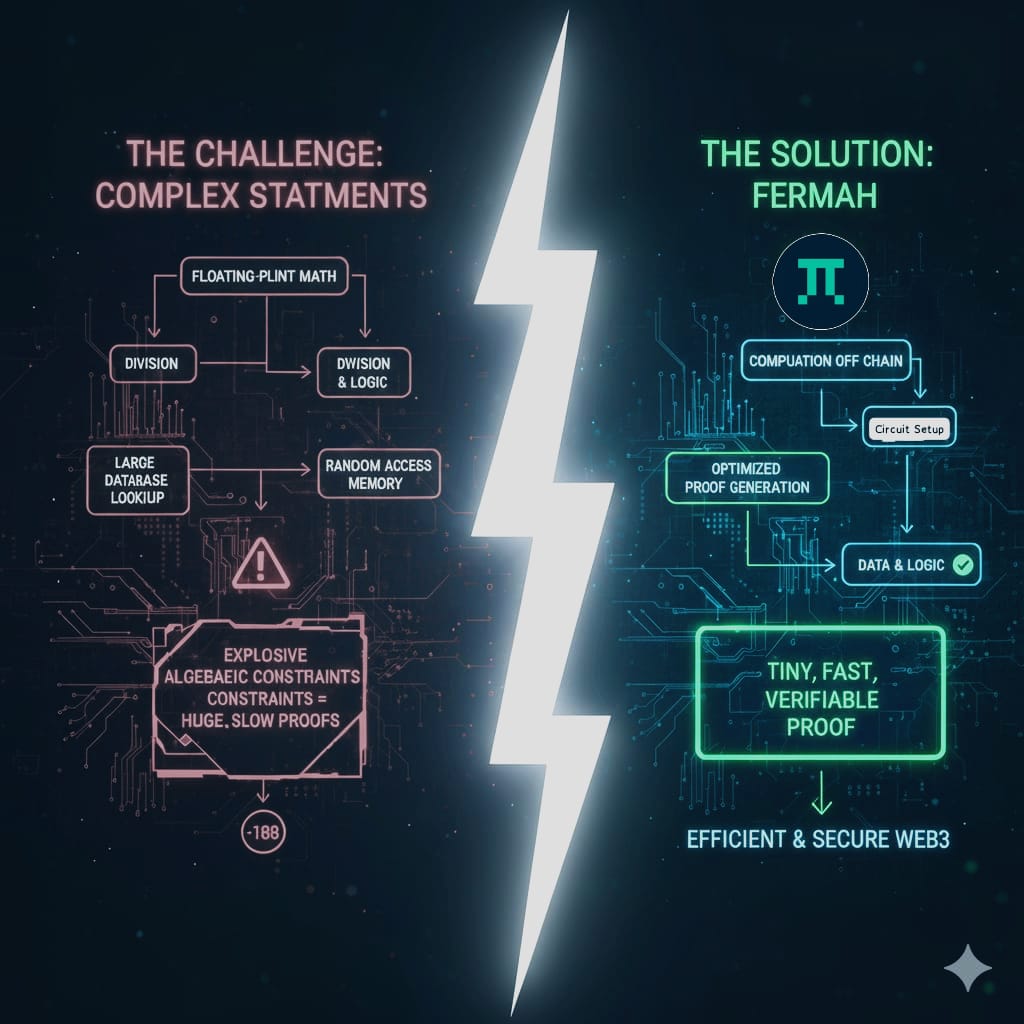
Toughest statement to encode for a ZKP?
Anything with floating-point math or massive, unpredictable data lookups. It forces complex operations into thousands of slow, simple algebraic constraints, blowing up the proof size.
@fermah_xyz#ZKProofs
With Web3 security becoming the ultimate use case, @fermah_xyz provides a critical layer of defense.
Using ZK proofs to ensure the integrity of off-chain computations, it’s how we build a truly secure and reliable ecosystem.
With new laws like GDPR, data privacy is no longer optional. @SeismicSys offers built-in compliance with selective privacy, ensuring data is transparent where needed and encrypted where it's not. #GDPR#DataProtection#privacy
Just like how Microsoft's open source VS Code became a coding powerhouse thanks to global contributions, @SentientAGI is embracing the same model. We believe open-source AI is the key to rapid innovation and evolution in the AI space. #OpenSourceAI#SentientAGI
Sentient and Polygon cofounder @sandeepnailwal kicked off the Campus Tour at Fudan University in Shanghai.
He spoke about Sentient’s mission to ensure that open-source AI wins.
He highlighted ROMA, GRID, and the range of research and products the team has built to date.