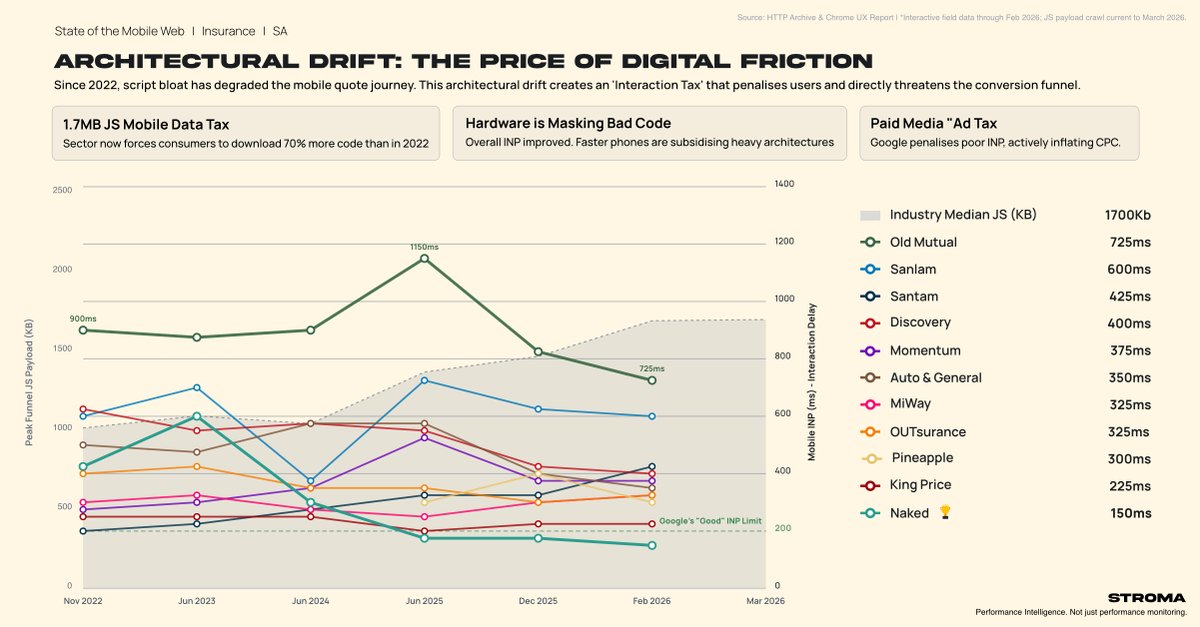
In an era where it's easier than ever to ship code, it's harder than ever to stay fast.
Where does your funnel sit on this curve? Run a scan to see your risk and opportunity: 🔗 https://t.co/TWDYAZrdcK
Since ChatGPT dropped, we're all 10x engineers now. So the web must be getting faster, right?
Wrong.
I pulled 4 years of empirical performance data for the South African Insurance sector. The findings are sobering. 🇿🇦
A short thread on the 'Interaction Tax' 🧵👇
Day 4: Bring your own Drum Kits 🥁
Drag & Drop your own samples directly into the sequencer (bulk import or per-track)
I'm debating adding persistence so you can A/B test kits without re-dragging. Would you use that?
#buildinpublic #webaudio
Definitely a process issue, not Figma - canvas and code should be parallel lenses, not sequential phases. The bigger reflection = is AI making us skip design craft? Fast output ≠ good outcome. Remember 'Designing in the browser' circa 2012? The canvas as a medium didn't die.
The Einstellung Effect - a working solution stops your brain from seeking better ones. Code commits you. The canvas keeps you curious.
@kylegawley 100%. That fear of being 'just a feature' drives the initial over-engineering.
Now add these LLMs to the mix: code generation becomes zero-cost = enter the era of 'Infinite Bloat.'
AI makes code cheap. Clarity is what’s expensive.
Any other tools getting this right?
My 2 cents: Don't learn syntax (HTML/CSS/JS). That is becoming a commodity.
Learn System Design.
If you can clearly draw the boxes (Client, Server, Data Models), the LLM can write the code inside them.
Grab the book 'Web Scalability for Startup Engineers'. It teaches you what to ask the AI to build (use Gemini etc as a study buddy to break down technical concepts to your mental model)
Less time to POC = Less time to validate with real users.
💡Stop over-indexing on synthetic Lighthouse audits that don't represent your real users.
Lighthouse tells you that your site is slow. The web-vitals library (attribution build) tells you what is slow.
Instead of a generic number (LCP: 2.4s), pipe the full diagnostic context as custom dimensions to your analytics tool:
1. debug_target (The exact DOM element)
2. debug_time_to_first_byte
3. debug_element_render_delay
Give it a go! 📦 npm install web-vitals
#PerfMatters #WebPerf
@helderbuilds Appreciate the feedback sir. next up is to get a way for users to import their own drum samples. Then subsequently we looking at wiring up both MIDI and Audio export options. Any 10x feature you think I may need to consider as well?
Day 3: Ghost notes + Grid Locks 👻
1. Sequencer now fills gaps with quiet, syncopated ghost hits (like a real drummer)
2. Ability to 'lock' tracks that bypass swing and stay on grid.
(Demoing the lock on the Kick below to keep the beat anchored 👇)
#buildinpublic#webaudio
Day 2: Finally cracked the math behind the #jdilla swing. 🍩
Got the humanize dial working - it injects specific micro-shifts (push/pull) to the kick, snare, and hihats to get that off-grid feel. It’s starting to sound properly "drunk" now.
Sound on 👇
#buildinpublic#webaudio
Been sleeping on the Web Audio API and @GoogleMagenta.
Trying to recreate that iconic #jdilla swing in the browser. 🥁
props to @cwilso for the article on audio clocks (https://t.co/RidSzDqJvH)
basic step sequencer for now 👇
#buildinpublic#webaudio
@helderbuilds@GoogleMagenta@cwilso Deep stack indeed @helderbuilds! Not taking on FL just yet. MVP for now-build on top of the GrooVAE model to feed a rigid on-the-beat drum loop through some humanization logic to specifically get that off beat 'drunk' swing #jdilla got on the MPC. Then MIDI export feature to DAW
@AritDeveloper This is dope. If it's deep internals and theory he'd relish, I'd highly recommend @AnthonyPAlicea 's JavaScript: Understanding the Weird Parts. It's a gem.