"What the Hell is Going On in Spain?"
At around half past eleven today, Spain and Portugal experienced an almost nationwide blackout.
Small parts of southern France were also briefly affected but reportedly regained power quite quickly.
The Portuguese grid operator currently attributes the likely cause to weather-related oscillations in power lines, which caused the grid to collapse.
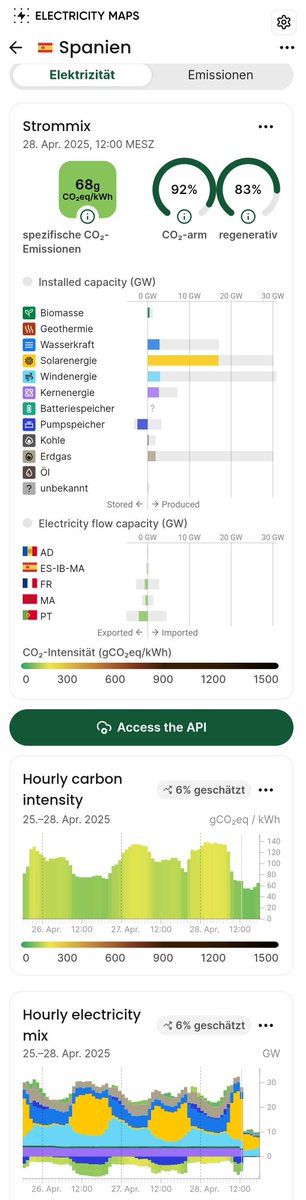
At the time of the load shedding, Spain’s electricity supply was in a very fragile state: 70% of the electricity was generated by producers without grid-synchronous inertia.
Grid-synchronous inertia refers to turbines in nuclear, coal, gas, or hydroelectric power plants that drive the generators of these plants.
The rotational speed of these turbines is synchronized with the frequency of the power grid.
Thus, the grid frequency is directly linked to the rotational energy of the turbines.
If the frequency drops, it means that the load on the grid exceeds the output of the power plants connected to it.
In such a case, the rotational energy of the turbines is converted into electricity to stabilize the grid.
The valves on the turbines respond by opening further to support the grid.
The opposite situation can also occur: if there is excess generation, that energy is absorbed as rotational energy, and the turbine valves close accordingly to adjust to the new load.
Although the rotational energy compared to the grid’s power consumption is not large, it is sufficient to stabilize excessive load fluctuations or absorb surplus generation until the valves have time to react.
This principle of grid-synchronous rotating masses has been the foundation of our power grids for over 100 years, ensuring that at every moment exactly as much electricity is produced as is consumed.
Over the past two decades, Europe has been rapidly building power generation facilities that do not use grid-synchronous turbines, but instead produce direct current, which is converted to alternating current via inverters:
Wind and solar energy.
These inverters can generate high-quality alternating current, but they cannot replace the function of grid-synchronous inertia.
The more wind and solar power is integrated into the grid, the fewer conventional power plants with grid-synchronous turbines remain.
The fewer grid-synchronous turbines there are, the less inertia there is to buffer instantaneous fluctuations in load.
If there is insufficient buffering, even small fluctuations can quickly cause the grid frequency to deviate dangerously from the ideal value of 50 Hz.
Consumers and producers alike respond to this by disconnecting from the grid for self-protection, which can trigger a cascading collapse.
What exactly tipped the balance in Spain remains unclear.
However, we do know that the Spanish grid was in a highly volatile state at the time of the collapse.
Please note:
This text is an AI translation of my orginal German language Tweet.