Ed Thorp beat blackjack. Caught Madoff seventeen years before the SEC. Predicted Buffett would be the richest man in America. Compounded twenty years without a losing quarter. He is 93. Everything he did came from one paper written in 1956. The paper is still free. Almost nobody has read it.
Vegas, 1961.
Thorp is 28. He walks into Claude Shannon's MIT office asking for five minutes. Shannon, famously impossible to see, gives him the five minutes and stays for two years. Together they build the world's first wearable computer to beat roulette. It works. 9:58
The Buffett lunch, 1968.
Thorp reads John Kelly's 1956 sizing paper. Meets Warren Buffett once. Walks away and tells his wife Buffett will one day be the richest in America. Sixty years later, exactly that. Thorp did the math on a person applying compounding to time. Same math as Kelly. 31:20
The one thing Thorp added.
Kelly's paper gives you the mathematical maximum bet. Bet Kelly, optimal growth. Bet more, you die.
Thorp bet half.
Half Kelly gives up a fraction of growth for a huge cut in drawdown. Full Kelly routinely produces 40-60% drawdowns. Half Kelly usually keeps them under 20%. Same edge. A fraction of the pain.
Every serious quant who survives uses half Kelly or less. The ones who don't are the blowup stories.
Princeton Newport, 1969-1988.
Nineteen straight years. 19-20% a year. Not one losing quarter. Kelly's paper, Shannon's math, half Kelly's number, and discipline nobody else could imitate.
Madoff, 1991.
An investor asks Thorp to check Madoff's returns. Days later, he has proof of fraud. He hands the SEC a memo. They file it.
Seventeen years later Madoff collapses. Sixty-five billion in losses. The memo had been on someone's desk since 1991. 48:10
Enough.
Thorp shut down Princeton Newport at its peak in 1988. Still compounding 19% a year. He walked away.
"You can have enough. And it's better than not having enough."
This is the layer nobody sells. Every course, every AI swarm is built to make you want more. Thorp read Kelly, sized his bets, made his money, and stopped. Almost nobody in his field ever has.
Half Kelly on the size. Full self-awareness on when to walk. That is the formula.
2026. Thorp is 93.
He still writes. He still teaches. The math was the easy part, he'll tell you. The signal was never the edge. The sizing was. Half of it. The paper has been in the Bell Labs library since 1956. It's still there. It's still free.
Madoff was the loudest receipt. The stack takes new tuition every quarter.
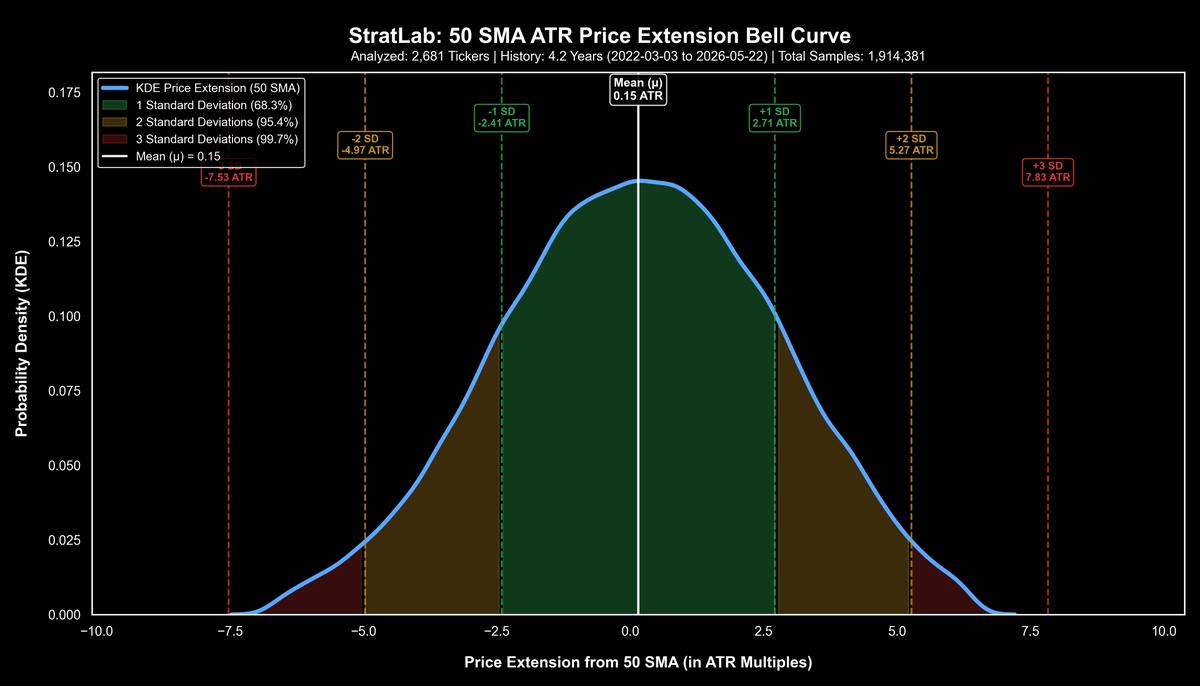
🧵 THREAD: ATR Extension - From Heuristic to Empirical P
1/ Backtested @jfsrev 8x ATR heuristic for the 50 SMA across ~2,700 tickers with nearly 5 years of data.
The result? It's not just a rule of thumb. It's statistically correct.
Here's what the data says 👇
Reading a chart this cleanly is a skill, not a secret. That is the whole thing I teach, in plain language, no jargon and no tips.
If it helps, everything is here:
Video course: https://t.co/4fjD5f0Slv
PDF course: https://t.co/JIPbcsvVMx
Follow @HB_Stocks
Man Group, the world's largest publicly listed hedge fund, $150B+ AUM, 40+ years of systematic trading, just revealed exactly how they're using AI agents to build trading strategies.
this is their actual pipeline:
agent 1: reads academic papers, analyzes datasets, reasons about whether there's an economic hypothesis worth testing.
agent 2: writes the code to build the signal.
agent 3: pulls the market data and runs the backtests.
agent 4: evaluates the output of the prior agents.
"there've been 15 to 20 models at last count that started as ideas generated by AI, went all the way through signal construction, the validation process, were reviewed and validated by a human investment committee, and deemed fit and proper to manage client assets."
"this is very real. it's not make-believe at this point."
a $150B hedge fund running a multi-agent pipeline that goes from reading a paper to trading live capital, with humans only entering the loop at the final approval stage. and they've been doing it for over a year and a half.
Jane Street spent $6 billion and 4,032 GPUs on one thing: AI agents that loop through trading strategies 100x faster than any human.
Generate, backtest, kill, repeat - thousands a week, until one survives data it's never seen.
That loop is why they made $39.6 billion last year while 89% of retail went broke trading one idea they never stress-tested.
The edge was never a smarter idea. It was volume.
They test 100 strategies for every 1 you test by hand, and a second agent kills the 97 that only look good on old data before a dollar goes live.
Now the entire loop fits in a chat box. Horizon takes one plain-English sentence and spins up the same two agents.
One builds your strategy, one tries to kill it - backtests 5 years in seconds, and only what survives goes live on your exchange.
The $150 billion setup. Free while beta open.
Bookmark this & read the full breakdown below - the exact two-agent loop, step by step, and who just handed it to retail.
@RealDayTrading Do you have hopes for an SMH bounce, or are you looking how to cut the MRVL loss. Would appreciate the answer cause I am holding short Puts on MXL and MU 😀
My friend makes $1.5 million a year as a Two Sigma quant researcher.
I asked him how he generates alpha using ML.
He sent me a video that was never supposed to get out. Their core team's full ML playbook.
You won't find anything better about ML for quants than this video.
I watched it last night.
Halfway through, I realized I could build a machine that prints alpha like hedge funds.
Bookmark and watch this before someone takes it down.
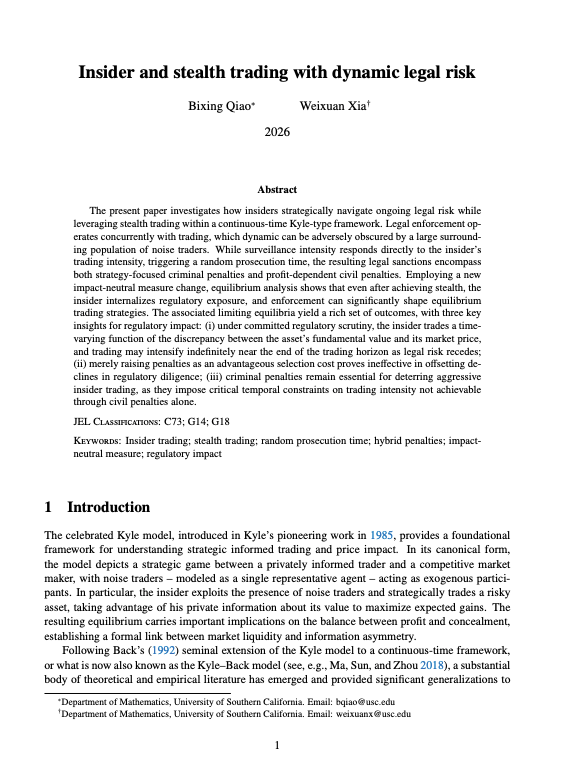
USC mathematicians just published the most dangerous quant paper of the year.
THE MATH BEHIND HOW INSIDERS BEAT THE MARKET WITHOUT GETTING CAUGHT.
This paper will teach you to detect smart money moving before announcements.
43 pages of pure game theory. Bookmark now.
My friend makes $1.2 million a year as an Anthropic engineer.
I asked him how he learned prompting so well.
He sent me a video that was never supposed to get out. Their core team's prompting playbook.
You won’t find anything better about prompting than this video.
I watched it last night.
Halfway through, I realized I've been using Claude completely wrong for two years.
Watch it, then read the article below.
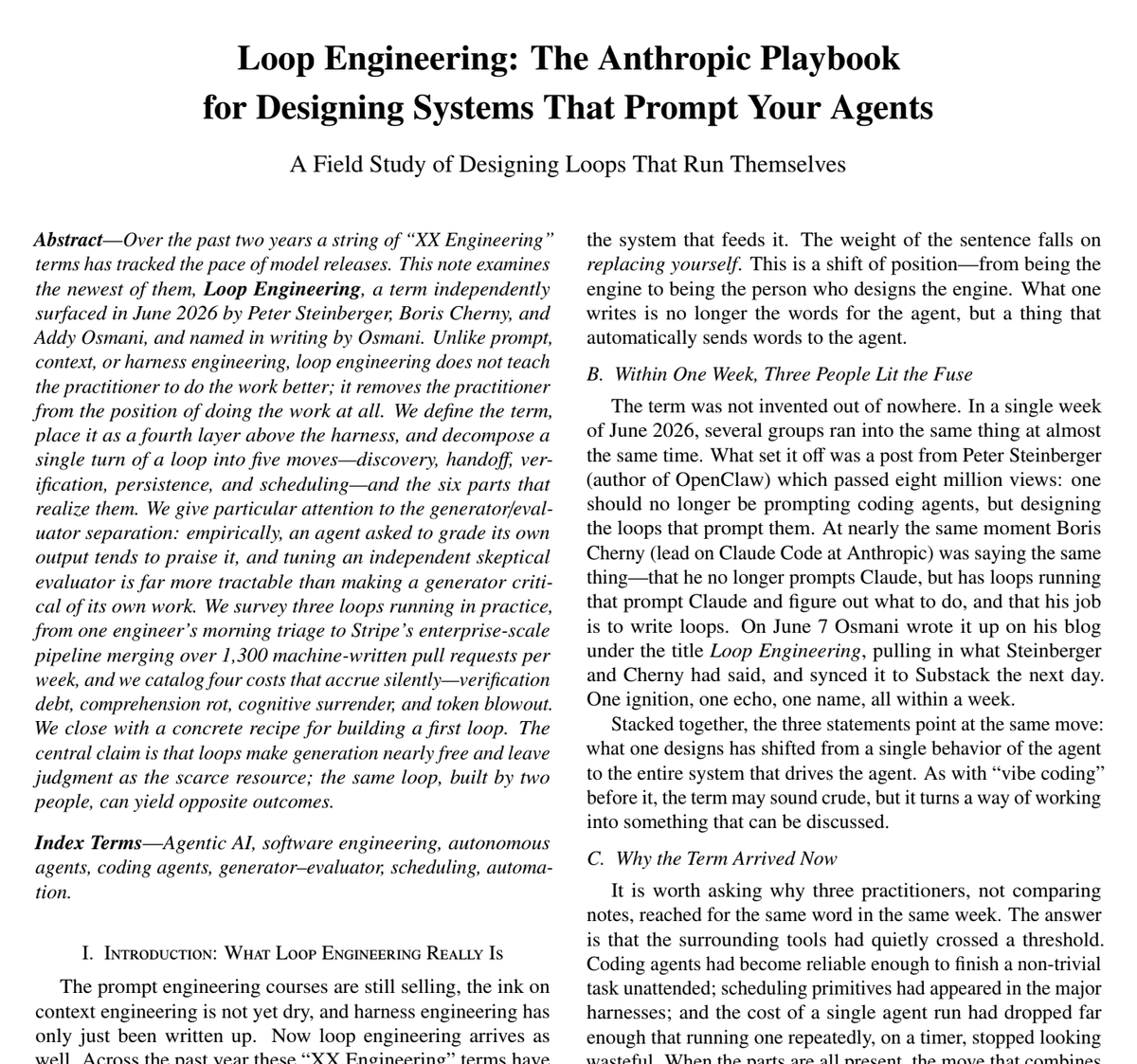
Anthropic's internal loop engineering playbook just got leaked.
And it's the most valuable AI guide I've read all year.
This guide is packed with info, and there are five things you need to know if you want to maximize your AI productivity with loops (save this):
1. You should structure every loop around these 5 principles:
• Discovery → Let the agent find its own work (CI fails, issues, commits)
• Handoff → Give every task its own isolated git worktree
• Verification → Never let the generator grade its own work
• Persistence → Always write state to disk (markdown or board)
• Scheduling → Run it on a timer so it works while you sleep
2. Separate Generator from Evaluator (most important rule)
Use two agents: one writes, the other is a skeptical judge who assumes the code is broken.
Make the evaluator act (run tests, click buttons, take screenshots) - this is what actually stops bad output.
3. Build with these 6 parts:
• Automations (the timer)
• Worktrees (safe parallelism)
• Skills (permanent project knowledge)
• Connectors (talk to GitHub, Linear, etc.)
• Sub-agents (generator + evaluator)
• Memory (state files that survive between runs)
4. Things you must watch out for with loop engineering:
• Verification debt (use verification agents)
• Losing understanding of your own codebase (start fresh if needed)
• Token costs exploding (solution below)
• Cognitive surrender (don't stop thinking because “the loop handles it”)
5. Solving token costs
Loop engineering can be crazy expensive.
I recommend you use an 80/20 "barbell" approach to loop engineering.
For your most complex tasks that require the best intelligence, use expensive models (Opus).
For the remaining 80% of your tasks (the gruntwork), use cheap, open-source models within the Claude Code harness (GLM-5.2 is great for code execution).
Save these 5 rules so you don't forget them.
I studied past crises and big stock market crashes to come to this rough guide.
Trading Post June 18, 2026
Dollar Cost Averaging with Volume Signals
https://t.co/MLXDBm052F
When I first started learning algo trading, it only took me about a week to realize that systematic trading was the real deal.
However, I decided that I would not make the same mistake I made when I began learning discretionary trading, which is: Learning from people with no track record. It cost me well over a year of mistakes back then.
So from early on, I made it my number 1 priority to ONLY learn from traders with a verified track record. That was my non-negotiable rule.
One of these verified traders I have been learning from is the number one trader on darwinex (SYO); 17 Million AUM, with a track record spanning from 2017.
He has blogs going all the way back to 2019 on trading ideas, advice and tips for systematic traders.
If you want to be the best, learn from the best. His blog page is packed with gems and it has saved me years of mistakes. Here you go: https://t.co/KslFyHJSBv
Jane Street pays $650,000 a year for quants. Stanford just released the exact RL-for-trading bible for free.
16 chapters. 0 to algo trader. Asset allocation, market making, American option exercise, full Python code & Colab notebooks.
Bookmark & give it a weekend.
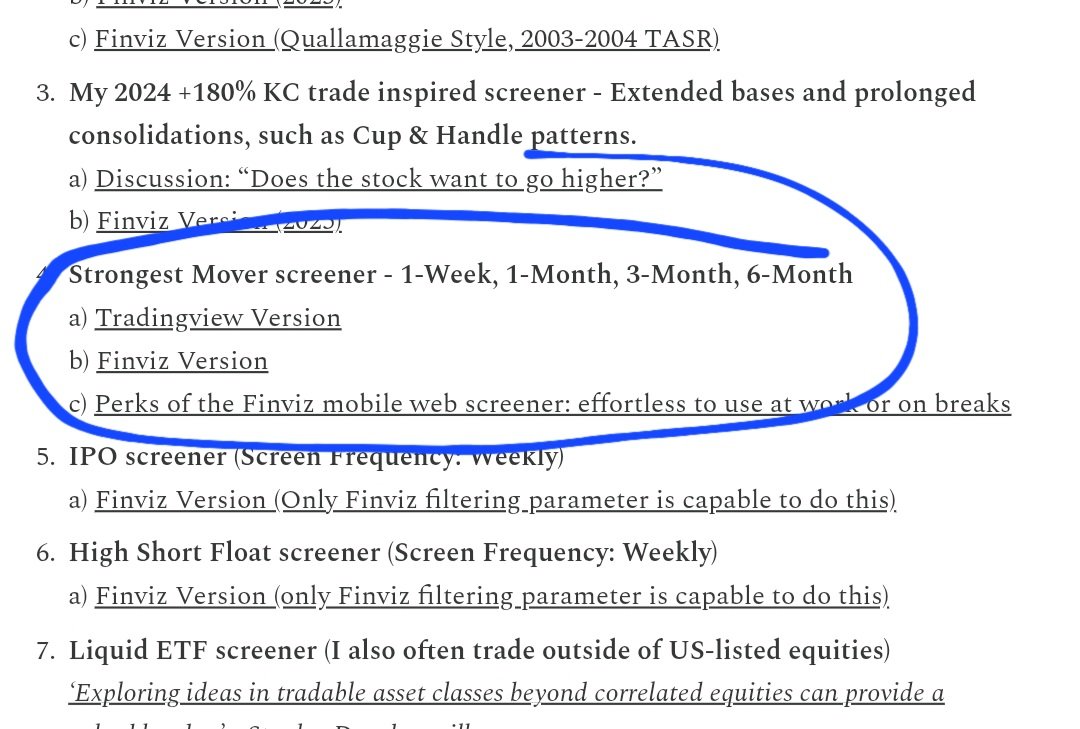
To find the top 10 stocks, you need to first define what time frames you are looking for. If you are looking for the strongest stocks currently see list here
https://t.co/x1qBq7E3He
The MIT professor who trains quants for Citadel, Two Sigma, and Renaissance just gave a closed-door keynote at Oxford in front of Man Group's $151B team.
They left the recording on a public server. Probably by accident.
1 hour. Free. No one's talking about it. Bookmark it before Oxford notices. Then read the article below.