@delhivery Placed an order for pickup! It's 4 days and no one turns up. Support doesn't answer.. One is always in que to be resolved..if you can't pick how do you even deliver? Pathetic !
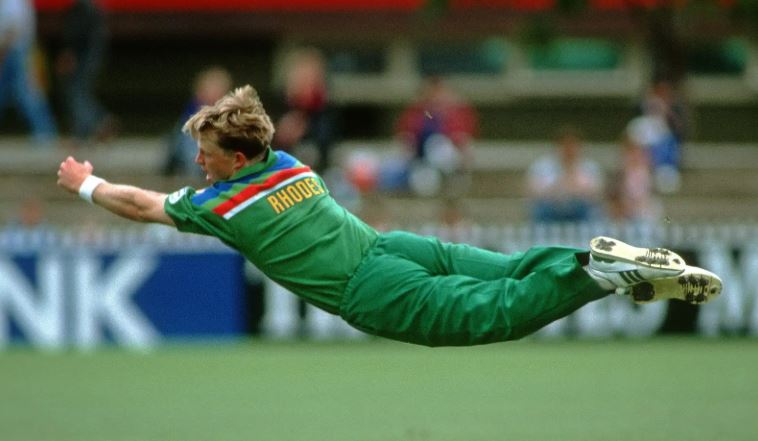
We cricket fans will keep fighting to the death over who the best fielder in cricket is.
AB de Villiers? Jadeja? Jonty Rhodes?
Hold that argument.
Because in 2018, three statisticians from Simon Fraser University — Perera, Davis, and Swartz — decided to end the debate with data.
They built a metric called "Expected Runs Saved due to Fielding" (E(RSF)).
And what they found?
It will upset you.
The best fielders in T20 cricket save... just 1.2 runs per match more than an ordinary fielder.
That's it.
While the best batters and bowlers contribute roughly 10 runs per match to their teams, the best fielder on the planet barely scrapes past a single run.
But here's where it gets properly wild.
The researchers didn't use GPS trackers. Didn't use hawk-eye data. Didn't even use video.
They used commentary text.
They parsed 160,247 balls of match commentary — from International T20s (about 750 T20 matches) and the IPL — and built a random machine learning model trained on 55 contextual keywords (words like "dive", "edge", "drop", "flat", "sharp") to predict what the batting outcome SHOULD have been on any given ball.
Then they compared that prediction against what ACTUALLY happened when a specific fielder's name was mentioned.
That gap — between what should have happened and what did happen — became the measure of fielding impact.
Essentially a Moneyball approach. For cricket. For FIELDING.
Now. The results.
The best non-wicketkeeper fielder? Nathan Coulter-Nile (E(RSF) = +0.35).
AB de Villiers, widely considered the greatest fielder alive? Ranked 21st. E(RSF) = -0.34. Negative. As in, on average, he cost his team runs while fielding.
And the most shocking finding?
MS Dhoni — the man with the fastest hands behind the stumps — was ranked the WORST wicketkeeper-fielder in the entire dataset. E(RSF) = -3.61.
Dead last among 13 keepers. Behind Mark Boucher. Behind Brad Haddin. Behind everyone.
How is this possible?
The paper reveals a beautiful paradox:
the best fielders are the ones whose names are NEVER mentioned.
Think about it.
When commentary says "brilliant diving catch by Kohli!", that's a notable event. But when a fielder simply... stops the ball cleanly, returns it accurately, and nothing remarkable happens — his name is never spoken.
Another instance: a batsman drives a ball, but notices Jadeja standing at short cover or point and DOES NOT DARE to run a single. This does not get recorded as a fielding achievement.
The study showed a clear decreasing trend:
the less often a player's name appeared relative to fielding opportunities, the BETTER he was.
In other words — excellence in fielding is invisible.
We celebrate dramatic recoveries.
Emergency interventions. The "brilliant diving catch" of a last-minute, a last ball run-out.
But the real measure of good work — like good fielding — is also in what DOESN'T happen.
The absence of disaster is the hardest outcome to measure. And the easiest to ignore.
Perera, Davis, and Swartz tried to measure cricket's invisible skill. Their approach was not perfect, but, they opened a door that was considered closed, sealed and deemed never to be opened.
This #IPL season, I will post one interesting cricket related research for fans to be amused, and get a different viewpoint on their beloved game.
Enjoy!
@ABsay_ek@AMP86793444
https://t.co/pgLAs5pDak
We’re back again! ✨
This time, we’re performing the iconic "Tip Tip Barsa Paani" with a fresh twist. This version has a more percussive vibe bringing a whole new energy to the song. Ojas has absolutely nailed it on the tabla, as always and I’ve added my touch on the Handpan to create something uniqe. We had a lot of fun putting this together and I hope you feel that vibe while listening to it.
I’ve seen hundreds of professors explain game theory.
But this professor explains it so simply that even a 15-year-old can understand it.
Once you understand this, you start seeing hidden strategies everywhere - in markets, business, and life.
(Save it for later)📌
Most people use Gmail only to send emails.
Here are 15 hidden Gmail features you should be using to save time and work smarter
(Save this so you can easily come back to it and share it.)
Don't know about you guys but I am waiting for Vijay Kedia's new song.
Humne toh jab kaliyan maangi
kaanton ka haar mila,
Munaafa dhoondne nikle the
nuksaan ka bazaar mila!
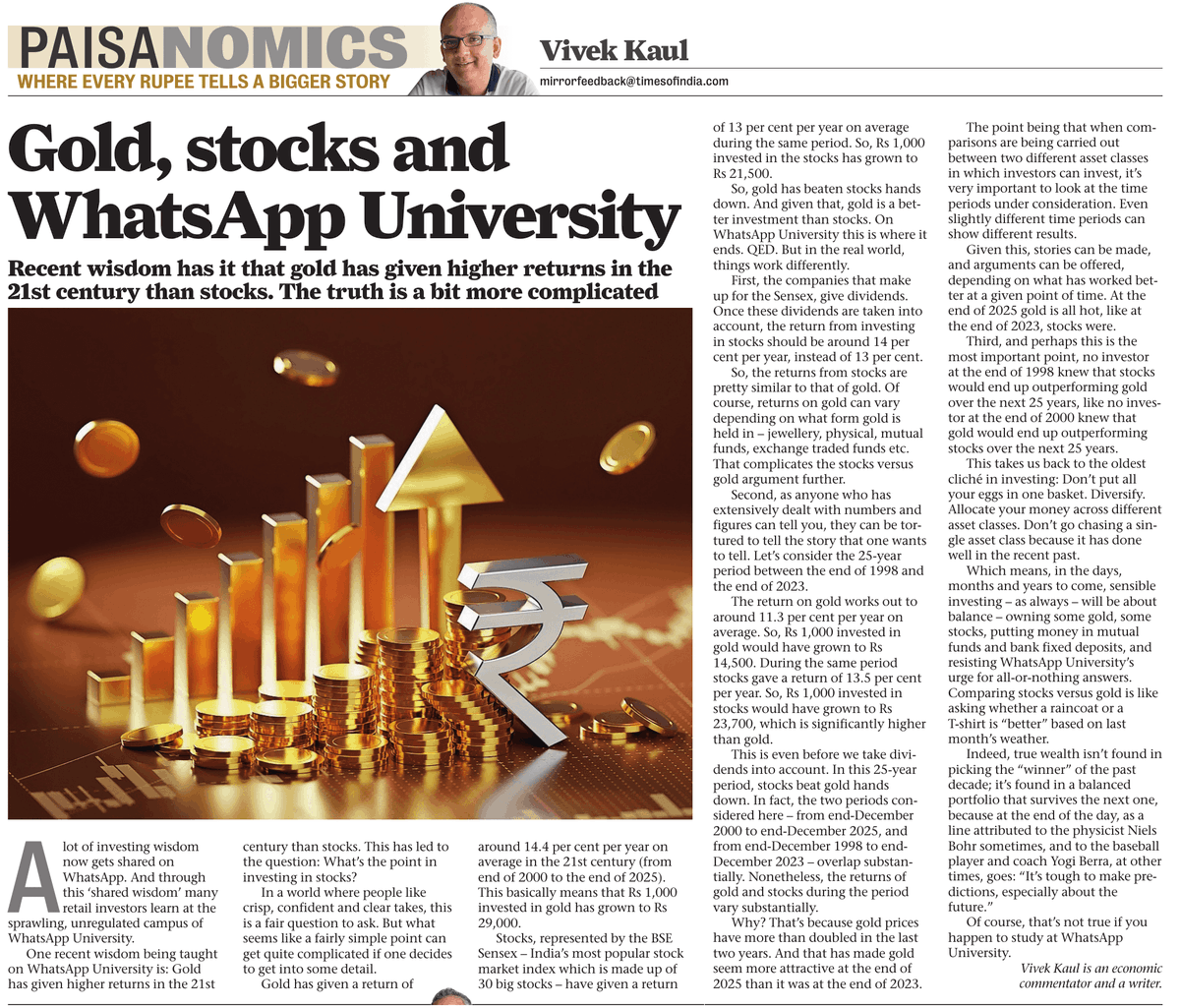
Gold, stocks and WhatsApp University
A lot of investing wisdom now gets shared on WhatsApp. And through this ‘shared wisdom’ many retail investors learn at the sprawling, unregulated campus of WhatsApp University.
One recent wisdom being taught on WhatsApp University is: Gold has given higher returns in the 21st century than stocks. This has led to the question: What’s the point in investing in stocks?
In a world where people like crisp, confident and clear takes, this is a fair question to ask. But what seems like a fairly simple point can get quite complicated if one decides to get into some detail.
Yes, gold’s recent surge has outpaced Sensex returns on a narrow look, but include dividends and stretch time frames, and stocks hold their own.
Gold has given higher returns than the Sensex in the 21st century, but stocks beat gold hands down in the 25 year period between 1998 and 2003.
The bigger lesson? Chasing simplistic headlines is dangerous. True investing isn’t about picking winners after the fact -- it’s about diversification, balance, and resisting the urge for all-or-nothing advice pushed in WhatsApp forwards.
My Paisanomics column in the Mumbai Mirror.
https://t.co/bATOTKN4OF
@thevirdas What an experience #HappyPatel was !! Wish we could make more like these ! Power to you ! Absolute fan! "Mama se toh sab aaye hain" laugh riot! Take a bow !
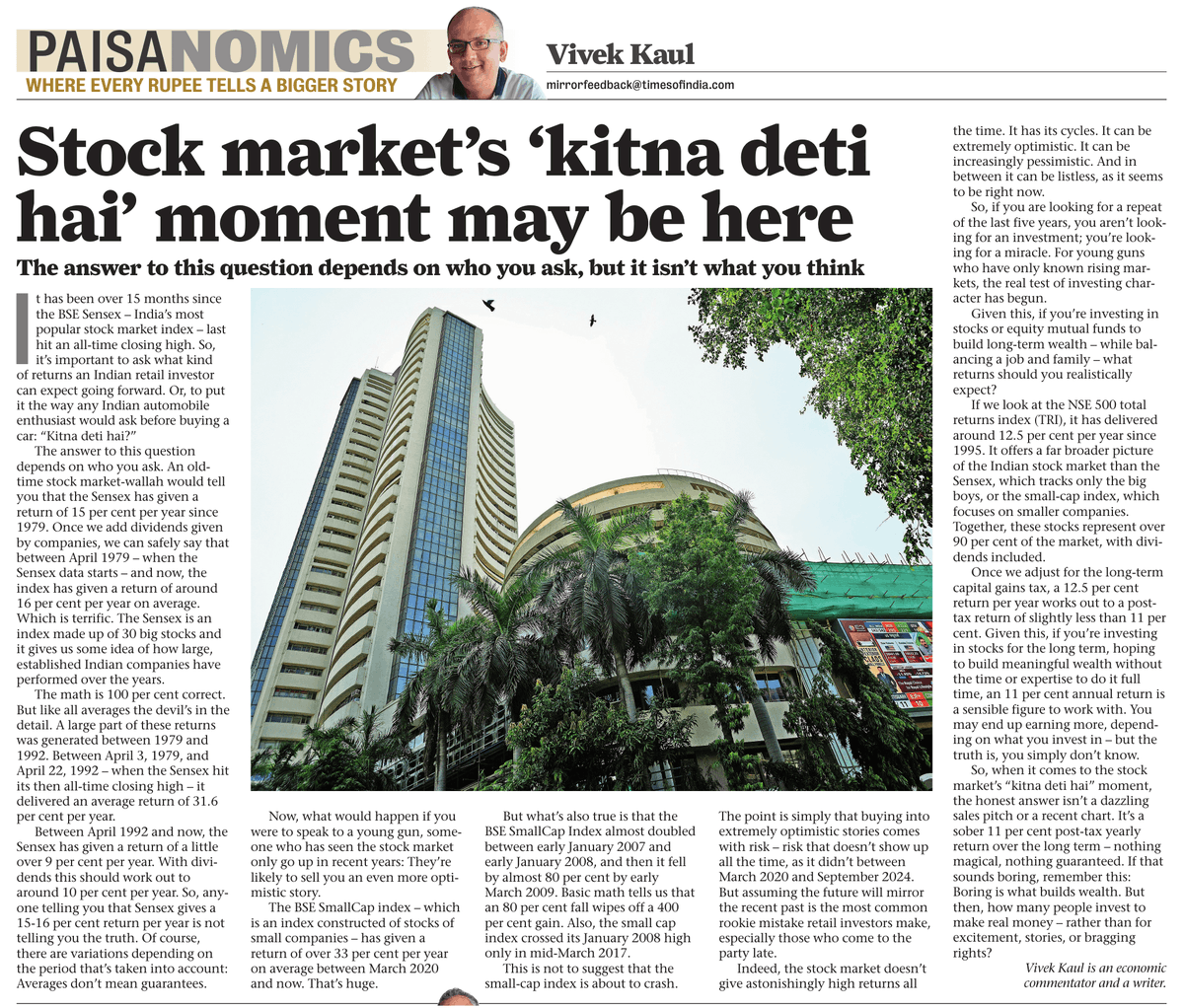
Stock market’s ‘kitna deti hai’ moment may be here
"Kitna deti hai?" It’s the quintessential Indian question, usually reserved for mileage-obsessed car buyers. But apply it to the stock market, and things get murky.
If you ask the "stock market-wallahs," they’ll quote the Sensex’s 16% average per year return since 1979. What they won't tell you is that most of that juice came before 1992. Since then? It’s closer to 10%.
Then there are the "young guns" who entered post-2020. For many of them, 30% is the baseline, because that's all they have seen.
Now, the BSE SmallCap Index almost doubled between early January 2007 and early January 2008, and then it fell by almost 80 per cent by early March 2009.
Basic math tells us that an 80 per cent fall wipes off a 400 per cent gain. Also, the small cap index crossed its January 2008 high only in mid-March 2017.
Given this, if you’re investing in stocks or equity mutual funds to build long-term wealth – while balancing a job and family – what returns should you realistically expect?
The boring truth? If you track the broader NSE 500 and account for taxes, you’re looking at a realistic 11% post-tax return. It’s not a dazzling sales pitch, and it won't make for a "viral" reel. But wealth isn't built on excitement or bragging rights; it’s built on being sober about the math.
Remember, boring is good. Excitement is expensive.
My weekly Paisanomics column in the Mumbai Mirror.
https://t.co/6djedykpDe
Get your Milton Friedman and Ayn Rand right: Zomato, Blinkit and Swiggy aren’t free-market capitalism
Illustration @MANJULtoons
After being called a Marxist and a leftist for criticising India’s quick-commerce giants, I respond in the only way I know – by going back to first principles.
By any honest capitalist test, the neighbourhood kirana store owner – bearing real risk without venture capital crutches – looks far more like the entrepreneur Rand and Friedman admired than the likes of Deepinder Goyal.
Whether one views this through the lens of Milton Friedman or through the basic logic of markets, the conclusion is the same: this is not a triumph of productivity, but a triumph of extraction.
In Ayn Rand’s world, “Atlas” is the entrepreneur who carries the weight of value creation on his shoulders. In the world Goyal has built, the real “Atlas” is a 26-year-old on a scooter, carrying a bag of groceries he is paid too little to deliver, for a company that has yet to earn a real profit, funded by investors betting that when the music stops, they will be the last ones standing and holding the prize.
My essay in @newslaundry. Read and share.
https://t.co/CpWFAZjFX1