🏀🎙️C'EST QUI LE MEILLEUR EUROPEEN ? DIRK OU GIANNIS !
Suite de notre série estivale. @pablitotti et @DebriefSportif reviennent sur le prime de ces deux joueurs.
Quelle place dans l'histoire pour eux ??
ENJOYYYY
>> https://t.co/ePsutdyX4w <<
My father died in Japan in February and I could not get back.
I told exactly one American, and only because he asked a direct question at a bad moment and I have never been able to lie fast enough.
He did not say he was sorry.
He said, "You busy Saturday?"
I was not busy Saturday. I have not been busy on a Saturday since I arrived in this country.
He wanted help moving a riding mower to the other side of his garage. The mower runs. He drove it out himself. I want to be accurate here, because I have thought about it a great deal since: the mower ended that day about two feet from where it started.
We were in the garage five hours.
There was a small refrigerator out there with beer in it and one orange drink belonging to his grandson, and neither of us touched the orange drink at any point.
We discussed a shelf. We discussed a bolt for some time. Around one o'clock we spent close to forty minutes on the correct way to coil a hose, and he was wrong, and I told him he was wrong, and he told me to prove it, and I proved it, and he said "huh," and that was the end of it.
He did not mention my father once.
I had prepared for it. In my country a man in mourning is approached with fixed phrases that have been in service four hundred years, which is the entire purpose of them, and I had built mine in English over three nights. They were not good. They were ready.
I never used them. I still have them written down.
At six he said, "Same time next week?"
We did that for five Saturdays. We moved a workbench. We rewired a light that already worked. One Saturday we sorted screws by length, which is not a job. That is somewhere to put a man.
In April a neighbor three doors down lost his mother.
I do not own a mower. I own a boat trailer that does not need to be moved.
He came at eight. He is coming again this Saturday.
I have not said one word to him about his mother and I am not going to.
He knows what time.
In Japan, if you use a word wrong, someone will quietly teach you the correct one.
In Texas, I thanked a mechanic by saying "you are a good man of the trucks."
He did not correct me. He put it on his voicemail.
"You've reached Ray. Good man of the trucks."
His son answers the phone that way now.
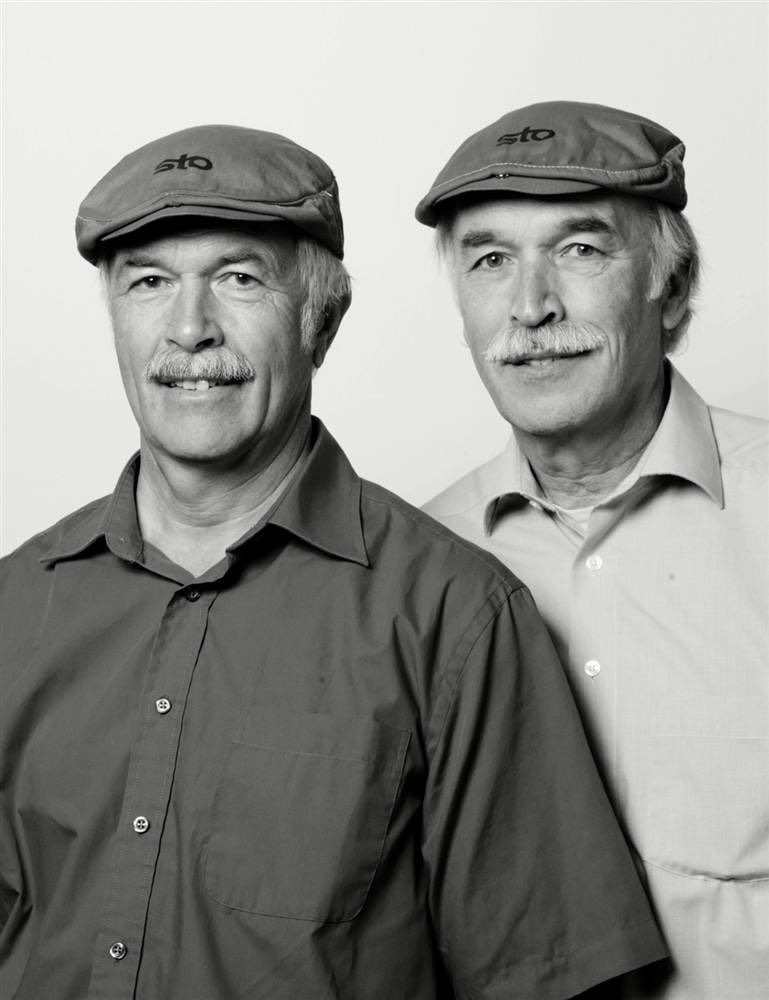
For more than 20 years, Canadian photographer François Brunelle has tracked down strangers who look almost identical despite having no known family connection.
He photographed these unrelated “twins” together, often as they meet for the first time.
À 22 ans, un jeune Parisien sans argent monte sur un bateau et traverse l'Atlantique pour aller se battre chez des inconnus : les colons d'Amérique se soulèvent contre l'Angleterre, leur maître depuis toujours.
Il rêve de gloire. Il deviendra célèbre là-bas, et il mourra oublié.
Son père est peintre du roi à Versailles, et l'enfant a grandi au milieu des plans, des dessins, des jardins tracés au cordeau.
En 1776, il s'engage comme simple volontaire dans cette armée de fortune, devient officier du génie, tombe blessé au combat.
La guerre gagnée, George Washington le remarque. La jeune Amérique veut bâtir une capitale à partir de rien, sur des marécages, et c'est à ce Français qu'on confie le plan.
Il voit grand, trop grand pour son époque : de larges avenues en diagonale, des places en étoile, une immense esplanade au centre. Un jour, il fait démolir la maison d'un notable qui gêne une perspective. On le renvoie.
On lui propose quelques milliers de dollars pour tout solde. Il en réclame près de 100 000, refuse l'aumône, et passera le reste de sa vie à réclamer son dû. Il meurt en 1825, ruiné.
Il s'appelait Pierre Charles L'Enfant, né à Paris un 2 août, il y a 272 ans.
La ville qu'il a dessinée s'appelle Washington, et ses avenues sont toujours là, exactement où il les avait tracées.
Un siècle après sa mort dans la misère, l'Amérique a exhumé son corps pour l'enterrer avec les honneurs à Arlington, sur une colline qui domine la capitale. La sienne.
I finally have all 1.2 million raw image files from my latest mission to ISS! Here is a sample of one of my favorite Milky Way photos, taken from the Cupola with Nikon Z9, Arri Zeiss 15mm lens, T1.8 with custom sidereal drive that cancelled out star motion relative to our orbit.
In the quietest room in the world, you wouldn't be able to survive for more than 30 minutes
Even people who have been in it for just a few minutes begin to feel nauseous and dizzy
Your vestibular system works by constantly picking up tiny echo signals, but in that room it receives no response, so your body thinks something is wrong
Clap your hands -> and the sound will simply cease to exist
Pop a balloon -> and there will be no explosion, just the snap of the shell breaking
Everyone's voices sound as if they're right next to your ear, no matter where they are in the room
And the reason this even exists:
Harvard built the first devices of this kind during World War II, because testing acoustics outdoors meant spies could watch what they were doing
Here's what most people overlook:
This video racked up 11 million views in a single day
No complicated editing, no plot, no climax. Just one question your brain refuses to let go of -> What does silence actually feel like?
That's the whole point. The experiment doesn't need a plot. It needs a question that people can't stop trying to answer
In the article below Paone wrote about two forms that underlie every viral video. This video is the purest version of one of them
Save this. The most-viewed video of the day was a video in which 11 million people listened to silence