USDT on Bitcoin is getting more interesting
@unisat_wallet has unveiled its roadmap for USDT on Bitcoin, and Utexo is part of this journey.
The vision goes beyond simply adding USDT to a wallet. It's about making dollar liquidity useful across Bitcoin-native asset trading, payments, and even AI-powered financial applications.
This is an important step toward making Bitcoin more practical for everyday financial activity.
With @utexocom and UniSat working toward this vision, I'm excited to see how the Bitcoin ecosystem evolves.
The more I think about NFTs, the more I feel like privacy is one of the things this space still needs to explore properly.
Most NFTs are designed around transparency. Anyone can inspect the traits, check the metadata and see what makes a particular NFT different from another. That openness is useful, especially when it come to verifying ownership. But I keep coming back to one question:
Does owning something digitally mean everyone should be able to see everything about it?
I don't think it always should. @FungoLabs is exploring a different approach by bringing encrypted NFTs to Ethereum using @zama's Fully Homomorphic Encryption technology.
The interesting part isn't simply that an NFT can hide its artwork or attributes. It's the possibility of working with encrypted information without having to reveal it first. Think about what that could mean for gaming.
A character could have hidden abilities. Certain traits could remain secret until a specific moment. Players could interact without being able to inspect every detail of what their opponents own. Those are just possibilities, but they show why encrypted NFTs could become more than a different way to store digital artwork.
And FungoLabs isn't stopping at the Genesis collection.
The team has also outlined plans for an encrypted NFT launchpad and a game built around its Genesis NFTs. If those ideas come together successfully, we'll get a better picture of how this technology works beyond the concept itself. Of course, I'm not assuming privacy automatically makes a project successful.
The experience still needs to be easy to use. The security needs to hold up. And there needs to be a genuine reason for people to use encrypted assets instead of conventional NFTs.
What I appreciate about the direction FungoLabs is exploring is that it challenges an assumption many of us have accepted for years that digital ownership must come with complete visibility.
Maybe the next step for NFTs isn't showing more information, but giving owners more control over what they reveal.
I'm interested to see how @FungoLabs turns that idea into something people can actually use.
Because if encrypted ownership becomes practical, it could change more than how we collect NFTs. It could change how we build applications around them.
Both @DegensCasinoRH and @zkArgoseth are FREE MINT but both of them have a floor price of $2.
Can we have a deal guys that every time there is a FREE MINT project, we only list it atleast $10 above? 😅
Guys, I'm so proud. SO PROUD! 🔥❤️
The brand-new @playaneemate website is LIVE!
Packs, the game economy, rewards, and everything we've been building are coming together. You can finally start seeing the bigger picture and how AneeMate will bring real utility and value to the QORPO ecosystem and $QORPO token.
Our goal is simple: 100% of the $QORPO used in-game will go into the treasury, with a significant portion dedicated to token burns. 🔥
But that's not even what excites me the most.
WE ARE NOW PREPARING OUR FIRST REAL PLAYABLE BUILD! 🎮
Until now, I've been testing everything inside the Unreal Engine editor. We're finally preparing a proper standalone build for community testing. If everything goes according to plan, the first community playtest could go live in the next week!
⚔️ Single-player, global competition!
You'll play your own adventure, but your progress will be connected to our online ecosystem. We'll track your rescued AneeMates, capture times, achievements, rewards, and leaderboard rankings.
You're playing single-player, but you're competing against EVERYONE.
🎬 Creator Program!
Create content, share gameplay, grow your audience, and earn exclusive in-game rewards, clothing, items, and much more.
Everything you achieve and collect in single-player will become part of your journey as we expand into co-op and PvP later on. Imagine collecting and developing your AneeMates in your own world, then taking them into battles with other players.
This is what we're building. A real game, a real economy, and a connected ecosystem that keeps growing.
I'm incredibly excited about what's coming. We've been working like crazy, and it's finally coming together.
Follow @playaneemate, stay close, and get ready.
👉 https://t.co/7eCnYZJVHt
And if you want to see what we're building, go check it out yourself. This is just the beginning. 🔥
The most interesting thing about a gaming ecosystem is not how many things it offers.
It is whether those things create a reason to keep exploring.
That is the lens I use when looking at @PlayOnMint
A strong ecosystem should make each interaction feel like it belongs to a bigger picture.
You discover something, become familiar with the environment, participate in different ways, and gradually build a relationship with the world around you.
That is where Web3 can add an interesting layer.
Instead of treating every interaction as disposable, digital ownership and persistent identity can give certain parts of the experience more continuity.
But the technology should never become the main attraction.
Nobody joins a gaming ecosystem because they want to think about infrastructure all day.
They join because the experience is worth their time.
That is why I think the product has to come first.
If @PlayOnMint can make the ecosystem feel simple on the surface while using Web3 where it genuinely improves ownership and persistence underneath, that is a much stronger direction than simply adding blockchain mechanics.
The goal should not be to make gaming more crypto.
It should be to make the digital experience more meaningful because crypto is there.
I’m starting to pay more attention to what happens around Dino Gotchis outside the Sleepagotchi app.
The collection has now crossed 20,000 trades, with total volume above 170 ETH.
That number matters to me more than another announcement about what might come later.
Because a character IP becomes interesting when people actually trade it, collect it, hold different traits, and keep coming back to the ecosystem.
Dino started as a character people saw while using a sleep app.
Now there’s an on-chain market forming around that character too.
That’s a very different stage of growth.
The bigger question isn’t whether Dino can become another NFT collection.
It’s whether @sleepagotchi can keep giving that IP reasons to exist beyond the NFT itself.
If they pull that off, the NFT becomes the entry point rather than the whole story.
A game can be fun without creating any sense of belonging.
You play.
You leave.
You come back.
Everything starts from the same place.
That is where I think Web3 gaming has an opportunity to become something different.
The goal should not be to turn every game mechanic into a blockchain transaction.
It should be to create digital worlds where participation can have more continuity and where ownership can contribute to a user's relationship with the ecosystem.
That is why I keep looking at @PlayOnMint through the lens of ecosystem design rather than simply gaming.
The interesting question is not how many Web3 features can be added.
It is whether the experience can make users feel like they are building a place for themselves inside the ecosystem.
That requires good product design first.
Blockchain comes second.
If that order is respected, Web3 gaming has a much stronger chance of becoming something people want to stay in, not just something they try once.
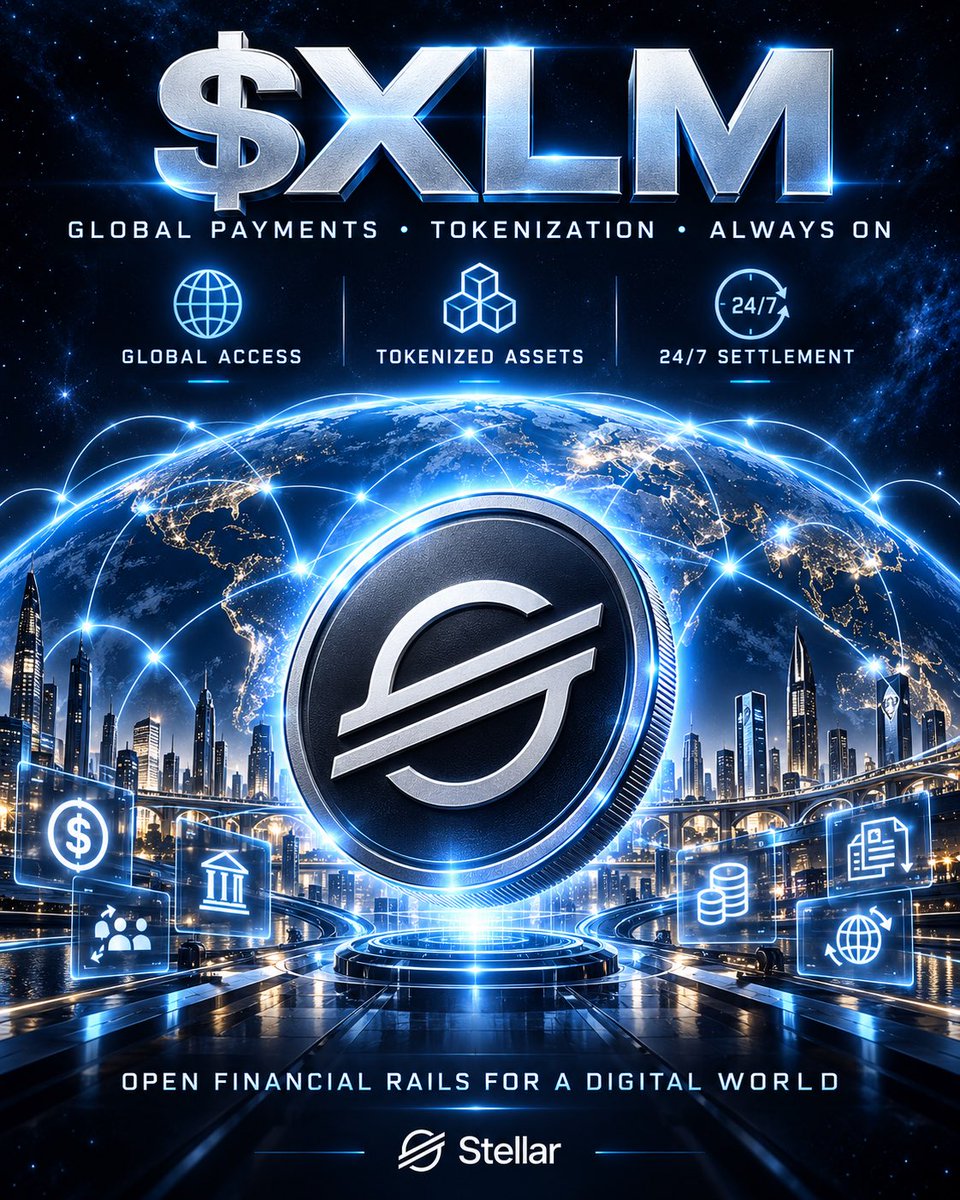
🚨 LATEST UPDATE ON $XLM — STELLAR IS MOVING DEEPER INTO THE NEW MONETARY SYSTEM
I just ran the latest Stellar developments, and $XLM is no longer just a “cheap cross-border payments” story.
🏦 U.S. BANK ISSUED ITS OWN STABLECOIN ON STELLAR
U.S. Bank completed its first pilot transaction using USBDC, its proprietary dollar-backed stablecoin, to make a cross-border payment between its North American and European entities.
This wasn’t just a sandbox token.
The transaction connected Stellar to the bank’s existing:
CORE BANKING
RISK
COMPLIANCE
OPERATIONS
The pilot tested the entire institutional lifecycle:
MINT → TRANSFER → REDEEM → FREEZE → CLAWBACK
And U.S. Bank + Stellar are now evaluating liquidity management, collateral mobility and cross-border treasury operations.
🥶 THAT IS A BANK-ISSUED DOLLAR MOVING ON A PUBLIC BLOCKCHAIN.
Now it gets bigger.
🏛️ DTCC → STELLAR
DTCC and the Stellar Development Foundation officially announced that DTC’s Tokenization Service will connect to Stellar.
The goal is to make DTC-custodied tokenized assets available on Stellar in the first half of 2027.
That potentially brings traditional securities into a digital environment with:
FASTER SETTLEMENT
GREATER ASSET MOBILITY
LONGER TRADING HOURS
LOWER COST / RISK
This is a direct institutional-market-infrastructure connection — not speculation.
📈 STELLAR NOW REPORTS ~$4 BILLION IN TOKENIZED RWAs
Stellar says tokenized real-world assets on the network have grown roughly 360% this year.
And remember our foundation thesis?
Those assets now need MARKET DATA.
Guess who just entered?
🎖️ $PYTH
Pyth’s mainnet integration now gives Stellar smart contracts access to 3,500+ price feeds across:
EQUITIES
FX
COMMODITIES
CRYPTO
FIXED INCOME
And Stellar says Chainlink Data Feeds + Data Streams + CCIP are also coming, with Stellar participating in Chainlink Scale.
👀
Look at the architecture forming:
DTCC TOKENIZED ASSETS
⬇️
STELLAR / $XLM
⬇️
$PYTH MARKET DATA
⬇️
$LINK / CCIP INTEROPERABILITY
That is EXACTLY why I keep saying:
INTEROPERABILITY + CCIP + MARKET DATA + INDEX/AUDIT ARE BASE REQUIREMENTS.
💵 USDT0 IS NOW LIVE ON STELLAR
USDT0 connects Stellar to the broader global USDT liquidity environment through LayerZero’s interoperability technology rather than forcing Stellar into an isolated liquidity pool.
Now add another major payment company.
💳 BVNK → STELLAR
BVNK — which reports approximately $39 BILLION in annualized stablecoin volume — integrated Stellar into its payment platform.
Its business customers can now use Stellar through BVNK’s API for:
CROSS-BORDER PAYMENTS
MERCHANT PAYOUTS
TREASURY DISBURSEMENTS
BVNK also says Stellar processed $55.6B of payment volume in 2025.
So zoom out:
U.S. BANK
→ bank-issued stablecoin
DTCC / DTC
→ tokenized securities
USDT0
→ global stablecoin liquidity
BVNK
→ enterprise stablecoin payments
PYTH
→ market data
CHAINLINK / CCIP
→ incoming interoperability + oracle infrastructure
STELLAR
→ public settlement environment underneath it
🥶🥶🥶
This is why I’m updating how I view $XLM.
It is not simply:
“SEND MONEY CHEAP.”
The emerging role looks closer to:
🚨 $XLM / STELLAR — PUBLIC PAYMENTS + TOKENIZED-ASSET + STABLECOIN SETTLEMENT RAIL
Now the important token question:
Stellar adoption does not mean every dollar moving across Stellar has to be converted into XLM.
But XLM remains the network’s native asset, is required for account/reserve mechanics and transaction fees, and historically serves as a bridge asset when useful.
So the thing I’m watching is:
How much institutional Stellar adoption translates into actual XLM liquidity, network activity and native economic demand?
Because the infrastructure is clearly getting bigger.
BANK MONEY.
DTCC ASSETS.
STABLECOINS.
MARKET DATA.
INTEROPERABILITY.
24/7 SETTLEMENT.
🚨 $XLM — THE PAYMENT RAIL IS STARTING TO BECOME AN INSTITUTIONAL ASSET RAIL TOO.
FOLLOW THE INFRASTRUCTURE. DYOR.