CHINA JUST DROPPED THE BIGGEST THREAT TO EVERY SaaS APP.
Alibaba just open-sourced PageAgent.
And almost nobody is talking about it.
Imagine opening a web app and typing:
> "Log in, generate my report, export it to PDF, and email it."
It just... does it.
No browser extension.
No screenshots.
No backend rewrite.
No custom AI workflow.
Just ONE line of JavaScript.
``html <script src="CDN_URL" crossorigin="true"></script>``
That's the entire integration.
Your website instantly gets an AI agent that can:
• Control your UI with natural language
• Fill forms automatically
• Navigate across pages
• Execute multi-step workflows
• Support voice commands
• Connect to MCP servers
• Use any LLM (Qwen, GPT, Claude, etc.)
This changes everything.
Every SaaS can become an AI copilot.
Every enterprise dashboard becomes conversational.
And every founder spending months building AI interfaces just got leapfrogged.
The era of clicking through menus is ending.
The era of talking to software has started.
Anthropic Product Team:
"Most people throw more tokens at AI to get better results - we tested the opposite
- same tokens, different jobs. accuracy jumped from 15% to 90%"
4 jobs for your tokens:
execute → do the work
advise → check the direction
grade → pass or fail against a rubric
dream → inspect, learn, write to memory, sharpen next round
instead of one AI doing everything - split it into four: one works, one checks, one scores, one learns - same cost, but 5x better
bookmark & watch this new guide how to use Claude ↓
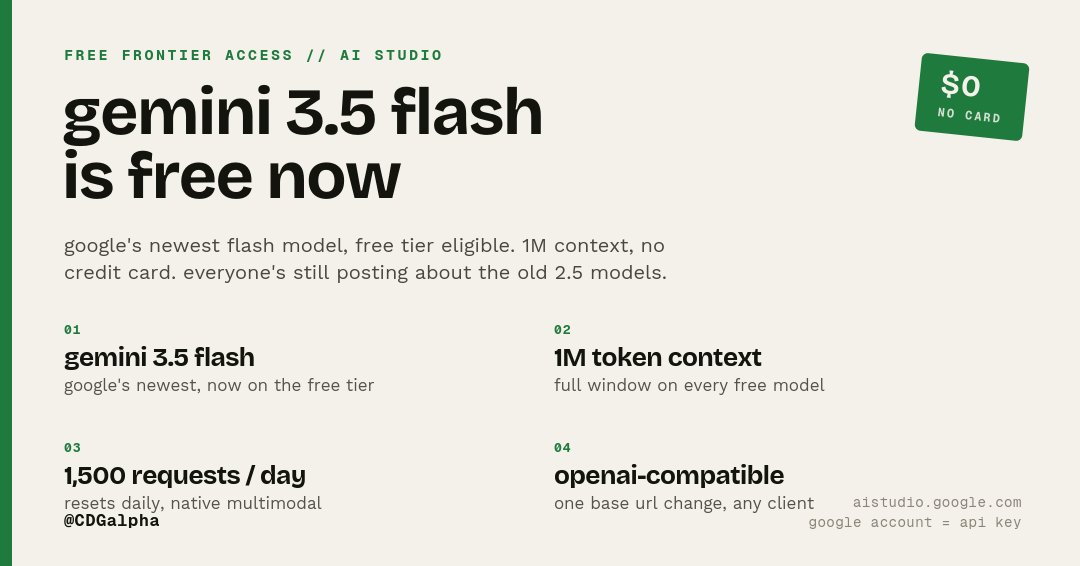
gemini 3.5 flash is free now 😳
google quietly made their newest flash model free-tier eligible. no credit card, 1M context window, and most people are still posting about the old 2.5 models.
what you get for $0:
- gemini 3.5 flash (google's newest, free tier)
- gemini 3.1 flash-lite for high-volume cheap calls
- full 1M token context on every free model
- 1,500 requests/day, native multimodal (text, image, audio, video)
- openai-compatible, one base url change
full setup (2 min):
step 1: grab a free api key
> go to https://t.co/bvoogVXOtj
> sign in with any google account
> click "get api key", no billing setup
step 2: point any client at gemini
> works in cursor, cline, claude code, anything openai-compatible
> or just prototype in the studio ui and hit "get code"
step 3: pick your model
> gemini-3.5-flash for the strong one
> gemini-3.1-flash-lite for cheap high-volume steps
important:
- pro models left the free tier april 1, flash and flash-lite only now
- free-tier prompts can be used to train google's models, don't send sensitive data
- limits are per project, extra keys don't add quota
- 1,500 req/day resets daily, plenty for building and testing
frontier-class model + 1M context + $0
while most guides are still telling you to use last-gen models
save this, the free tier shifts almost monthly
🚨Architects are going to hate this.
Someone just open-sourced a full 3D building editor that runs entirely in your browser.
No AutoCAD. No Revit. No $5,000/year licenses.
It's called Pascal Editor.
Built with React Three Fiber and WebGPU -- meaning it renders directly on your GPU at near-native speed.
Here's what's inside this thing:
→ A full building/level/wall/zone hierarchy you can edit in real time
→ An ECS-style architecture where every object updates through GPU-powered systems
→ Zustand state management with full undo/redo built in
→ Next.js frontend so it deploys as a web app, not a desktop install
→ Dirty node tracking -- only re-renders what changed, not the whole scene
Here's the wildest part:
You can stack, explode, or solo individual building levels. Select a zone, drag a wall, reshape a slab -- all in 3D, all in the browser.
Architecture firms pay $50K+ per seat for BIM software that does this workflow.
This is free.
100% Open Source.
/writing-great-skills is quickly becoming my most often-invoked skill
It's just really good at writing skills, guys.
npx skills add mattpocock/skills --skill writing-great-skills
“Loop engineering” is a hot buzzphrase after mentions of it by Boris Cherny (Claude Code’s creator) and Peter Steinberger (OpenClaw's creator) went viral on social media. Loops are now a key part of how we get AI agents to iterate at length to build software. In this letter, I’d like to share my 3 key loops, shown in the image below, for building 0-to-1 products. These loops guide not just how I build software, but also how I decide what software to build.
Agentic coding loop: Given a product specification and optionally a set of evals (that is, a dataset against which to measure performance), we can have an AI agent write code, test its work, and keep iterating until the code is bug-free and meets its specification. This idea of closing the loop took off around the end of last year, and it has been a game changer in enabling coding agents to work longer productively without human intervention. For example, over the weekend, I was building an app for my daughter to practice typing, and my coding agent could easily work for around an hour, using a web browser to check what it had built multiple times before getting back to me, without needing my intervention.
The engineering loop executes quickly. Every few minutes, the coding agent might build and test a new version of the software. I hear frequently from developers who are finding new ways to engineer more effective engineering loops. This is an active area of invention!
Developer feedback loop: In this loop, a developer examines the current product and steers the coding agent to improve it. Last year, a lot of developers (including me) were acting as the QA (quality assurance) function for our coding agents, manually finding bugs and then asking the agent to fix them. But with coding agents much more able to test their own code, the amount of time we need to spend on this function has decreased significantly. This allows us to make higher-level product decisions, such as what key features to offer, where the UI needs improvement, and so on.
The developer-feedback loop operates over time intervals between tens of minutes and hours — that's how frequently a developer might review a product and give feedback. In the case of the typing app, I changed my mind a few times about the visual design, what cat costumes she can unlock as she learns (she loves cats), and the user flow for a grown-up to log in and steer the child's learning experience.
When a developer has a clear vision for what to build, it is still a lot of work to translate that vision into a specification for a coding agent to implement. Further, after the developer has seen an implementation, they might update (or perhaps clarify) the spec to steer it toward what they want. If you find that the system repeatedly runs into certain problems, building a set of evals for the agent becomes useful.
AI-native teams are increasingly using AI to help shape product direction, for example, automating the gathering and analysis of usage data, summarizing written and verbal customer feedback, or carrying out competitive analysis. However, for pretty much all the products I’m involved in, I see humans as having a significant context advantage over current AI systems — we know a lot more than the AI system about the users and the context the product has to operate in — and thus humans play a critical role. Many people describe this human contribution as “taste,” but I prefer to think of it as humans having a context advantage, since that gives us a clearer path to helping AI systems get better. This also speaks to why this step can’t be automated: So long as the human knows something the AI does not, human-in-the-loop is needed to to inject that knowledge into the system.
External feedback loop: This includes a wide range of tactics like asking a few friends for feedback, launching to alpha testers, or putting the code into production with A/B testing. These tactics are usually slow, rarely taking less than hours and sometimes taking days or even weeks. This data informs the developer vision, which in turn continues to drive the detailed product spec, which in turn drives the coding agent.
With coding agents speeding up software development, more engineers are starting to play a partial product management role. For many engineers who are growing into this role, the hardest part is shaping the product vision and striking a balance between building (bridging the gap between vision and spec) and getting user feedback to evolve the vision. It is important to do both!
I will write more about how to do this in future posts, but for now, I find it encouraging that engineers are playing an expanded role (just as product managers and designers now do more engineering).
[Original text: The Batch]
GOOGLE ACABA DE LIBERAR SU CLI OFICIAL PARA CONSTRUIR AGENTES DE IA:
Convierte tu coding agent favorito en un experto creando, evaluando y desplegando agentes en Google Cloud.
Funciona con los que ya usas:
→ Claude Code
→ Codex
→ Antigravity CLI
→ y cualquier otro agente del mercado
No es un agente nuevo.
Es una capa de skills y comandos que le da superpoderes al que ya tienes.
Trae 7 skills oficiales que cubren todo el ciclo:
→ scaffold del proyecto
→ código con ADK
→ evaluación con métricas
→ deploy a Google Cloud
→ observabilidad y trazas
Open source y bajo licencia Apache 2.0.
Lo instalas en una línea y empiezas a montar agentes sin pelearte con mil servicios.
GUÁRDALO. 🔖
Enlace abajo👇
MIT's Books on AI & ML (FREE DOWNLOAD):
1. Foundations of Machine Learning
https://t.co/78p57EBbL8
2. Understanding Deep Learning
https://t.co/D2oyRrXqcE
3. Introduction to Machine Learning Systems
❯ Vol 1: https://t.co/IezLFJdhDV
❯ Vol 2: https://t.co/NYP3xAPZ6u
4. Algorithms for ML
https://t.co/lntuD4Q19H
5. Deep Learning
https://t.co/vCHVIZQYTI
6. Reinforcement Learning
https://t.co/JNWhFCuCkH
7. Distributional Reinforcement Learning
https://t.co/GXpkV4BDZi
8. Multi Agent Reinforcement Learning
https://t.co/T8zVmQVutO
9. Agents in the Long Game of AI
https://t.co/HeD3Nsm5zz
10. Fairness and Machine Learning
https://t.co/csAjhdf7Lb
11. Probabilistic Machine Learning
❯ Part 1 : https://t.co/5Leef9ypGj
❯ Part 2 : https://t.co/vRbF0rEIuh
google is casually giving developers 1M tokens per minute for free 😳
no credit card
no subscription
just official access through google ai studio
what you get for $0:
- 1M TPM on gemini 2.5 flash and pro
- deep reasoning with pro + ultra-fast inference with flash
- native text, image, audio, and video support
- instant api key generation in seconds
why this is huge:
> no fighting strict free-tier limits
> no topping up credits just to experiment
> no paying middlemen for api access
getting started takes less than a minute:
1. go to https://t.co/9vHiKEo4K2
2. sign in with your google account
3. choose flash or pro in the playground
4. generate an api key and start building
pro tip:
use flash for high-volume workloads and save pro for tasks that need stronger reasoning to get the most out of the free limits
the best part?
you can access all of this without spending a single dollar
free tiers can change anytime, so enjoy it while it lasts
bookmark this and grab your api key before everyone else does 👀
Üniversiteye gitmeden bilgisayar bilimi müfredatı tamamlanabilir mi?
GitHub’daki Açık Kaynak Bilgisayar Bilimleri Derecesi (Open Source Computer Science Degree), Harvard, MIT, Stanford, Princeton ve Duke gibi üniversitelerin derslerini bir bilgisayar bilimi lisans programı düzeninde bir araya getiriyor.
Programlama, matematik, bilgisayar sistemleri, algoritmalar, makine öğrenmesi, veritabanları ve kriptografi…
Üstelik her dersin süresi, haftalık çalışma yükü ve ön koşulu belirtilmiş.
Diploma vermiyor; fakat diplomaya giden bilgi haritasını ücretsiz sunuyor.
22 binden fazla yıldız alan bu kaynak, bilgisayar bilimini rastgele videolarla değil, sistemli biçimde öğrenmek isteyenler için gerçek bir yol haritası.
https://t.co/XSMSysd0Hd
¡Claude Code ahora también puede editar vídeos!
Esta SKILL es 100% gratis y de código abierto.
✓ Crea animaciones automáticamente
✓ Genera subtítulos con diferentes estilos
✓ Elimina silencios, errores y palabras de relleno
→ https://t.co/1SVpXY3BSG
In nearly 5 years of modern generative ai, this is the first book I’m seeing with a super high level of coverage and comprehension.
> language modelling
> inference optimisation
> RL and its methods
> system scaling
> applied concepts like agentic ai, rag, memory
> environments and benchmarking
These fields have a subtle boundary differentiating them, but ultimately overlap in modern applications. Agents require system scaling, memory needs inference optimisation, rl requires understanding of environments and benchmarks.
For the first time in my exp, all in one place. Found this on paperswithcode[.]co
Do yourself a favour
> go to https://t.co/auQJoYhm7b
> find “most cited” list of papers
> read the top 10 papers
> one or two papers per week
> read, read again, break it down, code it and write it back
Some of the most influential and transformative work of the last decade can be found here. It will be an amazing experience!!
Personalized learning without the endless prep. 🙌
Study notebooks in the @GeminiApp can instantly generate personalized, bite-sized quizzes to help students build knowledge.
Learn more: https://t.co/zA1pduIkkW
Yesterday we launched computer use in Gemini 3.5 Flash with browser, mobile, and desktop environments. I put together a quickstart for how to control an Android Phone.
1. Single script to install emulator from terminal.
2. Basic agent loop with interactions API using `adb` to control the phone.
3. Connects to remote devices too (`adb connect <ip>:5555`).
4. Same pattern works for iOS with, e.g. simctl.
"You play as Peter, an ordinary postman trying to save the world from the apocalypse. Solve puzzles, change outcomes and unravel why it's all happening."
i really want to play this! wishlist here and follow the talented devs @kaleidoscube
https://t.co/RWQT1u3YTP
Release day: Clapet est en ligne!
https://t.co/YzGBpQGd8j
J'ai construit le tool de System Design que j'aurais aimé avoir pour préparer mes entretiens.
Clapet te guide pas à pas pour construire une archi au lieu de te laisser seul devant un canvas vide a la Excalidraw.
Claude Code subagents can nest 5 levels deep now
@bcherny announced it, and today I finally got to try it, Here's the full chain running end to end:
- main
- project-auditor // level 1
- structure-checker // level 2
- import-validator // level 3
- dependency-tracer // level 4
- style-sync // level 5
Each level runs in its own context window
Only the top-level summary returns to main, depth 5 is the hard cap, that agent can't spawn further






![AndrewYNg's tweet photo. “Loop engineering” is a hot buzzphrase after mentions of it by Boris Cherny (Claude Code’s creator) and Peter Steinberger (OpenClaw's creator) went viral on social media. Loops are now a key part of how we get AI agents to iterate at length to build software. In this letter, I’d like to share my 3 key loops, shown in the image below, for building 0-to-1 products. These loops guide not just how I build software, but also how I decide what software to build.
Agentic coding loop: Given a product specification and optionally a set of evals (that is, a dataset against which to measure performance), we can have an AI agent write code, test its work, and keep iterating until the code is bug-free and meets its specification. This idea of closing the loop took off around the end of last year, and it has been a game changer in enabling coding agents to work longer productively without human intervention. For example, over the weekend, I was building an app for my daughter to practice typing, and my coding agent could easily work for around an hour, using a web browser to check what it had built multiple times before getting back to me, without needing my intervention.
The engineering loop executes quickly. Every few minutes, the coding agent might build and test a new version of the software. I hear frequently from developers who are finding new ways to engineer more effective engineering loops. This is an active area of invention!
Developer feedback loop: In this loop, a developer examines the current product and steers the coding agent to improve it. Last year, a lot of developers (including me) were acting as the QA (quality assurance) function for our coding agents, manually finding bugs and then asking the agent to fix them. But with coding agents much more able to test their own code, the amount of time we need to spend on this function has decreased significantly. This allows us to make higher-level product decisions, such as what key features to offer, where the UI needs improvement, and so on.
The developer-feedback loop operates over time intervals between tens of minutes and hours — that's how frequently a developer might review a product and give feedback. In the case of the typing app, I changed my mind a few times about the visual design, what cat costumes she can unlock as she learns (she loves cats), and the user flow for a grown-up to log in and steer the child's learning experience.
When a developer has a clear vision for what to build, it is still a lot of work to translate that vision into a specification for a coding agent to implement. Further, after the developer has seen an implementation, they might update (or perhaps clarify) the spec to steer it toward what they want. If you find that the system repeatedly runs into certain problems, building a set of evals for the agent becomes useful.
AI-native teams are increasingly using AI to help shape product direction, for example, automating the gathering and analysis of usage data, summarizing written and verbal customer feedback, or carrying out competitive analysis. However, for pretty much all the products I’m involved in, I see humans as having a significant context advantage over current AI systems — we know a lot more than the AI system about the users and the context the product has to operate in — and thus humans play a critical role. Many people describe this human contribution as “taste,” but I prefer to think of it as humans having a context advantage, since that gives us a clearer path to helping AI systems get better. This also speaks to why this step can’t be automated: So long as the human knows something the AI does not, human-in-the-loop is needed to to inject that knowledge into the system.
External feedback loop: This includes a wide range of tactics like asking a few friends for feedback, launching to alpha testers, or putting the code into production with A/B testing. These tactics are usually slow, rarely taking less than hours and sometimes taking days or even weeks. This data informs the developer vision, which in turn continues to drive the detailed product spec, which in turn drives the coding agent.
With coding agents speeding up software development, more engineers are starting to play a partial product management role. For many engineers who are growing into this role, the hardest part is shaping the product vision and striking a balance between building (bridging the gap between vision and spec) and getting user feedback to evolve the vision. It is important to do both!
I will write more about how to do this in future posts, but for now, I find it encouraging that engineers are playing an expanded role (just as product managers and designers now do more engineering).
[Original text: The Batch]](https://pbs.twimg.com/media/HMEtxp3bsAARJdi.jpg)


![TheGlobalMinima's tweet photo. In nearly 5 years of modern generative ai, this is the first book I’m seeing with a super high level of coverage and comprehension.
> language modelling
> inference optimisation
> RL and its methods
> system scaling
> applied concepts like agentic ai, rag, memory
> environments and benchmarking
These fields have a subtle boundary differentiating them, but ultimately overlap in modern applications. Agents require system scaling, memory needs inference optimisation, rl requires understanding of environments and benchmarks.
For the first time in my exp, all in one place. Found this on paperswithcode[.]co](https://pbs.twimg.com/media/HLuhEeJbgAA1ukW.jpg)


