AI agents now do real work on every team. On the bill, each provider is one line. Nobody can say what it paid for.
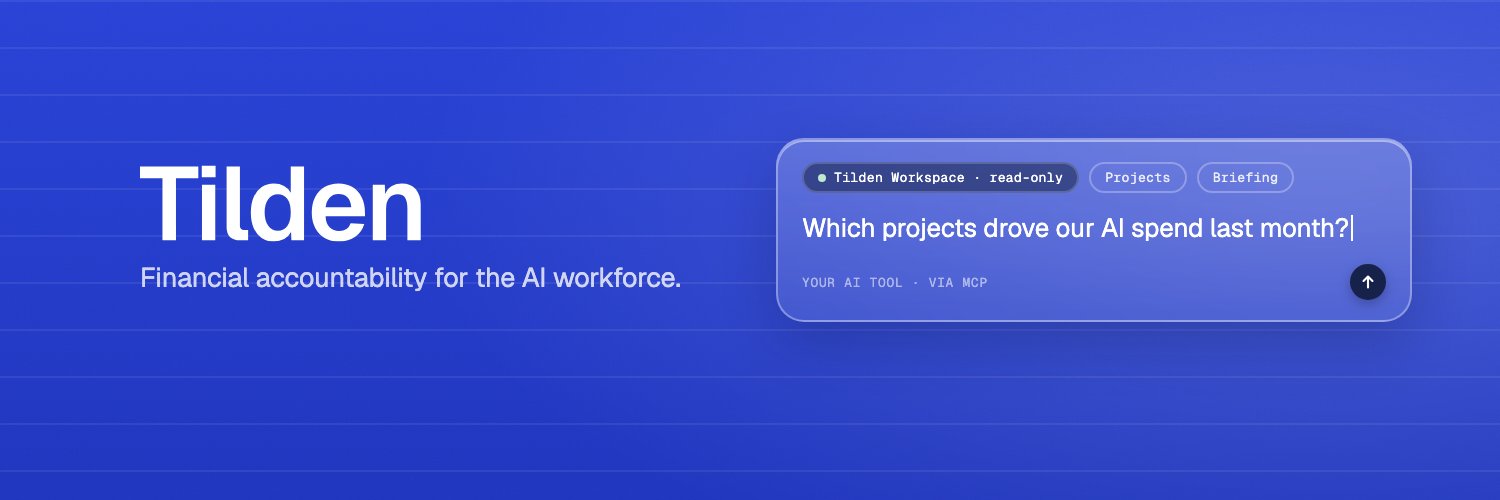
Today I'm launching Tilden: financial accountability for the AI workforce.
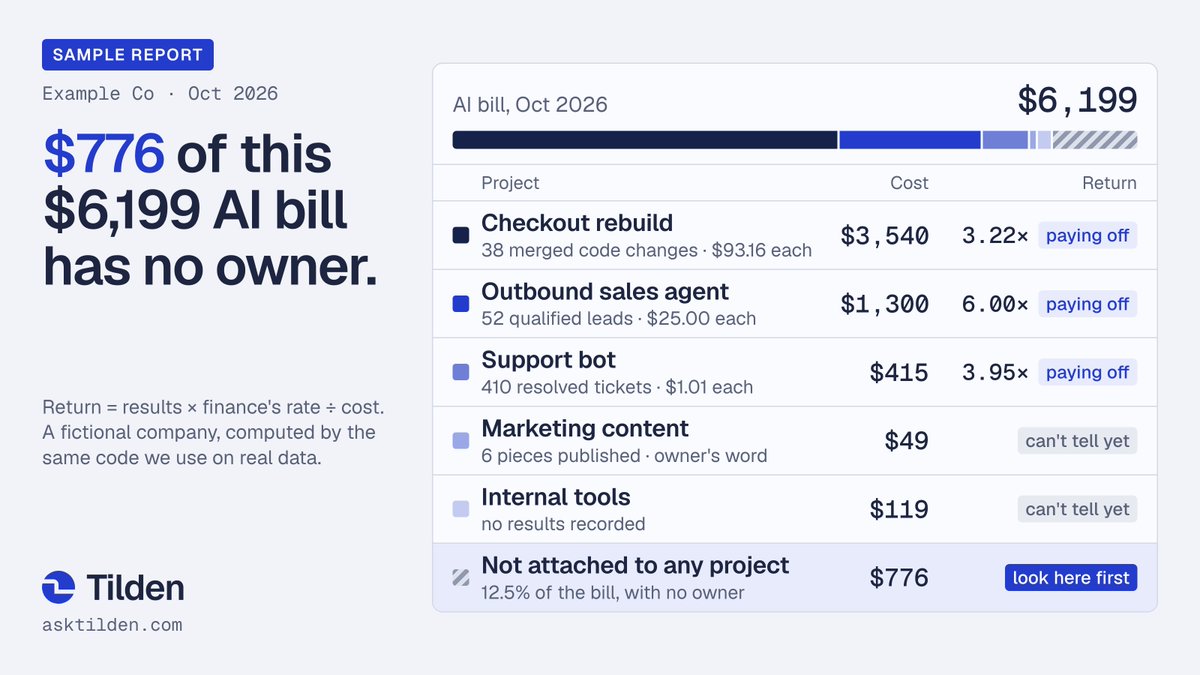
Connect OpenAI, Anthropic, Cursor, Copilot or AWS (more on the way) and see which project and owner drove your bill, with every number labeled billed or estimated. We're tying that spend to what it produces, so you know each project's ROI.
For the next few weeks, I'm breaking down 20 teams' AI bills by hand, for free. One page back in 48 hours, no API keys.
DM me, or request early access: https://t.co/Tl4ljuQoLQ
The number behind it: 46.9% of enterprises ran over budget on AI in Futurum's 2H 2026 survey, and only about one in six of those cut back.
Want the full one-page sample? No data needed from you. DM me.
Early access: https://t.co/fJIsTDsoE7
Last year's AI overrun is about to become next year's budget.
That works until finance asks what to cut and you have one total from OpenAI and one from Anthropic.
At Tilden we're tying each project's cost to what it delivered, so you see what's paying off and cut what isn't.
@AriaWestcott Good list. One catch on the API key tip: price a heavy session before you move it. When I priced my last 30 days of agent work at API rates, it came to more than 10x what I pay for my subscriptions. Saving the allowance can still cost you on the bill
@mardehaym The usage report per workflow is the one most teams skip. The invoice is one line per vendor, so when a limit changes, nobody can say which workflow just got more expensive. Tagging workflows now is cheap. Rebuilding that history later mostly isn't
@zachlloydtweets I'd underline ROI tracking. On laptops, the cost lands on a provider invoice, and the context (which repo, which ticket) stays on someone's machine. Running agents centrally puts both on the same record. What unit are you tracking, cost per run or per merged PR?
@m0xt_ Hard to answer without knowing what each use case costs today. Most teams get one line per provider, not per project, so deciding what deserves a frontier model ends up being a guess
@wallstengine The same thing happens inside a single company. Cost per task drops, teams run way more agents, and the monthly bill still goes up. The question finance ends up asking isn't the price per token; it's what all that extra usage produced
Question for anyone whose team pays for Claude Code, Codex, Copilot, or Cursor:
When someone asks what the AI bill paid for, what do you show them? A spreadsheet? The provider dashboard? Nothing yet?
And when they ask what it returned, can you put an ROI on that invoice?
I'm building Tilden to answer both: where the spend went, and the ROI of every project it paid for. I'd rather learn how you handle it now than guess lol
Starting tomorrow, your $200 ChatGPT Pro plan gets half the Codex usage it has now! Rip lol
Before you switch plans, measure what you actually use and for what project. In August, my own Codex usage came to $2,299.79 at API prices.
Check yours (free, runs locally):
npx aibill@latest
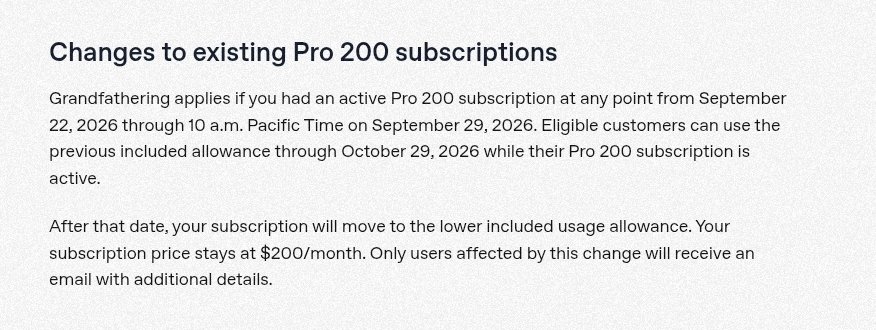
🚨 OpenAI is reducing ChatGPT Pro 200 usage tomorrow
Starting October 30: Usage allowance will be reduced for eligible existing subscribers and The subscription price stays at $200/month
Users who qualified for grandfathering keep their old allowance through October 29 and New Pro 200 subscribers already have the lower allowance
will users accept paying the same price for less usage?
@asktilden Want to see yours first? The free CLI reads your Claude Code and Codex logs and shows what that work costs at API prices, by project. Your logs never leave your machine:
npx aibill@latest
Reply with the % it can't tie to a project, and I'll tell you what I'd check first.
AI agents now do real work on every team. On the bill, each provider is one line. Nobody can say what it paid for.
Today I'm launching Tilden: financial accountability for the AI workforce.
Connect OpenAI, Anthropic, Cursor, Copilot or AWS (more on the way) and see which project and owner drove your bill, with every number labeled billed or estimated. We're tying that spend to what it produces, so you know each project's ROI.
For the next few weeks, I'm breaking down 20 teams' AI bills by hand, for free. One page back in 48 hours, no API keys.
DM me, or request early access: https://t.co/Tl4ljuQoLQ
@asktilden Here's mine. In 30 days, my agents did ~$3,570 of work at API prices, on a $400/month plan.
43% went to one repo. 17% I couldn't tie to any project.
That 17% is the question Tilden answers.
@shantanugoel@pidotdev Did you compare tokens per task between the two? The same task can burn wildly different amounts depending on the agent loop, which explains limits better than the model does
@JohnMcKeownn Before you move to Claude Max, check where the usage actually goes. When I measured mine, 43% went to one repo. Switching plans doesn't fix one project eating the budget
@zachmoskow Worth measuring before anyone switches. On $400/mo of subscriptions, my agents did ~$3,570 of work at API prices in 30 days. Half the allowance changes that math, but most people have no idea where their own usage sits.
@theo Devs don't. The person who has to explain the bill does. Different audience: the eng lead whose finance team asks what last month's AI spend actually paid for.
Had the pleasure last night of kicking off cohort #6 for @genzscout! Over 35 students out of 300+ applicants all across the country from schools all over to learn more about VC & startups