Just completed Unit 1: Fundamentals of Agents in the Hugging Face Agents Course! 🚀 Learned about AI agents, their design, and even built my first agent using smolagents.
Check out the course here: https://t.co/O7L4InjuqG
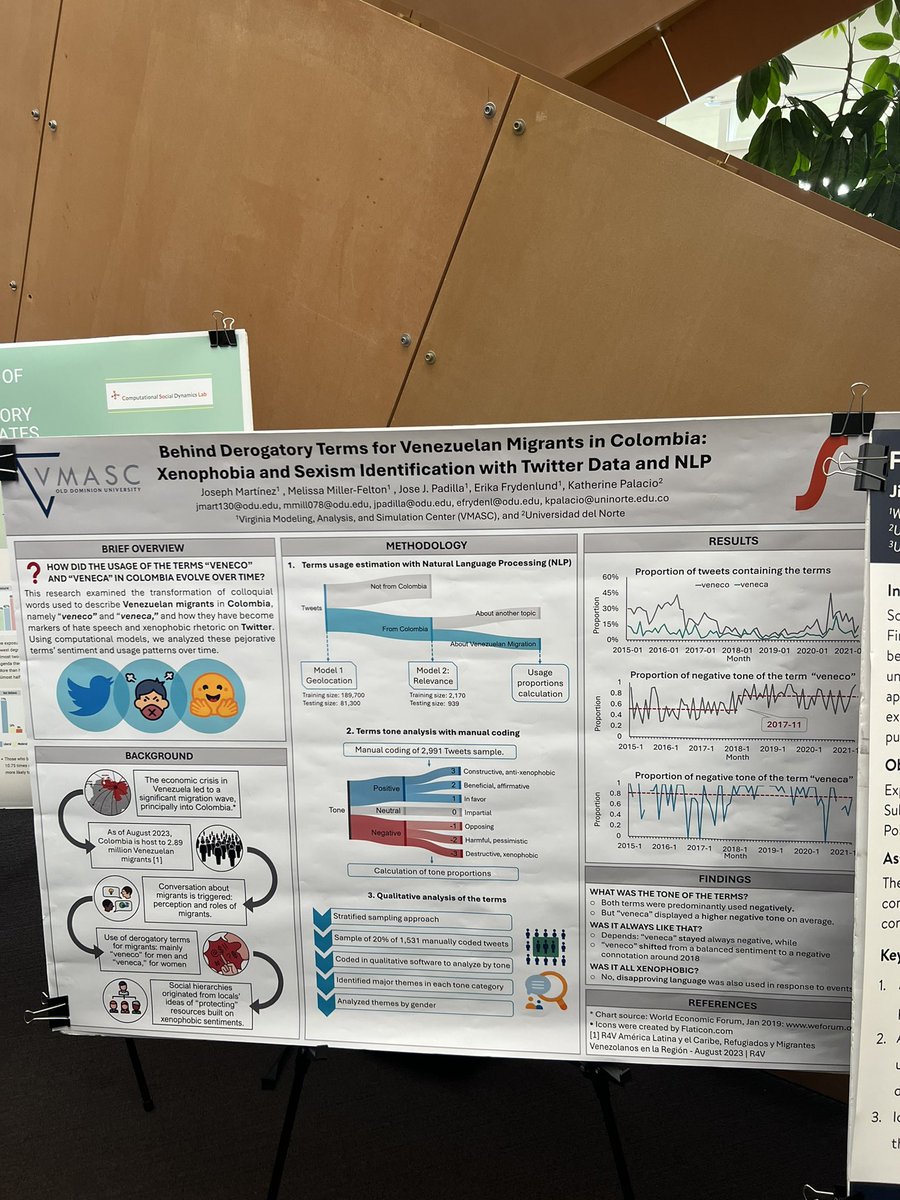
Storymodeler, Joseph Martìnez, spent a month in #Norway as part of the International Student Exchange Program funded by @AFOSR. Collaborating with @AgderUniversity faculty on #AI & cultural identity research was an unforgettable experience! 👀 https://t.co/KGa2N0ONPH
Check out my experience in the Digital Humanities and Mediterranean Mobilities Workshop - this event called for integrating historical perspectives 📔 into computer and data science research.📝 https://t.co/4COoVa6sEU
@storymodelers@UCBHistory@WebSciDL#Collaboration 🌐🤝
Why @huggingface Assistants are better than GPTs
Today, Hugging Face released Assistants, similar to OpenAI GPTs.
Here are the main advantages:
1. Choose your model:
Try different open-source models and choose the perfect fit for your use case. You can pick models like Mixtral, Llama2, OpenChat, Hermes, and more.
2. Absolutely Free:
The inference is provided by Hugging Face and you don't have to pay for any token you use. Total cost: $0
3. Publicly Shareable:
No subscription is needed to access the Assistant. Which means you can share it publicly with anyone, unlike GPTs.
Yet, the product is still in beta version.
There are some areas of improvement to match OpenAI GPTs:
- Adding RAG,
- Enabling web search
- Generating Assistant thumbnails with AI
These features are not yet available but are in the roadmap.
Let share your work !
🚀Planning to submit a grant proposal to NSF? Read the blog that @joseph_mars7 and I wrote with strategies to increase your chances of acceptance based on the experiences of Dr. Joshua Behr who has had previous success. #NSFGrant#ResearchSuccess
https://t.co/3a7ZBUfw7u
Adiós al pajarito azul, y poco a poco diremos adiós a la marca Twitter, que por cierto Twitter significa “Typing What I'm Thinking To Everyone Reading”. Y por si no lo sabías el pajarito es una especie en peligro de extinción que habita en los bosques de Asia, se le conoce como Monarca nuquinegro. Además, el pajarito tiene nombre, se llama Larry en honor a la leyenda de la NBA Larry Bird de los Boston Celtics, el cual el fundador de esta red social era fan.
Hoy se conmemoran 213 años de la Independencia de #Colombia. Queremos enviar un clauroso saludo a todos los colombianos en este día tan importante para la historia del país. 💛💙❤️
You'll soon see lots of "Llama just dethroned ChatGPT" or "OpenAI is so done" posts on Twitter. Before your timeline gets flooded, I'll share my notes:
▸ Llama-2 likely costs $20M+ to train. Meta has done an incredible service to the community by releasing the model with a commercially-friendly license. AI researchers from big companies were wary of Llama-1 due to licensing issues, but now I think many of them will jump on the ship and contribute their firepower.
▸ Meta's team did a human study on 4K prompts to evaluate Llama-2's helpfulness. They use "win rate" as a metric to compare models, in similar spirit as the Vicuna benchmark. 70B model roughly ties with GPT-3.5-0301, and performs noticeably stronger than Falcon, MPT, and Vicuna.
I trust these real human ratings more than academic benchmarks, because they typically capture the "in-the-wild vibe" better.
▸ Llama-2 is NOT yet at GPT-3.5 level, mainly because of its weak coding abilities. On "HumanEval" (standard coding benchmark), it isn't nearly as good as StarCoder or many other models specifically designed for coding. That being said, I have little doubt that Llama-2 will improve significantly thanks to its open weights.
▸ Meta's team goes above and beyond on AI safety issues. In fact, almost half of the paper is talking about safety guardrails, red-teaming, and evaluations. A round of applause for such responsible efforts!
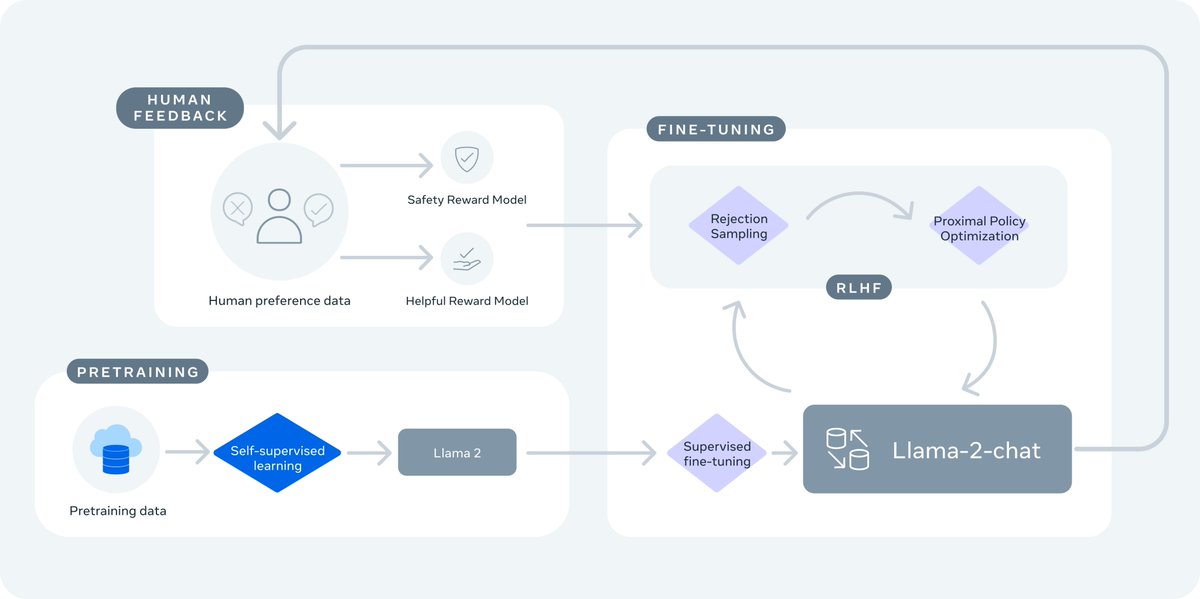
In prior works, there's a thorny tradeoff between helpfulness and safety. Meta mitigates this by training 2 separate reward models. They aren't open-source yet, but would be extremely valuable to the community.
▸ I think Llama-2 will dramatically boost multimodal AI and robotics research. These fields need more than just blackbox access to an API.
So far, we have to convert the complex sensory signals (video, audio, 3D perception) to text description and then feed to an LLM, which is awkward and leads to huge information loss. It'd be much more effective to graft sensory modules directly on a strong LLM backbone.
▸ The whitepaper itself is a masterpiece. Unlike GPT-4's paper that shared very little info, Llama-2 spelled out the entire recipe, including model details, training stages, hardware, data pipeline, and annotation process. For example, there's a systematic analysis on the effect of RLHF with nice visualizations.
Quote sec 5.1: "We posit that the superior writing abilities of LLMs, as manifested in surpassing human annotators in certain tasks, are fundamentally driven by RLHF."
Congrats to the team again 🥂! Today is another delightful day in OSS AI.
🔴 ¡¡¡ATENCIÓN AL BOMBAZO!!
Meta publica una nueva versión de su modelo del lenguaje:
✨ LLaMA 2 ✨🦙
Un modelo que podéis descargar y usar y que a diferencia del anterior tendrá una licencia comercial más permisiva.
¿Y lo más loco...?
Que lo acaban de presentar en un evento de...
¡¡¡MICROSOFT!!! 😵
...que recordemos Microsoft está en alianza con OpenAI al cual este modelo no debe de beneficiar.
Me entero bien de los detalles y os voy ampliando la información en los próximos tweets.
Today, with collaborators at @Google , we're excited to announce 🥳🥳HyperDreamBooth🥳 🥳! It's like DreamBooth, but smaller, faster and better. 25x faster. Think of 30 minutes vs. 14 hours for 100 models. And works on a single image!
(Thread 👇)
webpage: https://t.co/yCixpgjABd
What if we set GPT-4 free in Minecraft? ⛏️
I’m excited to announce Voyager, the first lifelong learning agent that plays Minecraft purely in-context. Voyager continuously improves itself by writing, refining, committing, and retrieving *code* from a skill library.
GPT-4 unlocks a new paradigm: “training” is code execution rather than gradient descent. “Trained model” is a codebase of skills that Voyager iteratively composes, rather than matrices of floats. We are pushing no-gradient architecture to its limit.
Voyager rapidly becomes a seasoned explorer. In Minecraft, it obtains 3.3× more unique items, travels 2.3× longer distances, and unlocks key tech tree milestones up to 15.3× faster than prior methods.
We open-source everything. Let generalist agents emerge in Minecraft! Welcome you all to try today: https://t.co/1d3YocozsI
Paper: https://t.co/JcWEasgtyI
Code: https://t.co/KsvVf7rcl0
Deep dive with me: 🧵