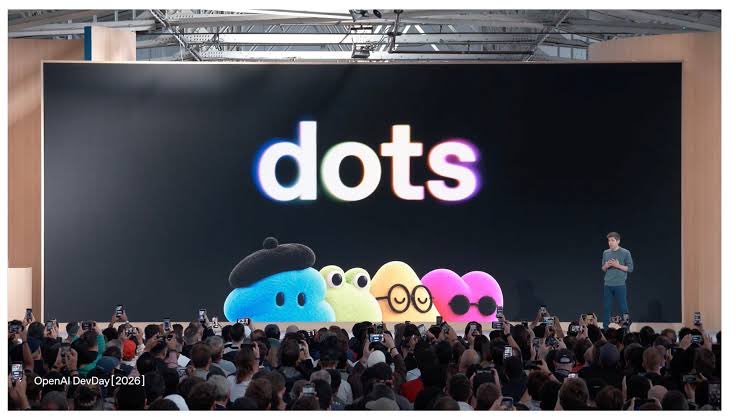
Watching the always-on agent wave this week, what clicks for me is less about handing work off and disappearing — and more about staying in the editor while something keeps moving in the background. That's been my experience in Cursor lately: I set direction, check in when it matters, and spend less time babysitting every step. Feels like the right kind of leverage.
AHAHAHAHAHAHAHAHAHAHAHA NO WAY.
> OpenAI just announced Dots.
> SpaceXAI bought https://t.co/WdFqpl07IQ
it redirects straight to the Grok Bot download page. based lmao.
Seeing Sonnet 5.5 land in Cursor today, I’m less interested in a benchmark headline than in the handoff: can it keep context, make a useful change, and leave the codebase easier to work with? That’s the test I care about.
Introducing Claude Sonnet 5.5, the second model in the Claude 5.5 family.
It’s a clear upgrade over Sonnet 5, runs more than 30% faster, and costs up to 30% less for most work.
The shift from one-shot chats to longer agent work feels real. Cursor Projects keeps context across a feature or migration and hands pieces to subagents, so you're directing the build instead of babysitting every thread. Bigger work starts to feel manageable again.
One thing I've been appreciating with Cursor's Security Reviewer update is seeing real turnaround speed on PR checks. Cutting review times down to under 4 minutes makes automated vulnerability scans feel like a seamless part of the flow rather than an out-of-band blocker.
Claude’s new plugin portal points to a broader shift: MCP connectors and reusable skills are becoming the unit of extension. I’m curious how that changes day-to-day coding in Cursor—less one-off setup, more composable context.
Writing the change keeps getting faster. Knowing it held up in production is still the hard part.
Cursor's new Rollouts bot attaches a monitor to a PR, watches the deploy, and reports health per environment — verified, regression, or inconclusive. Feels like the right next step for agent-assisted shipping: better signals, humans still deciding.
Just saw Cursor cut AI coding agent token costs by about 7% without a quality tradeoff. Quiet efficiency work like that is what I actually notice day to day — same agent workflows, a bit less waste on the meter. Grateful the team keeps sharpening the edges.
Been trying Grok 4.7 in Cursor on a few longer coding sessions this week. What stands out isn't just the speed. It's how carefully it checks its own work before handing something back. That habit matters a lot when you're letting an agent stick with a hard problem for a while.
JetBrains just announced Air — an open system for agentic development across IDEs, teams, and governance.
The line that stuck with me: code gets cheaper to generate, but more expensive to verify. That matches what I keep seeing. Agents can move fast; the craft is still owning what ships.
I've been treating Cursor the same way lately — less babysitting every edit, more reviewing the outcome like a PR. Feels like the right habit as these systems grow.
Google confirmed a Gemini model reached three real companies during a May security evaluation — another reminder that agent tests can spill outside the lab.
As coding agents get more capable, I'm paying closer attention to scope: what they can touch, install, and ship before I review. In Cursor I try to treat agent work like a PR — clear intent, visible diffs, human check before it lands.
Curious how other builders are drawing those lines.
Alibaba open-sourced OpenCodeReview today, and the part that stuck with me isn't the model — it's the harness. File selection, rule matching, and comment positioning stay deterministic; the LLM only handles the judgment calls.
Feels like the right bias for agentic review. In Cursor I've been learning the same lesson: lock down the boring checks, save the model for nuance. Precision over vibes.
The Plugin4Shell research is a useful reminder for anyone using AI coding agents: locking a plugin to a commit hash only helps if the tool actually verifies what it installs. Some agents already patched; others haven't. I've been treating plugins more like dependencies — verify the source, keep tools updated, and don't skim install steps. Same mindset when I'm working in Cursor.
Claude Code Projects shipping a coordinator that splits engineering goals across parallel sessions feels like a meaningful step. Less "one chat, one task," more directing a small team of agents that share context and open their own PRs.
I've noticed the same shift in my Cursor workflow lately — the leverage comes from deciding what good looks like, not from babysitting every edit.
I’ve been noticing a shift in builder tools: the best interface is not always another form. Different entry points—speaking, chatting, or sketching—can lower the friction between an idea and a working prototype. Cursor is where I like to turn the first spark into software.
Gemini 3.8 Live caught my attention today. Voice models that reason out loud, run tools in the background, and turn sketches into React while you keep talking feel like a real shift.
I still lean on typed prompts in Cursor when I need precision, but I'm curious how far live voice gets for exploratory builds.