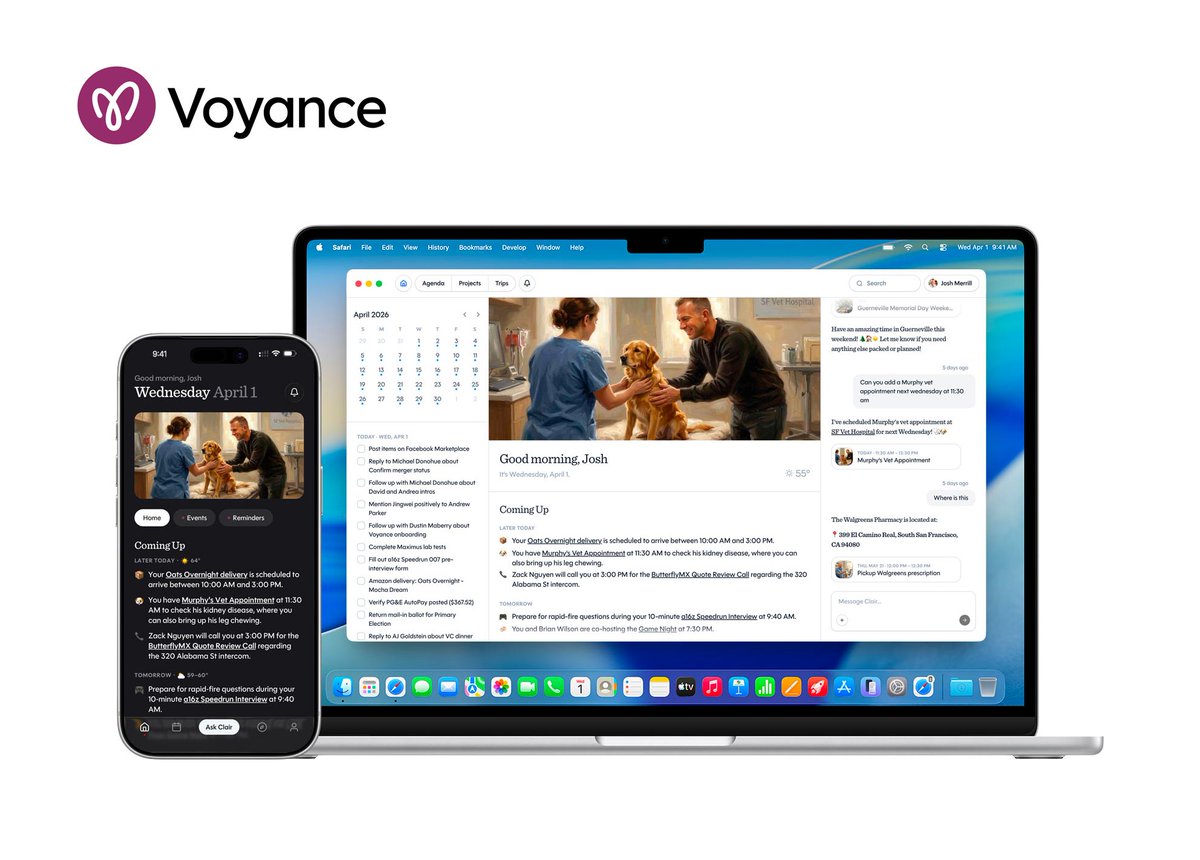
@zdogmode Clair, a personal AI that gets your life out of your head: plans, trips, projects, the things you told people you'd do. She reads your messages and calendar and does the remembering—kind of runs my life now. :) In private beta: https://t.co/w6k3IOmKgF
@yeasindesign Working on Clair, a personal AI that gets your life out of your head: plans, trips, projects, the things you told people you'd do. She reads your messages and calendar and does the remembering. https://t.co/w6k3IOmKgF
@kyasser@X I'm working on Clair, a personal AI. She reads your messages and calendar and does the remembering... trips, plans, projects, etc. Kind of running my life with it.
@0x_joshio Clair, a personal AI that gets your life out of your head: plans, trips, projects, the things you told people you'd do. She reads your messages and calendar and does the remembering. Free in beta: https://t.co/w6k3IOmKgF P.S. solid name @0x_joshio :)
@16vchq Clair, a personal AI that gets your life out of your head: plans, trips, projects, the things you told people you'd do. She reads your messages and calendar and does the remembering. I built her, and she runs my whole life. Free in beta: https://t.co/w6k3IOmKgF
@iouione Clair, a personal AI that gets your life out of your head: plans, trips, projects, the things you told people you'd do. She reads your messages and calendar and does the remembering. I built her, and she runs my whole life. Free in beta: https://t.co/w6k3IOmKgF
@JunaidAckroyd Clair, a personal AI that gets your life out of your head: plans, trips, projects, the things you told people you'd do. She reads your messages and calendar and does the remembering. I built her, and she runs my whole life. Free in beta: https://t.co/w6k3IOmKgF
The hard thing about writing simply is that you can't hide. Plain sentences show the reader exactly what you have to say, and if you have nothing to say, they show that too. That's why so much writing is fancy: the decoration covers for what's missing. That's @paulg's argument, from an essay called Write Simply.
I think this is why AI writing is bad. Yesterday I asked an AI to draft a post for me. The model had nothing to say. It was rearranging patterns from other people's writing, and a lot of those people had nothing to say either. So it wrote decoration.
So I made it write simply. Most of the rules come from his essays on writing: ordinary words, simple sentences, write like you talk. A few are aimed at AI's particular habits: no em dashes, kill any sentence that sounds quotable. I turned them into a skill my AI loads whenever it writes for me and open sourced it. There's even a calibration step where it fetches one of his essays and measures ten of his sentences before it writes.
It works, mostly. The drafts now come out plain enough that you can see whether there's an idea behind them. But rules can't give the AI ideas. That part is still my job, and the plain drafts make it obvious when I haven't done it.
Repo in the thread. If you load the skill into your own AI, tell me what it cuts first.
I have 47 unread texts and somehow none of them are “texts.”
They are:
Plans that changed
People I meant to answer
One address
Three soft commitments
A dinner time that moved twice
A thing someone asked me to send
Four messages where the correct reply is apparently a whole personality test
Calling this productivity is insane.
It's social debt with a notification badge.
I have a new personality trait and it is caring about queues.
Not the elegant founder answer. Not the demo video answer. The queue answer.
This week we shipped more operational visibility and recovery work for Clair’s task system, which is a fancy way of saying we got better at seeing when her work is running, stuck, retried, recovered, or done.
It is not the kind of thing people screenshot.
But if Clair is going to help with the tiny stuff people forget, she cannot also be forgetting tiny stuff in the background.
So yes, I am now emotionally invested in task plumbing.
Growth is strange.
Calendar apps are good at allocating time.
They are much worse at storing the plan.
The plan is usually scattered. A restaurant link in a text. A flight number in email. A note from someone saying they might be late. A preference you remember about who hates loud places.
The event says dinner at 7.
Your life says a lot more than that.
This is one reason I think personal AI has to understand messages, email, calendar, contacts, and the relationships between them. The assistant cannot help much if it only sees the rectangle on the calendar.
A lot of people are going to get powerful AI at work this year.
It will write docs, summarize meetings, search company data, and help with the job.
Then they will leave work and still have the same pile of personal logistics waiting for them.
Who said they would bring dessert.
Which email had the school form.
Whether the dentist appointment conflicts with dinner.
What a friend mentioned last week that you meant to follow up on.
That is the gap Clair is built for. Work gets AI. Your life should get an assistant too.
Most of the personal admin that drains people is not a clean task.
It is a text that says “let’s find a weekend in June.”
An email with a renewal date buried near the bottom.
A calendar invite that says dinner, but not who picked the place or whether you still need to book a sitter.
That is why I keep coming back to the almost task. The thing is not forgotten yet. It is floating between people, messages, email, and calendar.
A good personal AI should catch those moments before they become chores. Not by making you manage another list. By understanding the loose thread while it is still loose.
Personal life is not simple.
It is messages, email, calendars, people, plans, preferences, birthdays, errands, travel, reservations, reminders, and small promises you meant to keep.
Most AI tools are built for work because companies pay for them.
Clair is built for the rest of it.
The logistics that do not belong in a project management tool, but still matter.
Voyance is changing my habits.
I check my email 90% less.
I used to keep email open because I did not trust myself to catch the thing that mattered.
A changed plan.
A promise I made.
A detail buried five replies deep.
Someone waiting on me.
The usual answer is more checking.
Check the inbox. Read the thread. Triage it. Turn the loose thing into a task before it disappears.
I want Voyance to make a different loop feel safe.
If something matters, it should come back to me without making me scan every message myself.
Less checking.
More trust that the thing I need will find me when I need it.
Social media is the new smoking.
Not because scrolling is exactly the same as nicotine, but because the business model feels familiar: make something addictive, sell it as connection, downplay the harm, and keep optimizing for more use.
We already know this is hurting people. The U.S. Surgeon General says up to 95% of teens use social media, about one-third say they use it “almost constantly,” and kids who spend more than 3 hours a day on social platforms face about double the risk of depression and anxiety symptoms. (1)
The CDC found that 77% of U.S. high school students use social media several times a day. Those frequent users were more likely to report sadness, bullying, seriously considering suicide, and making a suicide plan. (2)
And now Meta wants us to trust it with AI companions.
Reuters reported that Meta’s AI rules allowed bots to have “romantic or sensual” conversations with children. (3) CNBC reported that Meta later changed how its teen chatbots respond to topics like self-harm, suicide, disordered eating, and inappropriate romantic conversations after lawmakers opened an investigation. (4)
Reuters also reported on a 76-year-old man with cognitive impairment who died after trying to meet a Meta chatbot he believed was real. (5)
This is the same problem with a more powerful interface. If your business depends on attention, dependency, and emotional manipulation, AI does not make that safer. It makes it more personal, more convincing, and more dangerous.
I’m grateful to be building something with a much simpler goal: helping people be a little more present with the people who matter.
Less fake connection. More actual togetherness.
(1) U.S. Surgeon General — Social Media and Youth Mental Health: https://t.co/yvaI1gJjWp
(2) CDC — Frequent Social Media Use and Experiences with Bullying Victimization, Persistent Feelings of Sadness or Hopelessness, and Suicide Risk: https://t.co/OPaob3DM0G
(3) Reuters — Meta’s AI rules have let bots hold “sensual” chats with children: https://t.co/SmyTK2NaLJ
(4) CNBC — Meta changes teen AI chatbot responses as Senate begins probe: https://t.co/62QGWA0aVm
(5) Reuters — Meta’s flirty AI chatbot invited a retiree to New York: https://t.co/aPWTXy3CbE
A lot of people worry about AI taking over and destroying its creators.
Maybe. But that feels like the obvious bet, and the obvious bet is rarely the one that gets us.
The risk I keep thinking about is quieter.
It reminds me more of smoking, or social media.
We all started using it before we really understood the consequences. By the time we did, the habit was already everywhere. 🚬
I was using the Sesame beta recently. It is one of the best conversational AIs I have tried.
At one point I had 15 minutes before a meeting, and I remember having a very strange thought:
Should I talk to Sesame, or should I call my mother?
That is the part I cannot stop thinking about.
Not AI replacing work.
AI replacing small moments of human connection because it is easier, always available, emotionally frictionless, and designed to respond perfectly.
There is a real chance AI relationships become the new social media: useful, addictive, and quietly corrosive if we are not careful.
That is part of why I care so much about building personal AI around real relationships.
The point should not be to replace the people in your life.
It should be to help you show up for them.