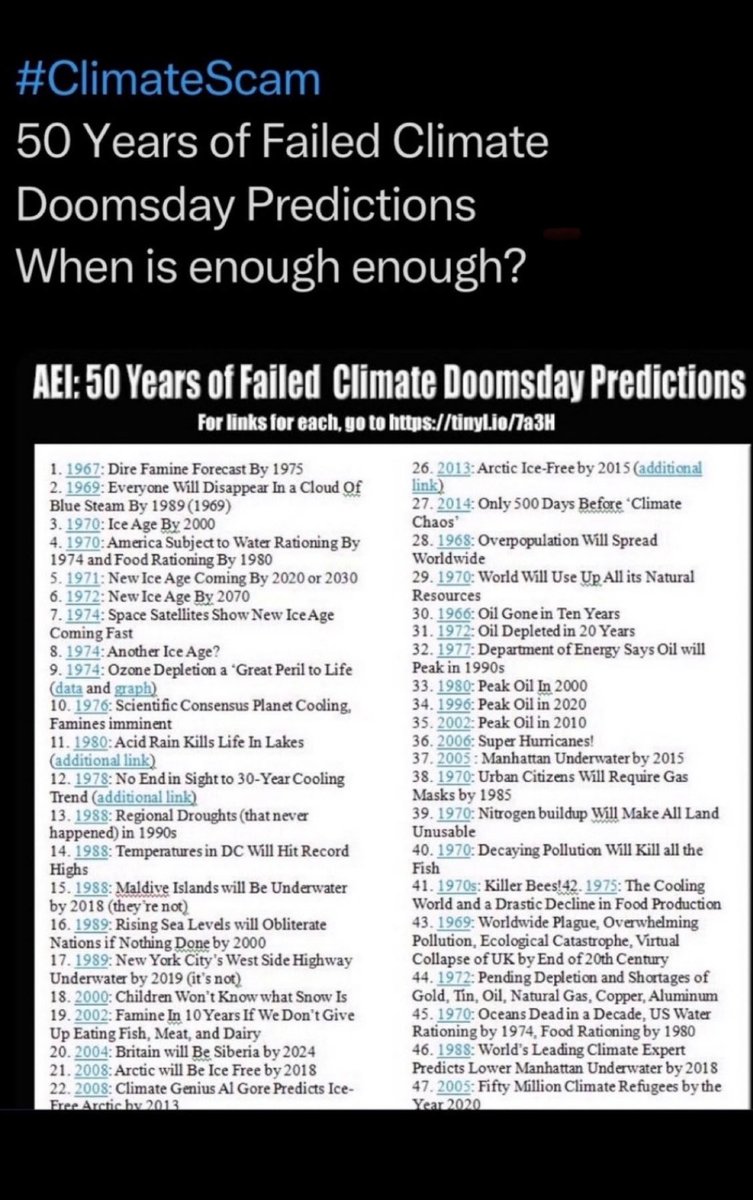
Piers Corbyn: "The policies for controlling climate are not actually about controlling climate, they are about controlling you. Making you pay money and pay taxes, controlling you to do all sorts of things, which is part of a big globalist agenda."
https://t.co/byxEtAQk1Z
https://t.co/XpG8aBGG7a
Climate “experts” at Imperial College, London, say man-made global warming just killed 1,134 people in England & Wales. I studied their “research.” Scientifically, it seems to be rubbish. I invite them to debate me on TV to defend what looks like total nonsense
Westminster has built a country where we spend more money on the planning paperwork for a single road than it costs other nations to build an entire mountain tunnel.
This isn't a system accidentally strangled by red tape: it is a highly lucrative industry. A vast priesthood of consultants and lawyers is making a fortune they have no interest in the work being done.
It is corruption by bureaucracy, and working-class communities are footing the bill for projects that never even see a spade in the ground.
The absolute paralysis of modern Britain was laid bare in a recent parliamentary committee. A single witness gave them the truth with both barrels, exposing the administrative vampires sucking public money dry while the work goes undone. The details are an insult to every community waiting for homes, decent transport, and cheaper energy.
Take the Lower Thames Crossing. The planning application alone has swallowed more than a quarter of a billion pounds. For that exact same amount, Norway actually constructed the world’s longest road tunnel. We spent it on paper, and we have not even turned a sod of earth.
This is a permission state eating itself alive.
Look at HS2, the most expensive railway line on earth. Part of the reason it cost so much is that we are spending £121 million on a specific "bat tunnel" to protect a few hundred bats living in a nearby wood, a wood the line does not even pass through.
Look at Hinkley Point C, the most expensive nuclear power station in human history. For eight years, developers locked in a multi-million-pound wrangle with regulators over installing an underwater "fish disco", an acoustic deterrent to stop fish swimming into the pipes. 20 years ago, we built nuclear fleets at a fraction of the cost. Today, we sacrifice national infrastructure to the gods of endless compliance.
The final absurdity is the plan to reopen just 3.3 miles of an existing railway line between Bristol and Portishead, a route already built but closed during the Beeching cuts. The planning application is 80,000 pages long. Over one thousand of those pages are about bats.
We have created a system that trades in paper while the real economy rots. The working class pay the price for this institutional cowardice. They pay for it in soaring energy bills, missing homes, broken transport links, and a country that cannot build the future it keeps promising.
Protecting the environment is vital, but drowning ourselves in paper is not environmentalism. A system that takes 80,000 pages to clear three miles of existing track is broken. It is not governance: it is managed decline with a clipboard.
It's the bureaucratic vampires drinking the country's wealth...
𝗡𝗲𝘄 𝗪𝗲𝗹𝘀𝗵 𝗧𝗲𝗺𝗽𝗲𝗿𝗮𝘁𝘂𝗿𝗲 𝗥𝗲𝗰𝗼𝗿𝗱 𝗮𝘁 𝗕𝘂𝘁𝗲 𝗣𝗮𝗿𝗸
The Met Office announced a new Welsh temperature record last month at Bute Park, a site they classify as Class 5 junk that can overestimate temperatures by 5C.
It's right next to a plant nursery full of greenhouses and solar panels.
The station is hemmed in by concrete and overgrown vegetation.
WMO rules say such sites should never be used for climate records.
But that didn't stop the Met Office.
Read the full article:
https://t.co/rQdaGzq87N
Offshore wind farms along the storm-swept coasts of the UK are the premature graveyards of corroding steel and plastic skeletons—bowing to the inevitable.
These are the volatile, often freezing seascapes of the windy North Sea, the Baltic Sea and Irish Sea, maritime zones that should provide ideal conditions for large-scale turbine farms - but don't. The wind industry and governments have long based their financial models on a projected 20- to 25-year turbine lifespan. But independent economic analysis reveals a more sobering reality.
The soaring power of the elements is starkly shown in a landmark study by energy and environmental economist Professor Gordon Hughes (University of Edinburgh), first published in 2012 by the Renewable Energy Foundation: 'The Performance of Wind Farms in the United Kingdom and Denmark'.
Hughes’ data reveals the performance of offshore turbines dropped sharply after just 10 to 15 years due to harsh marine wear and tear. As a consequence, their load factors - the volume of electricity generated as a percentage of capacity - decline much faster than the official narratives admit.
Many of these massive marine structures - primarily owned by UK and Danish interests - are hitting the wall after just a decade of buffeting from exposure to relentless Atlantic weather. Soaring maintenance costs make them highly unprofitable.
Specifically, the study showed that an offshore wind farm's ability to meet electricity demand plummeted by at least a third after 10 years. This led to the conclusion that many become fully uneconomic by year 12.
Rather than keeping these assets spinning for the promised quarter-century, many operators are now forced to 'repower' - replacing old turbines with entirely new hardware long before the 25-year target.
Turning the hardware over early is presented as an upgrade to maximise output, but it's really an admission that the original infrastructure simply cannot go the distance.
More importantly, it exposes a large PR gap between marketing and engineering reality.
Link to the study: https://t.co/3rzH6ZU85r