📊 Global Liquidity Rate of Change and #Bitcoin 🚀
When you zoom out 🔎 Bitcoin's rally (on a log scale) gains some context! Is Global Liquidity's increasing rate of change gearing up to propel us even higher? 🔥 #Crypto#BTC#GlobalLiquidity
Crypto in Your SMSF: Key Considerations
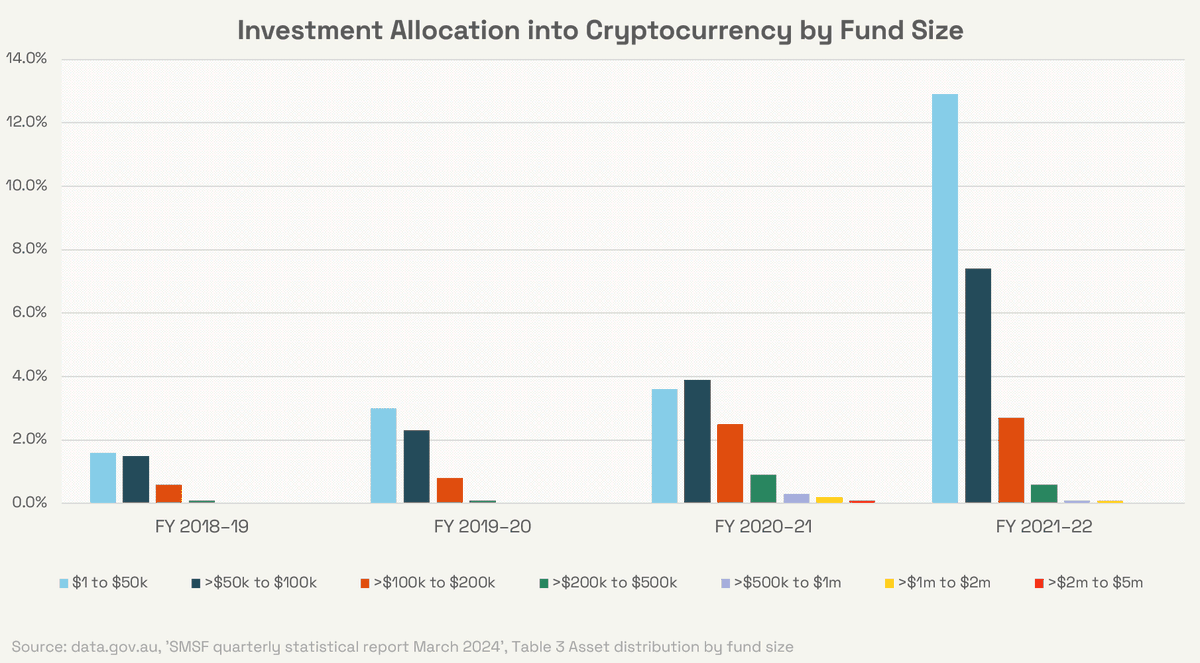
The 2024 financial year saw a near-record number of new Self-Managed Superannuation Fund (SMSF) establishments across several quarters, with 7,836 set up in the September 2023 quarter and 7,371 in the March 2024 quarter. Many of these funds are being created to gain exposure to cryptocurrency as investment narratives gain traction and traditional APRA-regulated funds continue to refuse members access to this asset class. Key factors driving investor interest include the #Bitcoin halving in April 2024, which has historically preceded strong Bitcoin rallies, the launch of Bitcoin and Ethereum ETFs in the US by major global asset managers like BlackRock, which has alleviated regulatory concerns, and the anticipation of interest rate cuts, which typically favour risk-on assets like technology stocks and #cryptocurrencies.
Mat Merlehan, who oversees SMSFs at @TaxOnChain , a specialised accounting firm focusing on cryptocurrency and #digitalassets, has observed substantial new interest from investors wanting to gain exposure to cryptocurrency through their superannuation. Mat says many view this as an opportunity to capitalise on what they believe to be the start of a new market cycle.
@TaxOnChain offers tax and SMSF compliance, forensic accounting, and virtual CFO services tailored to clients in the crypto ecosystem. With their team's expertise in the cryptocurrency landscape and growing interest from investors seeking to gain exposure to crypto through their superannuation, this article provides valuable insights from #Tax On Chain on how to effectively and safely navigate the volatile cryptocurrency markets. Investing in cryptocurrency within a #SMSF offers exciting opportunities but comes with significant responsibilities and risks. As digital assets gain traction as a viable investment class, it's crucial for SMSF trustees to be well-informed about the intricacies of holding crypto. This article explores key considerations for potential investors, covering the importance of understanding the volatile nature of crypto markets, the need for regulatory compliance within SMSFs, and the steps to protect yourself from scams.
What to Consider Before Investing in Crypto
High Risk Tolerance and Volatility: Investing in cryptocurrency demands a high-risk tolerance, as the market is known for its extreme volatility. Prices can swing dramatically in short periods, and investors need to be prepared this volatility so they can remain level-headed and avoid making impulsive decisions.
Understanding Your Investment: Understanding what you’re investing in is crucial so that you have conviction in your choices and investment thesis. This conviction will be invaluable in helping you weather extreme volatility and avoiding panic selling. Moreover, having a deep understanding of your investments also equips you with the knowledge to identify potential scams. By recognising red flags and conducting due diligence, you can protect yourself from fraudulent schemes that prey on uninformed investors.
Use Reputable Exchanges: Opt for reputable crypto exchanges, particularly Australian ones, as they adhere to higher regulatory standards. This can provide added security and assurance that your transactions are handled properly, and assets stored securely.
Self-Custody Safety: If you decide to hold your own crypto, ensure you know how to do so securely. Self-custody requires careful management of private keys and understanding the risks involved, including the potential for loss or theft.
Avoid FOMO: Don’t let the fear of missing out (FOMO) drive investment decisions. Chasing after assets that have already seen significant price appreciation can lead to significant losses. Stay disciplined and avoid impulsive decisions.
Be Patient: It’s worth remembering that money invested through superannuation generally cannot be accessed until retirement age, which is currently between 60 and 65 years of age. Because of this, time horizons for investments in SMSFs tend to be substantially longer compared to personal portfolios. As such, patience is key in cryptocurrency investing. Investors who adopt a simple buy-and-hold strategy tend to outperform those trying to trade based on short-term market movements. Long-term investment tends to yield better results in the volatile crypto space. It also results in substantially lower costs for the administration of the SMSF.
Key Compliance Considerations When Holding Crypto in an SMSF
Trust Deed Compliance: Before investing in cryptocurrency, ensure that your SMSF’s trust deed allows for investments in digital assets. Many SMSFs were established before cryptocurrency became mainstream, so the deed may need to be updated to permit such investments.
Investment Strategy Inclusion: Cryptocurrency must form part of your SMSF's investment strategy. An SMSF investment strategy is a plan that outlines the fund’s investment objectives and how these will be achieved. It must consider factors like risk, return, diversification, and liquidity. Ensuring crypto aligns with these objectives is crucial for regulatory compliance.
Liquidity Considerations: SMSF assets must be valued at market rates as of June 30 each year. Ensure that your crypto investments have sufficient liquidity to justify a market value. Illiquid assets like NFTs and digital art can pose challenges in meeting these valuation requirements.
Proper Documentation for Self-Custody: If you choose to self-custody crypto assets within your SMSF, ensure all wallets designated for the SMSF are properly attributed to the fund through formal documentation and resolutions. This helps in maintaining clear ownership and compliance.
Avoid Commingling of Assets: Commingling of private and SMSF crypto assets is strictly prohibited. Separate exchange accounts and private wallets must be maintained solely for the SMSF, ensuring clear delineation between personal and fund assets. This is essential to meet regulatory standards and avoid potential legal issues and penalties.
Use Exchanges with High Reporting Standards: It’s essential to use cryptocurrency exchanges that adhere to high reporting standards. These platforms offer transparency and accuracy in transaction reporting, which is crucial for verifying and accounting for your SMSF's #crypto transactions. Proper documentation is vital for meeting regulatory requirements and ensuring that all transactions are accurately reflected in your fund's financial records. This not only aids in compliance but also simplifies the auditing process and helps maintain the integrity of your SMSF.
Engage Professionals Who Understand Cryptocurrency: Working with accountants and auditors who understand the crypto landscape and have expertise in navigating its complexities will help keep your compliance costs down. Relying on traditional accountants with little experience in cryptocurrency can lead to excessive accounting fees, as they may charge you for the additional time spent learning how to property account for and verify your crypto transactions. This “on the job learning” can be costly and may still may not provide accurate results.
Cryptocurrency Scams: Avoid Becoming a Victim
Protecting yourself from cryptocurrency scams is crucial in today’s digital landscape. Scammers often target vulnerable investors who have limited understanding of digital assets with promises of high returns, exploiting the allure of cryptocurrency. To safeguard yourself, it's essential to conduct thorough research before making any investments. Ensure the platforms or services you use are reputable and regulated, as this reduces the risk of fraud. Look for warning signs such as unsolicited offers, pressure to invest quickly, and overly complex or obscure investments.
Engaging professionals who are knowledgeable about the cryptocurrency market is another vital step. These experts can help you navigate the complexities of crypto investments, ensuring compliance with regulatory standards and minimising the risk of falling prey to scams. Scammers often exploit a lack of understanding, so having a knowledgeable team can be a strong defence.
Additionally, it’s important to maintain a sceptical mindset when evaluating investment opportunities. Offers that seem too good to be true, particularly those promising guaranteed returns, should be approached with caution. Verify any claims made by doing independent research and seeking advice from trusted professionals.
You can find more detailed information regarding common red flags to look out for on Tax On Chain’s website here - https://t.co/Qcieep7qYq
Closing remarks
As the popularity of cryptocurrency continues to grow, more investors are exploring the potential benefits of including digital assets in their SMSFs. However, this comes with its own set of challenges and risks. Navigating the volatile crypto market requires a high-risk tolerance, a strong investment thesis, and careful compliance with SMSF regulations. By using reputable exchanges, avoiding common pitfalls, and seeking guidance from professionals who specialise in crypto, investors can better position themselves to capitalise on the opportunities while mitigating risks. Ultimately, informed and strategic decision-making is key to safely and effectively managing cryptocurrency investments within an SMSF.
If you are interested in @TaxOnChain's specialised crypto services, you can contact the team directly via their website https://t.co/LsnkPSx4hH
Taking a Closer Look at the Global Liquidity Cycles Since 1970 🕵️🗃️
The ebbs and flows of global liquidity are highly significant when it comes to understanding global markets, leading the way they have responded for more than 50 years.
Let’s take a closer look at the past 11 global liquidity cycles, the driving factors, and consequences, from 1970 onwards.
🪩 1970s 🪩
📉 A sharp drop in global liquidity triggered a period of economic instability which led to the 🔴 U.S. "Nixon Shock" Inflation Crisis where U.S. President Nixon ended the gold standard, resulting in significant inflation.
📈 Policies to recover resulted in a steady rise in global liquidity which led to the 🟢 Global Commodity Price Boom with prices surging on the back of high demand as the Vietnam war was ending and the drive for economic expansion, urbanisation and infrastructure development increased.
📉 Global liquidity plummeted as governments responded to stubborn inflation, exacerbating economic challenges worldwide which led to the 🔴 Global Oil Price Stagflation Crisis as an OPEC oil embargo caused oil prices to spike during a period of weak economic growth, resulting in stagflation (high inflation combined with economic stagnation).
📈 In an attempt to spark economic recovery and growth to offset the persistent inflation pressures, policies shifted back to provide a significant increase in global liquidity, which led to the 🟢 Global Expansionary Fiscal & Monetary Policy Boom as governments and central banks around the world implemented expansionary policies to combat stagflation.
🕹️ 1980s 🕹️
📉As the pressure increased to crush inflation more permanently there was a severe contraction in global liquidity, triggering recessions in various countries, which led to the 🔴 U.S. "Volcker Shock" Inflation Crisis as U.S. Federal Reserve Chairman Paul Volcker raised interest rates significantly to control runaway inflation.
📈 With inflation coming under control the focus turned to increasing global liquidity to encourage more robust economic growth, which led to the 🟢 U.S. Tax Cut & Deregulation Boom as tax cuts and deregulation under the Reagan administration stimulated economic activity.
📉 As global liquidity cyclically decreased it highlighted the fragility of economic conditions in emerging markets and the agricultural sector, which led to the 🔴 Latin American Debt Crisis & U.S. Farms Crisis where several Latin American countries defaulted on their debt, while U.S. farmers faced financial distress.
📈 Another surge in global liquidity was then used to drive economic expansion which led to the 🟢 U.S. "Reaganomics" Boom with continued tax cuts, deregulation, and increased defence spending.
📼 1990s 📼
📉 A significant decline in global liquidity led to the 🔴 Japanese Asset Price Bubble Bust as Japan's real estate and stock market bubbles collapsed, contributing to a period of economic stagnation in Japan known as the "Lost Decade."
📈 A substantial rise in global liquidity, spurring economic growth worldwide, led to the 🟢 Globalisation Boom with increased integration of global markets, facilitated by trade liberalisation and technological advancements.
📉 Global liquidity was contracting into the 🔴 U.S. Savings & Loan Crisis where deregulation and risky investment practices resulted in widespread insolvencies of S&L institutions, ultimately costing taxpayers hundreds of billions of dollars in bailout funds.
📈 With global liquidity back on the rise, the 🟢 Emerging Markets Boom was fuelled by significant foreign investment, economic liberalisation, and rapid industrial growth, particularly in Asian and Latin American countries, resulting in robust economic expansion and increased global trade.
📉 A sharp contraction in global liquidity resulted in economic downturns in many affected regions and led to the 🔴 Asian Financial Crisis where several Asian countries were under immense pressure due to currency devaluations and speculative attacks.
📀 2000s 📀
📈 Policy responses to the prior downturn increased global liquidity in the lead up to the 🟢 Dot-com Bubble where there was a speculative frenzy in Internet related technology stocks.
📉 The following decrease in global liquidity to manage the overheated stock market swiftly led to the 🔴 Dot-com Bubble Bust causing a recession in the early 2000s.
📈 Significant increases in global liquidity, driving economic expansion, led to the 🟢 Global Housing Market Boom where low interest rates and easy credit encouraged property speculation in many countries.
📉 A severe contraction in global liquidity, leading to a deep global recession, commenced in the mid 2000s with 🔴 Initial Global Financial Company Collapses followed by the full-fledged Global Financial Crisis and the collapse of major financial institutions due to subprime mortgage defaults.
📈 The U.S. Federal Reserve implemented Quantitative Easing (QE) to inject liquidity into the economy as a response to the Global Financial Crisis which led to the 🟢 U.S. QE 1 Boom and provided significant aid in the economic recovery.
📱 2010s 📱
📉 A reduction in global liquidity after the initial QE injections resulted in economic challenges for the Eurozone and led to the 🔴 Eurozone Banking Crisis where financial instability was experienced in several European banks due to sovereign debt issues.
📈 A sustained increase in global liquidity, in an effort to support prolonged economic growth, led to the 🟢 U.S. QE 2 & QE 3 Boom where continued Quantitative Easing by the U.S. Federal Reserve buoyed markets and the economy.
📉 A temporary dip in global liquidity led to the 🔴 U.S. Repo Crisis where a sudden spike in overnight lending rates in the U.S. repo market caused panic and was quickly addressed by U.S. Federal Reserve interventions.
🔮 2020s 🔮
📈 An unprecedented increase in global liquidity with massive fiscal stimulus and monetary easing in response to the COVID-19 pandemic led to the 🟢 COVID-19 Boom where markets and the economy experienced a rapid rebound after the initial shock collapse.
📉 The ongoing reduction in global liquidity after the COVID-19 injections, continues to create the potential for economic repercussions and led to the 🔴 U.S. Regional Banking Crisis with financial instability in several U.S. regional banks and the possibility of further issues ahead until global liquidity returns to more robust levels.
Conclusion
The chart illustrates how global liquidity cycles have driven economic booms and crises since 1970. Periods of increased liquidity emerge with accommodative monetary and fiscal policies, technological advancements, and global trade expansion, and lead to economic booms. Conversely, liquidity contractions, triggered by policy tightening after the preceding boom, consistently result in financial crisis. Ultimately each crisis plants the seeds for the next global liquidity driven boom, and so the cycle continues…
⚡📊 FLASH UPDATE: MACRO AND GLOBAL LIQUIDITY ANALYSIS 📊⚡
Global liquidity has gained momentum, increasing by 4.9% on a 3-month annualised basis. This marks an improvement over the previous months, although it remains below the double-digit growth seen earlier in the year. In nominal terms, liquidity rose to reach a new total of US$172.35 trillion. This increase indicates a positive shift in financial conditions globally. The current liquidity cycle, which typically spans 5-6 years from trough to trough, began its upturn in October 2022, making it 19 months into this phase. A decline in the 2nd quarter of 2024 was anticipated due to factors such as tax payments draining money from U.S. markets and the People’s Bank of China (PBoC) tightening policies to support the Renminbi. However, recent data from the Federal Reserve and PBoC show a slight improvement. It is projected that global liquidity will continue to increase through the second half of 2024, with the peak of this cycle expected around late 2025.
The Shadow Monetary Base (SMB), which includes Central Bank liquidity and collateral such as government bonds, is a critical measure of underlying global liquidity. Recently, the SMB has shown a significant rise, driven by increases in both Central Bank liquidity and collateral values. A decrease in bond market volatility has positively impacted the collateral multiplier, enhancing liquidity. The MOVE index, a measure of bond market volatility, has dipped below 90, well below the year-to-date average of 106.
Investor appetite for risk assets globally is improving slightly, but still remains below the year-to-date averages. Notable adjustments have occurred in developed markets, particularly in the U.S. and Japan, with movement away from there in favour of the U.K. For emerging markets risk exposure is increasing, with the significant exception of China, which continues to lag.
Global liquidity measures encompass all sources of cash and credit flowing through world financial markets, including both private sector and Central Bank contributions. In terms of global Central Bank liquidity specifically, it contracted for the fourth consecutive month in April 2024, decreasing by US$335 billion. The year-to-date contraction totals US$1.39 trillion. Developed Market Central Banks collectively drained US$321 billion, while Emerging Market Central Banks withdrew US$14 billion. The contraction in the emerging markets was primarily driven by the People’s Bank of China. Nominal global Central Bank liquidity stands at US$24.9 trillion, down from the Covid-era peak of US$29.1 trillion in 2021. Adjusting for currency movements shows that major non-US Central Banks (excluding China) recorded a small decrease in liquidity, with notable injections from the European Central Bank offsetting reductions from the Bank of Japan, Bank of England, and Swiss National Bank.
Overall, we continue to hold a cautiously optimistic outlook for global liquidity, with a gradual improvement expected to continue through the second half of 2024. The anticipated peak in late 2025 should continue to be preceded by more periods of increasing liquidity, driven by rising Central Bank liquidity, improved collateral values, and reduced market volatility.
——
Simplified Summary:
Global liquidity, which is the amount of money available in the world, has been growing by 4.9% recently, reaching a total of US$172.35 trillion. This growth shows an improvement in financial conditions worldwide, though it is still not as fast as earlier in the year. This upward trend began in October 2022 and is expected to continue, peaking in late 2025.
The Shadow Monetary Base, which includes Central Bank money and assets like government bonds, has also increased significantly. This rise is partly because the bond market has become less volatile, making it easier to use these assets to boost liquidity.
Investors are becoming more willing to take risks in developed markets, and they are showing a growing preference for investing in the U.K. In emerging markets, risk exposure is increasing except for China, which is still lagging behind.
Global Central Bank liquidity, a key part of the overall liquidity, has decreased for the fourth month in a row, totalling a reduction of US$1.39 trillion this year. Despite this, global liquidity is expected to improve through the second half of 2024, driven by better Central Bank liquidity, higher asset values, and lower market volatility.
Until the next flash update, good luck in the markets!
* Note: Global Liquidity data sourced from CrossBorder Capital.
#macro #liquidity #gold #silver #bitcoin
Bitcoin Analysis: Beyond the Block - May 2024
Today the Ainslie Research team brings you the latest monthly update on #Bitcoin – including the Macro fundamentals, market and on-chain technical metrics and all of the other factors currently driving its adoption and price. This summary highlights some of the key charts that were discussed and analysed by our expert panel. We encourage you to watch the video of the presentation in full for the detailed explanations.
Bitcoin and Global Liquidity
Bitcoin is the most directly correlated asset to Global Liquidity. Trading Bitcoin can be thought of as trading the Global Liquidity Cycle, but with an adoption curve that leads to significantly higher highs and lows each cycle. As such we look to buy Bitcoin during the ‘Bust’ phase or liquidity low, then rotate out of it during ‘Late Cycle’ where liquidity is over extended and downside protection is required (our preference is to rotate into #Gold). When correctly timing and structuring the rotation, it is possible to significantly outperform ongoing monetary debasement. The Bitcoin cycle low was in November 2022, and since then the returns have been unmatched by any other major asset.
Where are we currently in the Global Macro Cycle?
A fall in global growth has turned our latest update to the monthly indicator down. While there are calls of stagflation (lower growth, higher inflation) from the macro investing crowd on socials, we believe this is a temporary blip for global growth and expect ‘Mid cycle’ to continue well into the year. The overall trend is still up.
U.S. economic growth, as measured by the ISM data, is a useful tool to forecast the trajectory of the economy moving forward. This month, and going forward, we have included the Services PMI to complement our existing Manufacturing data. While these two PMIs historically track closely, we believe it is important to monitor both for possible divergences in the future.
The slight contraction in both services and manufacturing aligns with the small downturn in our global macro cycles. Though PMIs are currently in a choppy period and the 3 month leading indicator has turned down back to neutral, we expect a return to expansion in Q3 as we approach the U.S. elections and financial conditions continue easing.
Historically, Bitcoin performs well when economic growth turns up. Despite current sideways price action, we maintain that crypto summer is a ‘buy the dip’ period.
💬 BITCOIN ANALYSIS: BEYOND THE BLOCK - MARCH 2024 💬
⬆️📈 Bitcoin 🟢BUY🟢 Signal 📈⬆️
Join @Packin_Sats @IsaacsDevCorner and I as we update you for the month on where we are in the Bitcoin cycle with some expert analysis and discussion. We look at the macro fundamentals, market technicals, and everything else you need to know.
Trade #Bitcoin in Australia with https://t.co/FAox72NL44
💬 BITCOIN ANALYSIS: BEYOND THE BLOCK - FEBRUARY 2024 💬
⬆️📈 Bitcoin 🟢BUY🟢 Signal 📈⬆️
Join @IsaacsDevCorner , @Packin_Sats and I as we update you for the month on where we are in the Bitcoin cycle with some analysis and discussion, looking at the macro fundamentals, market and on-chain technicals and everything else in between.
Trade Bitcoin in Australia with https://t.co/FAox72OiTC
🚨 INCOMING! 🚨
The year's BIGGEST central bank meeting is next week.
On August 24-26, central bankers and economists will come together to decide their future plans for interest rates and monetary policy.
The annual Jackson Hole Economic Symposium, initiated in 1978 serves as a pivotal three-day international conference focused on the goals of central banks globally.
JP Morgan has published several scenarios they deem possible in regard to central bank policy.
It's no surprise that the one causing the most stir is the most negative scenario, in which high inflation is once again used as a reason to re-start the hiking cycle.
Let's explore further in today's article on our website - https://t.co/ukg6EeAbS3
Crypto Weekly Roundup: PayPal, SEC, ETFs
Recent weeks have witnessed consistent $BTC and $ETH market behaviour, marked by suppressed short-term volatility.
The current trading environment, shaped by technical dynamics such as delta hedging and the ongoing deliberation by the SEC regarding spot ETF decisions, is crucial for understanding potential market fluctuations.
Lets explore further in today's crypto news on our website - https://t.co/o2LbemE12x
Today, we delve into an unfolding financial narrative that's gripping global economies.
The recent credit downgrades of 16 banks and China's startling economic slump.
🎉🎈Happy 2nd Birthday to our Melbourne store! 🎈🎉
Two years ago, we opened our doors in the heart of Melbourne, aiming to provide the same level of security, comfort, and top-notch service our clients have come to expect from us.
We're incredibly grateful for the support we've received from our Melbourne customers. Your trust in us has allowed us to grow and continue to provide you with the best in bullion trading and education.
Here's to many more years of serving you in Melbourne! If you're in the area, why not drop by and say hello? We'd love to see you.
Cheers, The Ainslie Bullion Team
Did you know… #Gold and silver bullion are allowable assets in your SMSF.
By placing a percentage of your Self-Managed Superannuation Fund (SMSF) investment in real, physical gold and #silver bullion you are balancing your risks.
👉 Learn more: https://t.co/NBvQN2qViE