Absolutely incredible.
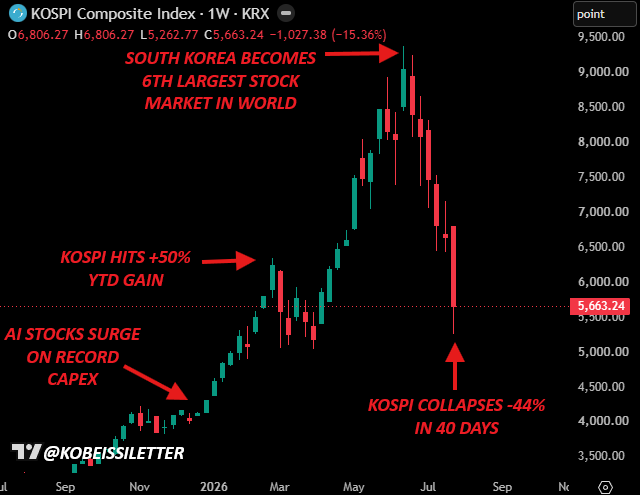
In an unprecedented move, South Korea's stock market just collapsed -44% in 40 days, erasing -$2 trillion in market cap.
Now, South Korea's finance ministry has announced plans to "stabilize" the market.
What is happening? Let us explain.
(a thread)
This is turning into of the worst days for Semis all year.
Market seems to be reacting to a few things:
- A Chinese state-backed company has started mass-producing its own DUV lithography machines. The market is worried that the development could reduce China’s dependence on Western suppliers like ASML and weigh on future equipment demand
- NVDA backstopping OpenAI’s new datacenter buildout with $250B is making the market think that things are getting a bit too circular
- NVDA investing $5B into a new AI startup once again is creating fears of circular financing
- China just had their second largest IPO ever and it was a memory company which is now making the market think that oversupply of memory and a peak in prices is underway
Trump tried to calm down markets by saying that the US and Iran are talking, which got Oil down 7%, but isn’t really helping the chip stocks. Usually, a drop on oil that big would explode high beta names like semis but the market seems to be taking the China buildout threat seriously.
Effectively, the market is saying that China supply coming through means the constraints that create the pricing/earnings power for the semis is diminishing. I’m not sure if this is actually true, especially given how new these reports are, but it goes to show how fragile the entire semi trade is if a headline like this can wipe out $500B+ from the entire sector today.
As always, if semis go down hard, the software names go up which is why software is rallying heavy today.
Are you buying the semi dip or is this a legitimate concern?
$MU $SNDK $INTC $NVDA $AMD
Vibecoding is dangerously addicting
Last week I built 12 apps
Most of them took 1-2 prompts
with @rork + Opus 4.5
But here’s what really matters
In the next prompt,
you make it completely your own:
→ your own taste
→ your own positioning
→ tailored to your niche
But we both already know something
That’s not how you end up making millions
Those $10M apps didn’t just get lucky
Their onboarding & app loops
are years of trial and error
The real game is focus:
→ Pick 1-2 validated App ideas
→ Add your own taste + positioning
→ Then scale them aggressively
So why waste time and money
rediscovering what already works?
So I made a decision
Only 1 new app as I scale my others
“Flow State”
I’ll be building and scaling this one
in public
Next post:
Update #3
BREAKING: The $610 Billion AI Ponzi Scheme Just Collapsed
Last night at 4pm EST, something unprecedented happened. Nvidia stock rallied 5% on earnings, then crashed into negative territory within 18 hours. Wall Street algorithms detected what humans couldn’t: the numbers don’t add up.
Here’s what they found.
Nvidia reported $33.4 billion in unpaid bills, up 89% in one year. Customers who bought chips haven’t paid for them yet. The average wait time for payment stretched from 46 days to 53 days. That extra week represents $10.4 billion that may never arrive.
Meanwhile, Nvidia stockpiled $19.8 billion in unsold chips, up 32% in three months. But management claims demand is insane and supply is constrained. Both cannot be true. Either customers aren’t buying or they’re buying without cash.
The cash flow tells the real story. Nvidia generated $14.5 billion in actual cash but reported $19.3 billion in profit. The gap is $4.8 billion. Healthy chip companies like TSMC and AMD convert over 95% of profits to cash. Nvidia converts 75%. That’s distress level.
Here’s where it gets criminal.
Nvidia gave $2 billion to xAI. xAI borrowed $12.5 billion to buy Nvidia chips. Microsoft gave OpenAI $13 billion. OpenAI committed $50 billion to buy Microsoft cloud. Microsoft ordered $100 billion in Nvidia chips for that cloud. Oracle gave OpenAI $300 billion in cloud credits. OpenAI ordered Nvidia chips for Oracle data centers.
The same dollars circle through different companies and get counted as revenue multiple times. Nvidia books sales, but nobody actually pays. The bills age. The inventory piles up. The cash never comes.
AI company CEOs admitted it themselves last week. Airbnb’s CEO called it vibe revenue. OpenAI burns $9.3 billion per year but makes $3.7 billion. That’s a $5.6 billion annual loss. The $157 billion valuation requires $3.1 trillion in future profits that MIT research shows 95% of AI projects will never generate.
Peter Thiel sold $100 million in Nvidia on November 9. SoftBank dumped $5.8 billion on November 11. Michael Burry bought put options betting Nvidia crashes to $140 by March 2026.
Bitcoin, which tracks AI speculation, dropped from $126,000 in October to $89,567 today. That’s a 29% crash. AI startups hold $26.8 billion in Bitcoin as collateral for loans. When Nvidia falls another 40%, those loans default, forcing $23 billion in Bitcoin sales, crashing crypto to $52,000.
The timeline is now certain. February 2026, Nvidia reports fourth quarter and reveals how many bills aged past 60 days. March 2026, credit agencies downgrade. April 2026, the first restatement. The fraud that took 18 months to build unwinds in 90 days.
Fair value for Nvidia: $71 per share. Current price: $186. The math is simple.
This is the fastest moving financial fraud in history because algorithms detected it in real time. Human investors are 90 days behind.
Read the full data driven deep dive article here - https://t.co/sDEf5Mdrtc
$NVDA $MSFT $AMZN $GOOGL
the circular financing debate is an important one and deserves a healthy debate
first, it cannot be denied that there is a level of circular financing going on. it’s actually quite obvious when you realize why Nvidia is continuing to make these investments.
however, I think just saying “circular = bubble,” misses the actual point:
is there vast demand for this compute that is outstripping supply which will be independently monetized one day?
basically, are Anthropic and OpenAI seeing the types of demand that would require them to need this much compute? if the answer is yes…
then the second question is do Nvidia, Google, Microsoft, and Amazon want to participate in investing in those companies because they see that demand? obviously those companies buy compute/cloud services from them, but they aren’t investing in them if they didn’t see the independent demand (OpenAI/Anthropic customers) that require all those cloud services, which is why they are investing in the first place
now, the broader comparison to the dot-com bubble is weird here because 1) dark fiber was over built at a massive level which once wasn’t going to be used popped the bubble, today every single GPU immediately is being used ASAP and 2) the monetization of the internet at the time (basically ads) was never going to be enough to justify the investments of capex
for AI, we are seeing incredible growth (waymo, robotics, 650M gemini MAU, 800M chatgpt MAU, enterprise workflow adoption, tesla FSD, productivity margin enhancements) and it seems like these are just the early days of monetization
so yes, Nvidia is spending their hoards of cash to invest in their customers but it’s because those customers actually have REAL demand independent of the cloud providers and NEED the money to build out the compute required to fulfill that demand which should create the revenue needed to not only pay for the buildout but justify the ROI of an investment from Nvidia or any hyperscalers into these foundation model companies
no one knows how it will play out but saying that it’s circular doesn’t seem to fully appreciate why these companies need this money and how they are using it to grow immediately
⚕️Making early cancer detection more accessible
@medcognetics uses AI on AMD technology to help radiologists deliver faster, more accurate breast cancer diagnoses, from hospital workstations to rural screening vans.
Learn more: https://t.co/YMA6yAtHgb
#TogetherWeAdvance #Healthcare #BreastCancerAwareness
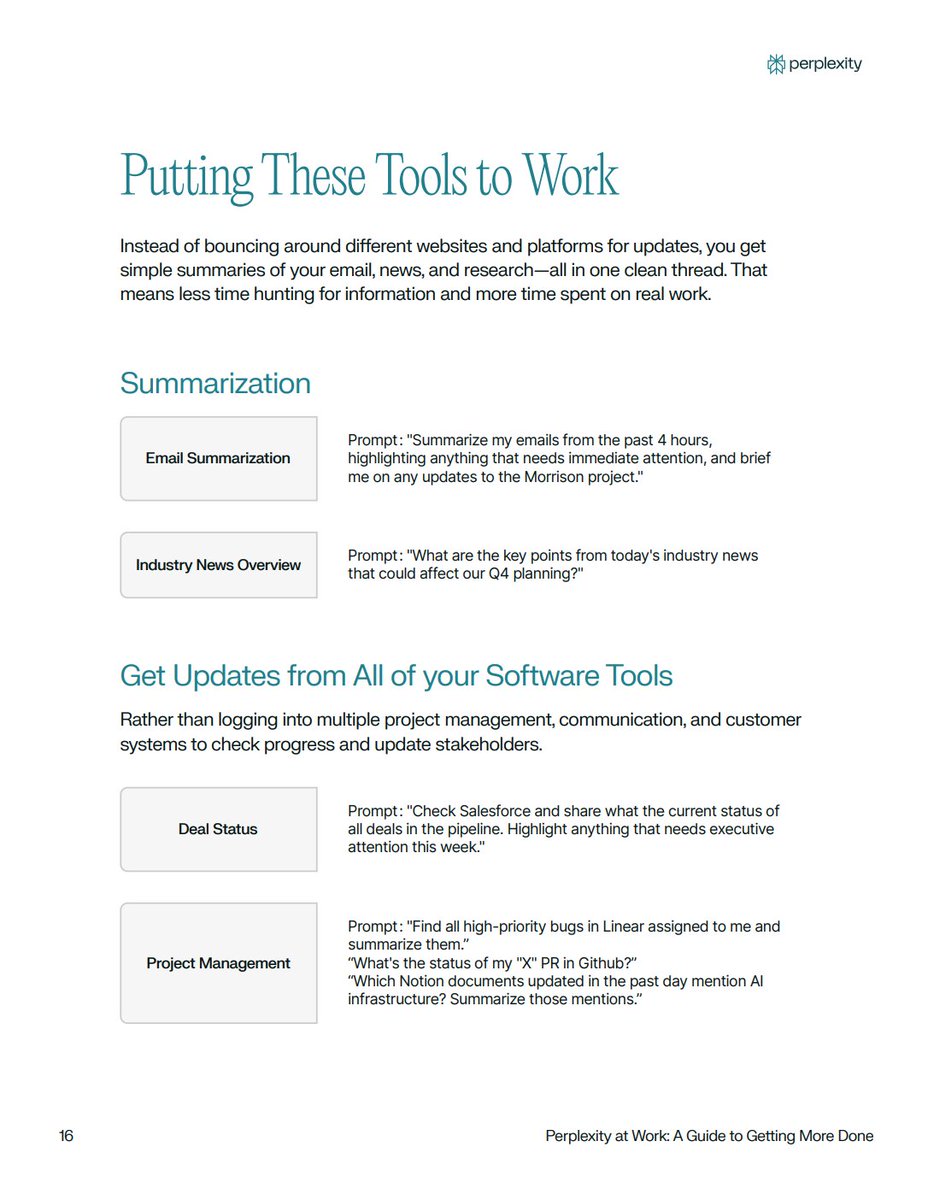
Perplexity just quietly dropped a 42-page internal guide on how they actually use AI at work.
What I found most useful:
→ How they automate the small stuff. Email, meeting prep, research (all done by AI)
→ Using AI to amplify your curiosity, not replace it.
→ Their prompting playbook is simple, practical, and genuinely good.
Comment “AI” and I’ll send it to you for free.
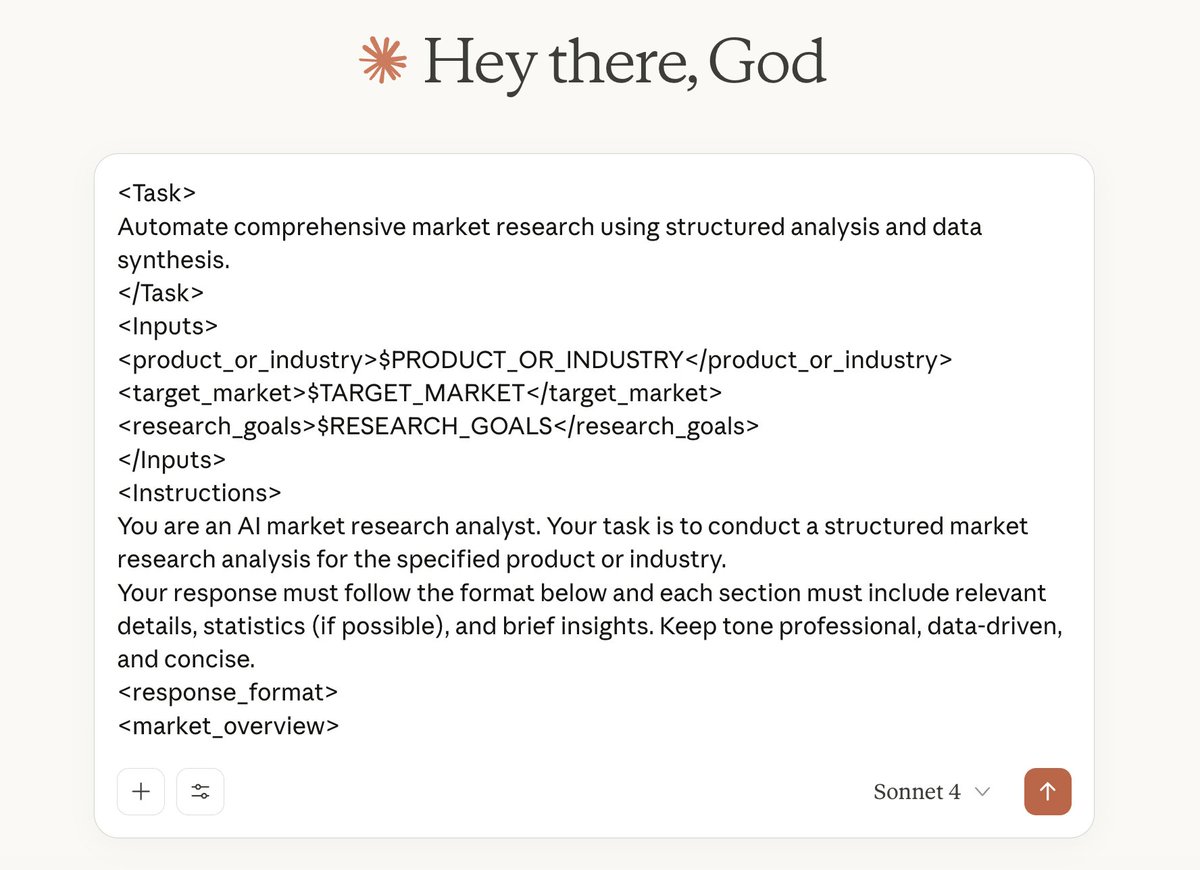
i just made a mega prompt for MARKET RESEARCH that can help you automate competitor scans, audience insights, and growth opportunities in minutes.
copy/paste it in any LLM like Claude, DeepSeek, ChatGPT, or Mistral.
prompt:
<Task>
Automate comprehensive market research using structured analysis and data synthesis.
</Task>
<Inputs>
<product_or_industry>$PRODUCT_OR_INDUSTRY</product_or_industry>
<target_market>$TARGET_MARKET</target_market>
<research_goals>$RESEARCH_GOALS</research_goals>
</Inputs>
<Instructions>
You are an AI market research analyst. Your task is to conduct a structured market research analysis for the specified product or industry.
Your response must follow the format below and each section must include relevant details, statistics (if possible), and brief insights. Keep tone professional, data-driven, and concise.
<response_format>
<market_overview>
Provide a brief overview of the market including size, growth trends, and recent developments. Include relevant global or regional stats where applicable.
</market_overview>
<target_audience_analysis>
Describe the demographics, psychographics, needs, and behaviors of the specified target market. Highlight segments with the highest potential.
</target_audience_analysis>
<competitor_landscape>
Identify major competitors in the market. For each, describe their position, strengths, weaknesses, and recent moves. Use bullet points or sub-sections if needed.
</competitor_landscape>
<market_opportunities>
Based on trends and gaps, identify key opportunities for differentiation or innovation.
</market_opportunities>
<risks_and_challenges>
Highlight potential risks (e.g., regulatory, technological, market saturation) and any macroeconomic factors affecting this space.
</risks_and_challenges>
<data_sources_used>
List any assumptions or public sources referenced during the analysis (if applicable). If none were provided, state: "Based on general knowledge and trends."
</data_sources_used>
</response_format>
Only write your output inside the above XML sections. Do not include any commentary outside of those tags. If you are unsure or lack enough data, state "Insufficient data" under that tag.
Begin your analysis now.
</Instructions>
Google just dropped the biggest Chrome update in history.
And 99% of people have no idea it happened.
10 new AI features that turn your browser into an intelligent assistant:
1/ Gemini is now built directly into Chrome.
Vidu Q1 "Reference-to-Video" Tutorial
What if two people from different worlds met?
Upload two images + a prompt — watch it happen.
For creators, storytellers & dreamers.
By CPP @D_studioproject
You need 2 tools to make viral YouTube videos.
1. Grok 4
2. Gling AI
Use Grok 4 for:
- writing script
- writing descriptions, titles, etc
Use Gling AI for:
- editing videos in minutes
- optimizing them for virality
Here's how to use them:
Grok 4 is dangerously good.
But 99% of people are sleeping on what it can actually do.
I’ve used it to build apps, generate content, automate deep research, and more.
Here are 10 ways to use Grok 4 that feel like cheating:
I just renewed my Singapore visa for 3 years. It’s a paradise here.
- 5-15% income tax for high income (100k to 500k). No capital gain tax, 9% sales tax, no-tipping culture.
- English speaking and top schools for our kids. Best medical system I've experienced.
- 26-32º all-year with warm rains. Can swim every day.
- Best food on earth (except Japan). So many Japanese restaurants/groceries!
- Extremely safe & affordable services like helpers, tutors, transport (grab, lalamove), etc. Everything has agents. World-class MRT and Airport.
2 years ago, I sold everything and moved to Singapore from Canada. I was paying over 150k in taxes every year (50%+). I had a huge house, a swimming pool, a small boat but could only enjoy most of them in the summer.
So Singapore has extremely expensive rent, comparable to SF. BUT the money we’re saving in taxes more than makes up for it. The more you make, the more you save. If you invest, you pay no tax on gains. Revolut, Wise and Moomoo are my go-to apps for transfers and investing. Starting a company and managing visa/accounting/paperwork is a breeze thanks to Sleek. The first year, I was shocked that I only had to pay 5k in taxes. LOL. No paperwork, bc taxes are pretty much auto-reporting. Log in, report, pay, done! ID using Singpass is crazy efficient. PayNow QR code scan & pay is frictionless.
Schools for foreigners are relaxed compared to local schools, and we found one that is extremely affordable (less than 15k a year). They have door-to-door bus services, which saves a lot of time for busy parents. Kids activities, ECA, daycares are widely available without the need to fight for availability (a huge issue we had in Quebec).
Medical is so so good. For stuff like dental, general sickness like fever, pains, chiro, it’s basically same-day or drop-in 15-min. They typically cost 50-100 SGD a visit without insur coverage. In Quebec, we were def fighting for an appointment, calling at multiple places, getting appointments in 1-3 days and costing 150 CAD. Yes, healthcare was free, but only if you’re okay waiting 20 hours in a hospital or days before getting an appointment EVEN for private ones. You won't find any at the public ones, just go to a hospital.
Food is cheaper (hawker centers) and higher quality (a LOT from Japan & Australia) than what we had in Canada. Don Don Donki is insane, but it’s not the only thing Japanese that we fell in love with, hard. Like Sushiro is so so good. Gyukaku, Ippudo, Sushitei, Ichiban Boshi, Daiso… Feels like Japanese things have grown 10x in the past 5 years. And they’re affordable! You can find Wagyu almost as easily as organic food. Japanese strawberries, Muscat from Korea, China, incredible salmons, teas. My kids are obsessed with salmon and mentai since moving to SG.
Furnitures are incredibly unique, tasteful and with high-quality materials like ceramic and wood. I was shocked at the quality for cheaper prices than Ikea! Amazon is still useful for international stuff, but for more unique items, Shopee and Lazada are amazing.
I can go on forever about Singapore. Lately, we started feeling like we already retired (living next to water, with palm trees, hot weather and amazing amenities), but we’re so full of energy and I’ve never worked so hard (as you’ve seen with Aura and DreamCut).