Newly published in @GlobalChangeBio, we look within seeds of historic herbarium specimens for changes in the prevalence of beneficial fungal symbionts in response to climate change drivers. https://t.co/LmpKgKQgGk
I feel really fortunate to have had mentors who have helped me and supported the "slow science" I needed to make something meaningful. There's lots more I could say, but I have to go water a greenhouse.
How do microbial symbionts affect host responses to environmental variability?
Our new publication in @Ecology_Letters answers this question using amazing long-term data for grasses and their fungal symbionts. -> https://t.co/cIU1ux4hCb
This article has been a long time in the making, including fourteen years of field data and over 16000 plants. I started working on this during my first semester as a PhD student.
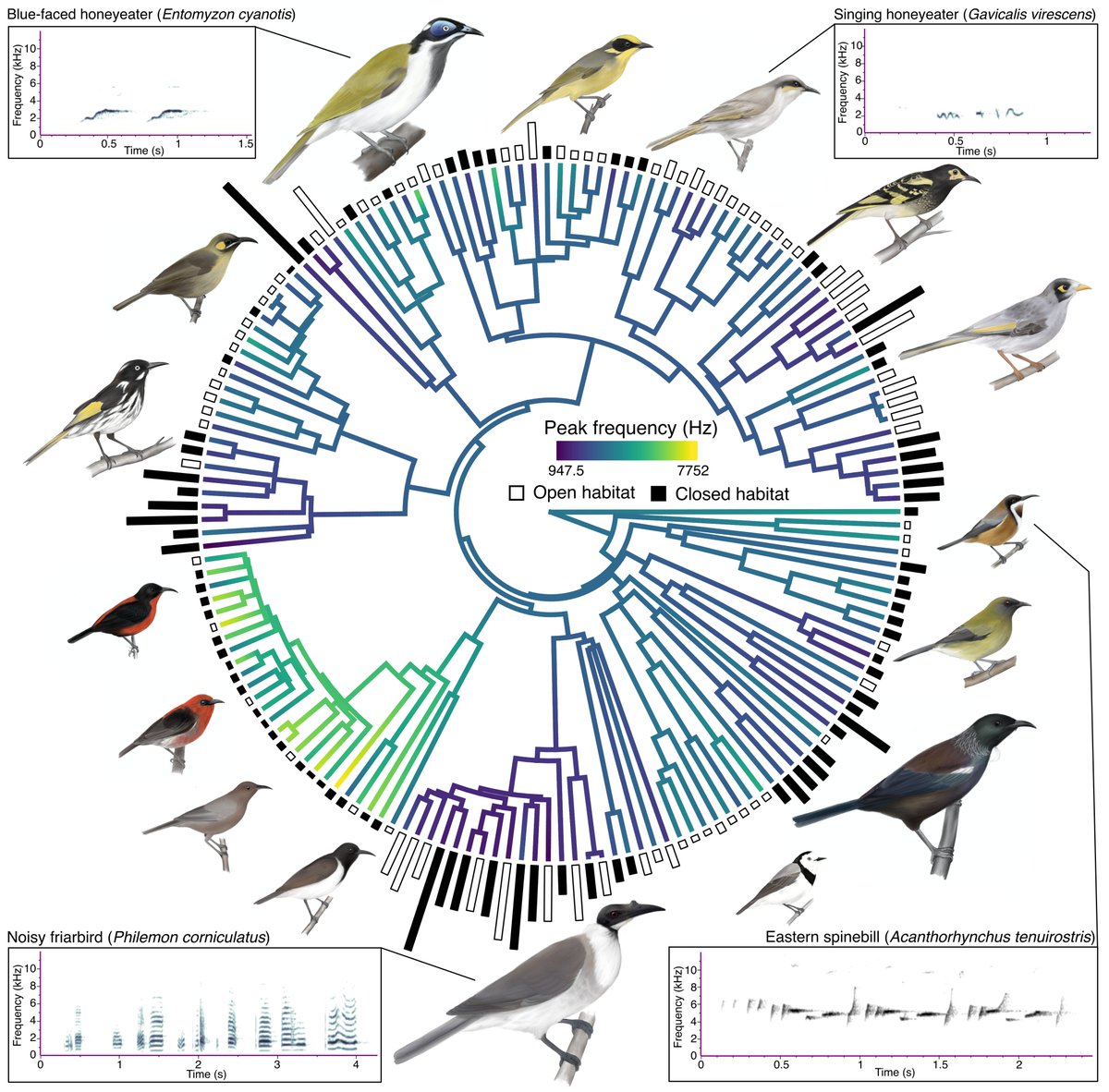
Our new paper is now out in #ProcB! We explored the drivers of song evolution across honeyeaters, focusing on the morphological constraint and acoustic adaptation hypotheses. @Chownlab@MonashBiol
Check out the paper here: https://t.co/hqxGD2S5pC
Our latest TEAM Network work just came out!
By applying TEAM Network camera-trap dataset, we unraveled how evolutionary history and environmental variability can shape ground-dwelling mammal and bird diversity across worldwide tropical rainforests.
https://t.co/hDpBGl8Tu7
How does selection from environmental gradients influence the eco-evo dynamics of range expansions? With @rangelimits, we use the experimental evolution of duckweeds to test some theoretical predictions on expansion speed. Out now in @Ecology_Letters!
https://t.co/px39VYMDRR
Really nice review by our neighbors at @RiceUniversity on how mutualists influence species’ range limits
https://t.co/ESXvV09o0k
congrats @joshuacfowler@MarionLDonald @OtherTomMiller!
And thanks to my co-authors (@MarionLDonald, Judie Bronstein, and @OtherTomMiller) for making this work possible, and teaching me so much along the way!
How do mutualists influence species' range limits?
For the first research out of my PhD, we reviewed studies addressing this question. Even though many focus on abiotic and negative biotic interactions as drivers of range limits, mutualists leave an underappreciated footprint.
What I hope is useful is organizing common mechanisms by which all types of mutualism can impact their partner's demography. Better understanding of the mechanisms driving range dynamics will hopefully improve our ability to predict how species will move with climate change.