I'm going to disable this post in 48 hrs...
Because I just dropped the #1 strategy to take any ecom brand to $30,000+ days with the SAME product.
This is the exact DESIRE framework we use to scale multiple brands from $1,000/day to $30,000/day and onwards.
We charge $10,000/mo to do this for our clients…
But today, I'm giving it away 100% FREE.
Like + Comment "DESIRE" and I'll send it to you.
McDonald's isn't a burger company.
It's a real estate empire that uses burgers to finance the land underneath every store. Ray Kroc said it himself in 1974: "We are not technically in the food business. We are in the real estate business."
This is the same mechanism every $5M+ ecom brand is sleeping on right now.
Your front-end product isn't the business. It's the customer acquisition vehicle. The business is the recurring revenue stack that lives behind it — subscription, replenishment, retention infrastructure.
Most $1M brands optimize the burger. The brands compounding past $5M optimize the land. They'll run breakeven front-end ads on purpose because they've engineered the back end to print on the second, third, and fourth purchase.
I spent 18 months trying to perfect a hero product in one of our brands. Problem was I'd never built the land underneath it.
Stop trying to make a better burger. Start buying the land.
Since I started spending 5-10 mins every morning thanking God for every little thing good that happened the previous day and praying over people around me, everyday has been such a big WIN. Little things don't even bother me anymore like they used to and stress has been at an all time low. More and more good things keep happening for me. Biggest personal development thing i've introduced in the last 2 months.
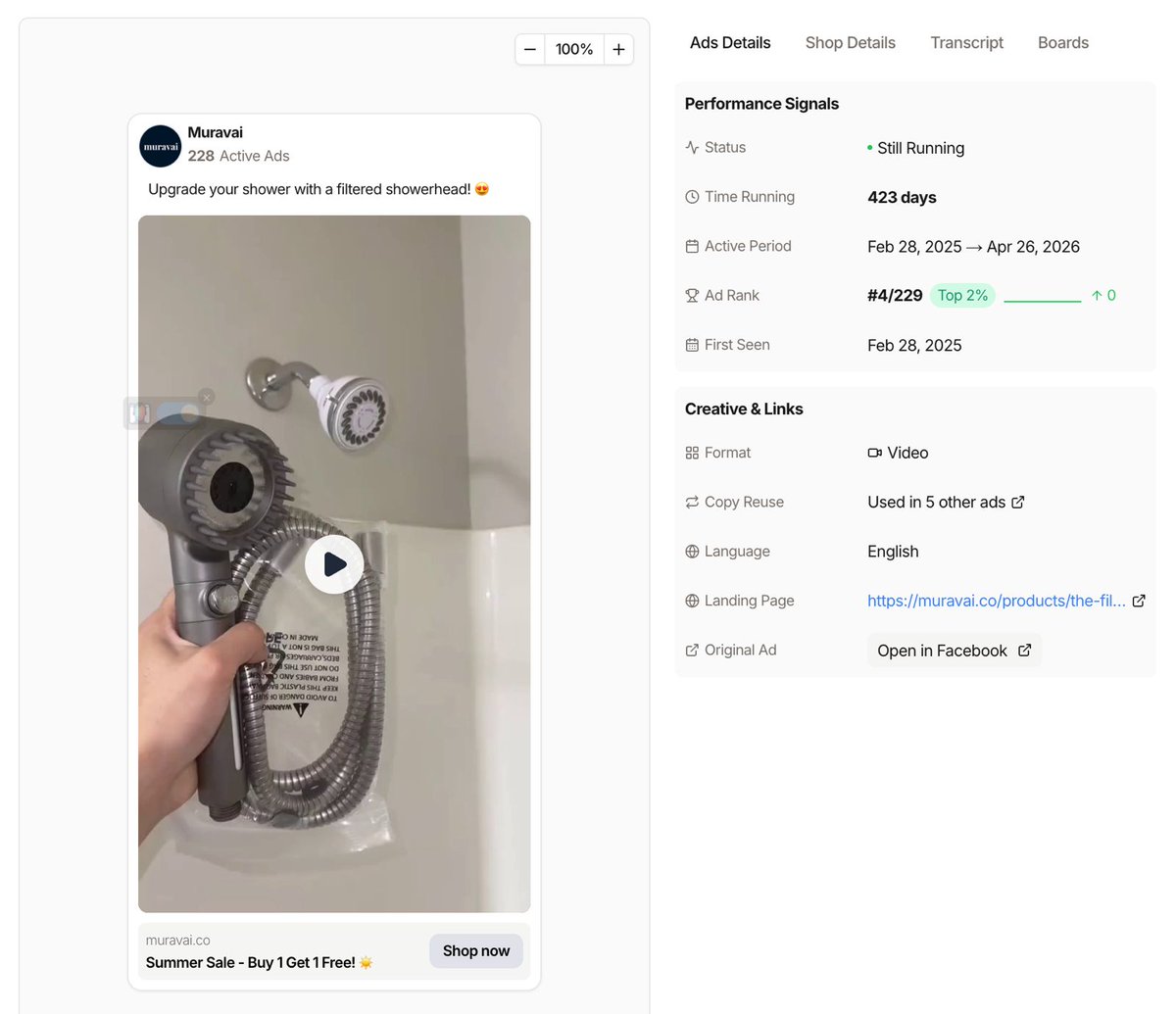
This hand-held first-person shower head install video ad has been printing for months as their #4 top-performing ad because it took a boring invisible upgrade (water pressure) and turned it into a visible before/after transformation you can't unsee.
Plus the fact that it's still scaling in the home goods space (which is low-margin, high-competition, commoditized as hell) tells me the underlying psychology is so dialed in that the algorithm just keeps feeding it new audiences without burning out.
Initially, the hook removes all friction immediately.
"Today I'm gonna be installing the viral high pressure shower head"
Unlike "check out this cool product" bullshit, this ad is solving the entire purchase anxiety most home upgrade brands suffer from in just 3 seconds with the installing angle.
These guys made it look like anyone can install it in 30 seconds.
The people who see this hook are:
- Already frustrated with weak water pressure
- Already aware their current shower sucks
- Already looking for a solution but hesitant to install something new
If you've ever stood under a weak stream contemplating why you're putting up with this, you're stopping your scroll right here.
This is textbook solution-aware messaging for a BORING problem, which is the hardest thing to pull off in home goods.
Then, they do something most brands are too scared to try.
They show the contrast so brutally simple your brain does the math for you.
Weak stream ❌
Powerful spray ✅
This works well as it's:
- Visual (you SEE the difference, not told about it)
- Instant (happens in under 10 seconds)
- Undeniable (the contrast creates belief, not persuasion)
This is the "show don't tell" framework executed at the highest level, that builds insane trust before you've even seen the product features.
It also introduces escalating value stacking.
• Built-in scalp massager.
• Transparent water filtration.
• Three spray settings.
• Matte gunmetal finish.
• One-thumb pause button.
This is the epiphany loop.
You're buying a multi-functional upgrade system that keeps revealing "oh it also does THIS?" instead of some random shower-head.
That's how you escape the commoditized bathroom hardware trap.
Another thing is the features are shown as ACTIONS, not bullet points.
⦁ Scalp massager physically massages your head in real-time
⦁ Water filter visibly traps sediment through transparent chamber
⦁ Spray modes switch instantly with one-hand control
⦁ Pause button clicks mid-shower without reaching for knobs
Instead of just listing "massage function" and "filtration system" like every other shower head brand, these guys are SHOWING the features doing the work.
When you watch the transparent filter catching sediment in real-time, your brain stops asking "does this work?" and starts asking "where do I buy this?"
This is also why the retention rates on this video are crushing.
Every 2-3 seconds there's a new reveal, a new feature, a new spray mode switch.
Your dopamine doesn't have time to drop.
You can't scroll because you want to see what else it does.
Then they drop a sniper-level friction removal.
"Simple plug-and-play installation shown without complexity."
This is dog-whistle objection handling.
When you show someone how easy installation actually is better than they imagined it, their brain automatically assumes the hard part is already solved.
Another upside is, the feature order is engineered for trust escalation.
⦁ Pressure first (main benefit, gets you watching)
⦁ Scalp massager second (comfort upgrade, emotional hook)
⦁ Water filter third (health reassurance, safety signal)
⦁ Spray modes fourth (control, personalization, versatility)
By the time you see the fourth feature, every trust barrier has been pre-handled inside the creative itself.
That's why the conversion rate stays high.
It's built for cold traffic too.
This ad works on people who've never heard of Muravai because:
⦁ Visualizes a problem they experience daily (weak pressure)
⦁ Shows transformation instantly (before/after in 10 seconds)
⦁ Introduces escalating value they didn't expect (massage, filter, modes)
⦁ Proves ease of installation without saying a word
That's why it scales without burning out.
So what should you steal from this?
If you're selling home goods, bathroom hardware, or any physical upgrade product:
- Personify the transformation (before/after contrast so obvious it's undeniable)
- Show installation without complexity (remove the "this might be hard" objection in 2 seconds)
- Introduce escalating feature value (each new feature increases justification after they're already interested)
- Show features as ACTIONS, not specs (massager massaging, filter filtering, modes switching)
- Use hand-held first-person perspective (puts them in the experience before they own it)
- Stack trust signals through feature order (performance → comfort → safety → control)
- Build retention with reveals every 2-3 seconds (new feature, new mode, new angle)
- Stop running boring "professional installer" creative
If your home goods ads are still showing stock footage of pristine bathrooms with text overlays listing features, you're getting destroyed by ads like this that turn a boring upgrade into a visible transformation with escalating value reveals.
This ad works because it doesn't sell a shower head.
It sells a story where weak water pressure was the villain, and replacing it takes 30 seconds and gives you 5 upgrades you didn't know you needed.
That's why it's been their #4 top converting ad for months.
More Eastern European markets printing for ecom brands.
Last week I covered Czech Republic and Slovakia. Now: Hungary.
10 million people. Growing supplement and skincare market. Meta CPMs at $2-4.
Found a brand called Nira scaling on Meta in Hungary right now. Hungarian-language ads, localized landing page, the full direct response playbook.
Here's what I'm noticing about Eastern Europe in general:
The CPMs are 40-60% lower than Western Europe. The audiences are younger on average. Health and wellness spending is accelerating fast as these economies grow.
And the number of Western DTC brands competing for attention? Single digits in most niches.
Hungary specifically has one brutal advantage for whoever gets there first:
Hungarian is a unique language. Not related to any neighboring language. Not related to German, Czech, or anything Slavic. Which means brands that take the time to translate properly face almost zero copycat competition. Nobody is going to casually "also launch in Hungary" — you have to intentionally decide to go there.
That linguistic moat is real. The brands that invest in proper Hungarian translation own the market by default.
Setup cost: $1,500-$2,500 for translation, localized creatives, and payment integration. Fulfillment through any EU 3PL.
Hungary alone won't make you rich. But Hungary + Czech Republic + Slovakia + Poland as an Eastern European bloc? That's 70+ million people at CPMs that make your US ad account feel like a scam.
If you're Hungarian or have connections to Budapest — you're literally sitting on a market that nobody in the Western DTC space is touching. Lock it down before someone else does.
I always do 3 angles per ad account:
1. Problem-aware
2. Competitor-aware
3. Product-aware
1st one gets clicks from cold audience.
2nd one steals their customers.
3rd one retargets warm traffic.
That’s the only creative strategy you need.
Bookmark this.
hiring a copywriter
you'll work next to me
40 hours a week
30 min lunch break and 2 x 15 min breaks
phone and laptop not allowed in office
you'll get a clock to know when it's time to break
you'll get a stack of paper and a set of g2 pens
you will write headlines for me 4 hours straight in the morning
after lunch you'll write copy for me 4 hours straight
starting pay $10 an hour
dm me 50 reasons why i should hire you
The biggest waste of time in modern media buying?
Trying to manually control ad-level budget allocation.
I see so many advertisers punishing their high-spend ads because the CPA (or worse, CPM or CPC lol) is higher than other ads 🤦♂️
1. Ad-level CPA and ROAS is irrelevant!
The system isn't trying to get you the best CPA on every individual ad, it's trying to get you the most possible conversions for your overall budget.
It might spend more on ad A with a higher CPA so that ad B (and C, D, E, F, etc) can have lower CPAs, lowering the overall ad set, campaign, and account CPA.
This is the breakdown effect in action.
2. The more you spend on an ad, the worse CPA is going to be.
3. The ads that get the most spend are the ones most likely to wear the scars of other/external performance shifts. Don't punish them for it.
4. The system already handles all of this for you! Stop worrying about ad level budget allocation, the system handles that better than any human can because the system has black box data that humans don't.
5. You're better off spending your time doing more qualitative and empathetic analysis on ads to see things like negative comments piling up on ads, and consider pruning comments and/or recreating the ad fresh, or iterating on it.
Focus on the creative quality. Let the system focus on the delivery quantity.
I've spent almost $1 billion advertising on FB since '08 and this is something I see advertisers getting wrong all the time:
🛑 Stop focusing on FB CPMs (and CPCs)! They don't matter that much.
❌ Turning off ads due to high CPCs or CPMs can be turning off top performers.
🧵👇
Here are the top performing formats in our ad accounts right now:
1. "David & Goliath" videos
2. AI Animation Videos
3. TikTok Love Letters
4. Native Reels
5. "We’re Not Cheap" videos
6. Listicles videos
7. Yapper ads with creators
Everyone talks about learning from ads, but the real magic happens when you know how to do a proper breakdown
one that actually extracts meaningful insights you can apply
Figure out what you want.
Ignore the opinions of others.
Do so much work it would be unreasonable that you fail.
Realize it never mattered to begin with.
Help others once you get there.
Turn Claude into the best creative agent in the world!
Our users generate over 1 billion images and videos every year.
Now Claude can too.
RT and comment "Pixa" for free access!
10. Why This Works (Let Facebook Choose the Winner)
You don't know which visual will perform best.
I don't know which visual will perform best.
Facebook DOES.
So we give it options.
Same message. Different packaging.
Let the algorithm decide.
How to create fresh angles when your ads stop converting:
1. Identify 1 symptom (ex: CTR dropped 50% in 2 weeks)
2. Flip it 5 ways (market sophistication, ad fatigue, algorithm shift, new competitors, offer dilution)
3. Write 3 counter-attacks per problem (new stage of awareness, new angle, new creative style)
4. Add 2 desire levers (desire-first vs problem-first, new pain points)
5. Combine into new creative directions
5×3×2 = 30 new angles in 20 minutes.