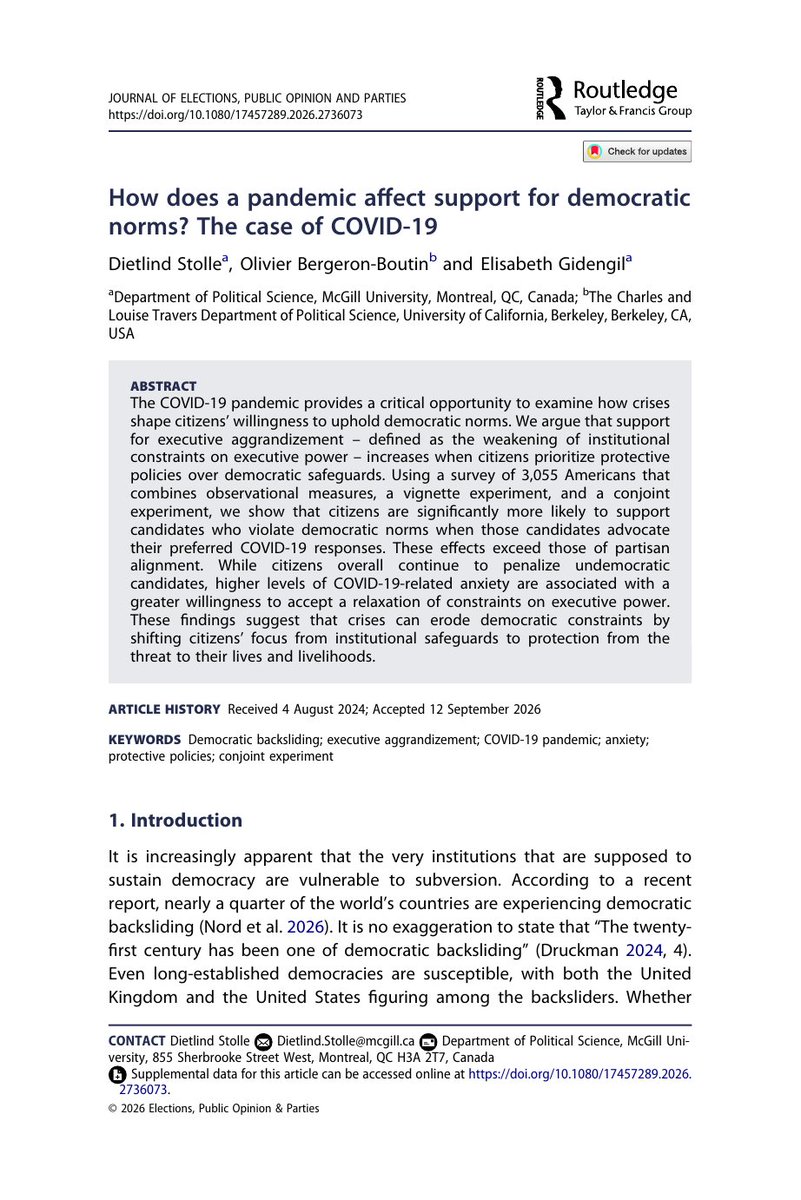
New article: Do crises erode democratic norms? Stolle, Bergeron-Boutin and Gidengil's survey experiments find voters back norm-violating candidates more when they share their COVID-19 policy preferences. Read the article: https://t.co/VGsljx00jh #polsci#DemocraticBacksliding
IN NEW ISSUE: Perelló and Chaudhuri test economy, security and partisanship in 9 countries: all three factors make a difference but economic views and partisanship matter the most. Read the article: https://t.co/Jdd5bvefuj #polsci#EconomicVoting#Caribbean#AmericasBarometer
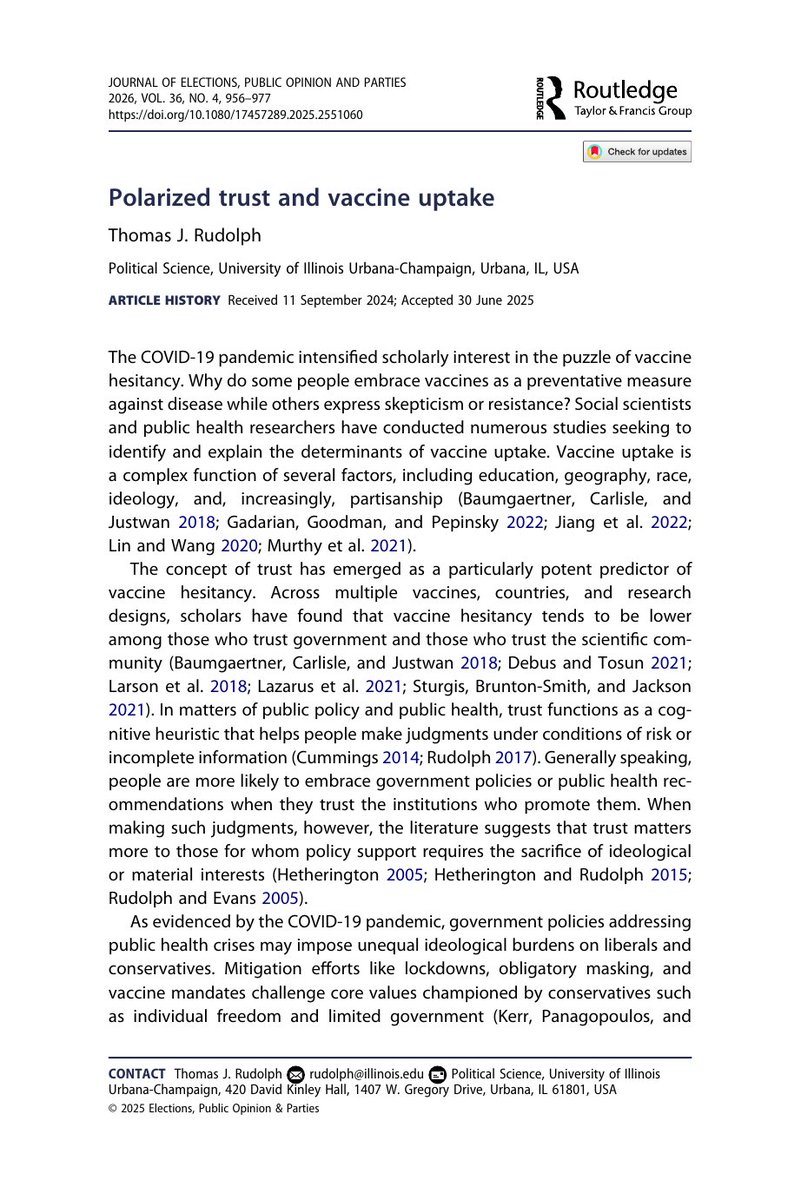
IN NEW ISSUE: Why do some embrace vaccines while others resist? In US panel data, Thomas Rudolph finds trust in government and scientists predicts COVID-19 and MPOX vaccination, especially among conservatives. Read the article: https://t.co/exgqgXaWF9 #polsci#VaccineHesitancy
IN NEW ISSUE: Do Eastern Europeans vote for parties matching their economic views? Zivkovic and Kostadinova find positional voting in ESS and CSES data, mostly among the politically attentive. Read the article: https://t.co/4jXq6VtsL5 #polsci#EconomicVoting#EasternEurope
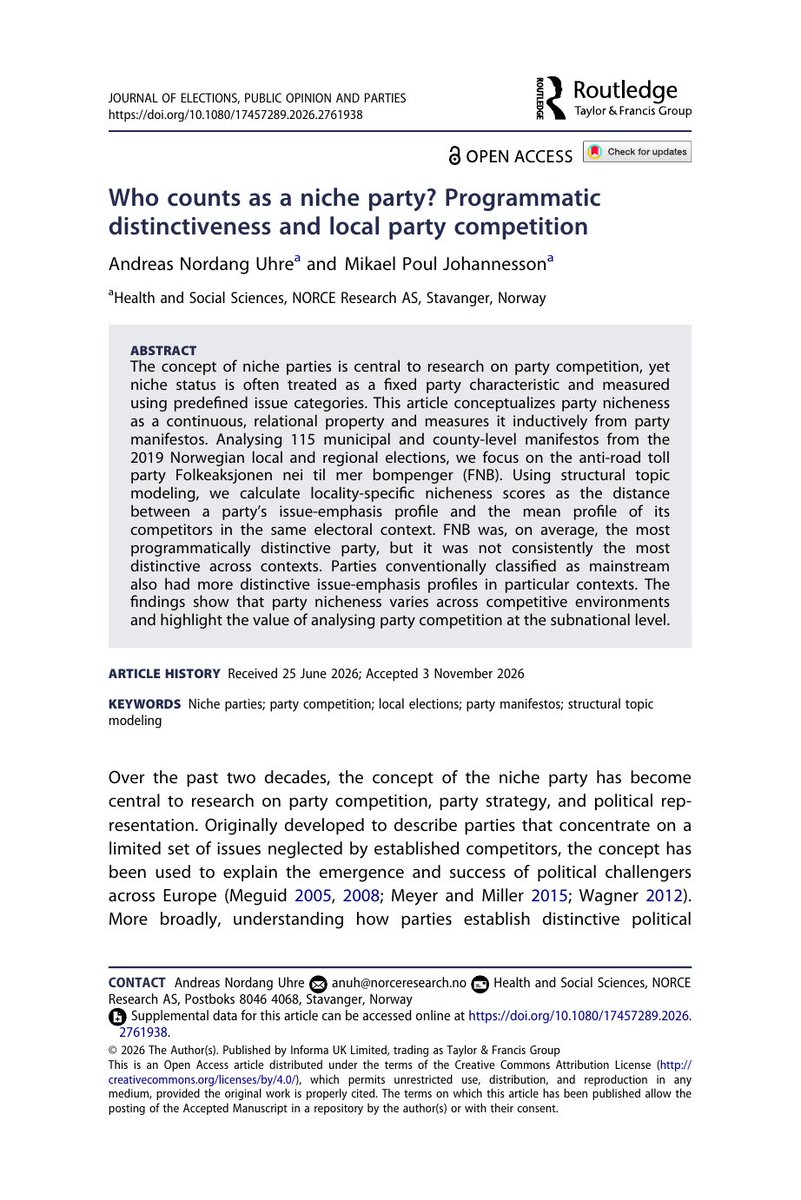
New article: Who counts as a niche party? Uhre and Johannesson study 115 Norwegian local manifestos: an anti-road toll party is most distinctive on average, but nicheness varies by context. Read the article in OPEN ACCESS: https://t.co/XNsTf1JOSh #polsci#PartyPolitics
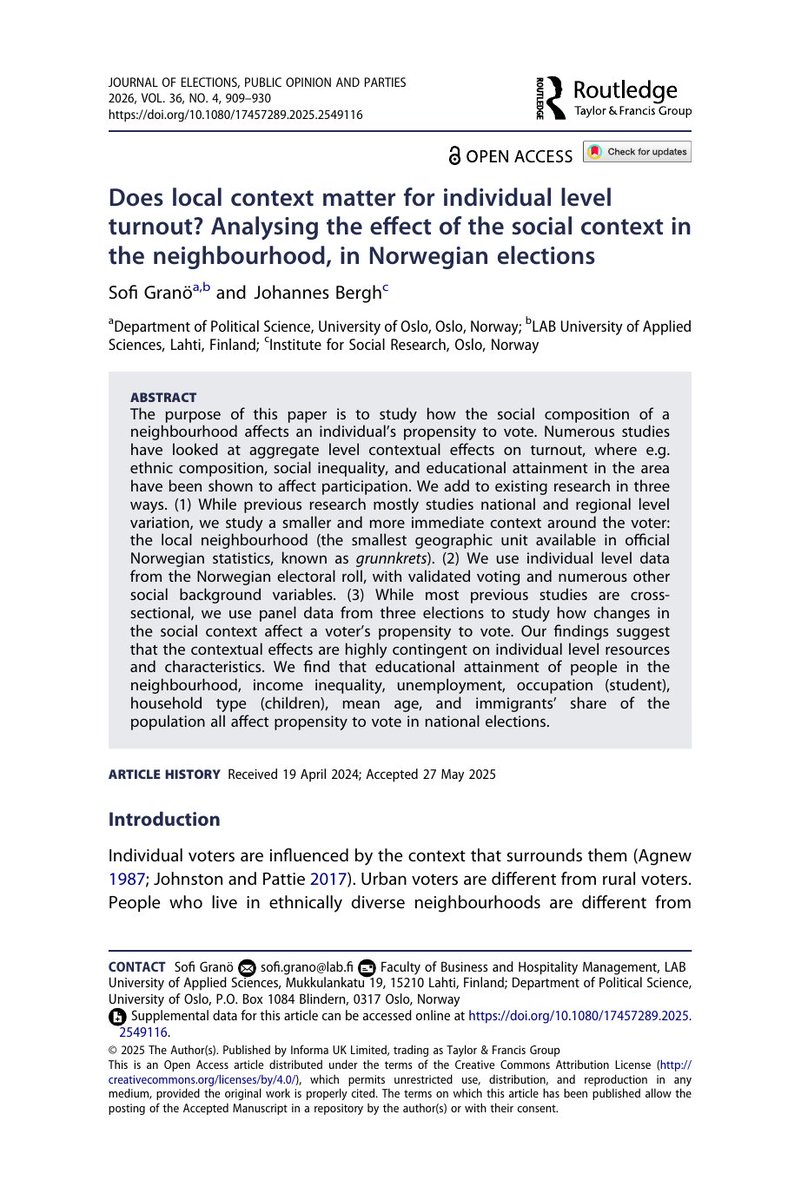
IN NEW ISSUE: Does your neighbourhood shape whether you vote? Granö and Bergh's validated electoral-roll data from three Norwegian elections show local context effects hinge on voters' resources. Read the article in OPEN ACCESS: https://t.co/qN7q3wl4nG #polsci#Turnout#Norway
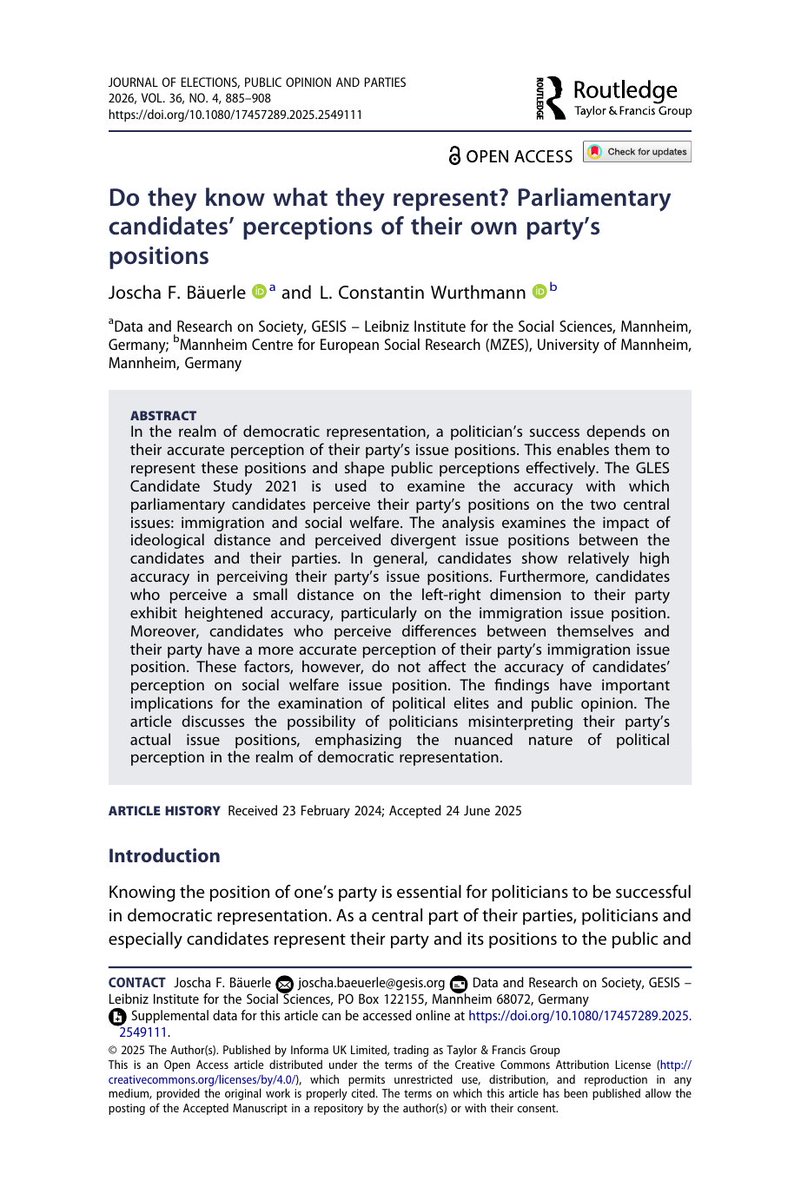
IN NEW ISSUE: Do candidates know where their party stands? Bäuerle and Wurthmann use 2021 GLES candidate data to show relatively high accuracy, sharpened by ideological closeness on immigration. Read the article in OPEN ACCESS: https://t.co/WLz2Szf3jN #polsci#Representation
IN NEW ISSUE: Did Trump's 2016 win boost Europe's far right? Trevor J. Allen finds an immediate backlash in European Social Survey data, especially among peripheral supporters. Read the article: https://t.co/xbJ8Fj32Ba #polsci#EuropeanPolitics#FarRight
IN NEW ISSUE: Can voters learn by accident? Emily Anderson links longer-serving US representatives to better knowledge of their party, informing accountability debates. Read the article in OPEN ACCESS: https://t.co/tQL52lOzIV #polsci#electoralpolitics#AmericanElectorate
Our November issue is out! Explore new research on elections, public opinion and political parties in Volume 36, Issue 4 of JEPOP. Browse the issue: https://t.co/bnDhaRqioO #PoliticalScience#PublicOpinion#electoralpolitics
Attention all prospective contributors to @journalEPOP: Effective immediately, references DO NOT count toward your manuscript's word count limit. The editorial team at #JEPOP believes strongly that our contributors should be able to cite all relevant works to your projects.
The Journal of Elections, Public Opinion & Parties is taking a brief hiatus from accepting new manuscripts between August 14 and September 1, 2023. During this time, no new submissions will be processed. Thank you for your patience and understanding.
The Journal of Elections, Public Opinion & Parties is taking a brief hiatus from accepting new manuscripts between August 14 and September 1, 2023. During this time, no new submissions will be processed. Thank you for your patience and understanding.
Attention all prospective contributors to @journalEPOP: Effective immediately, references DO NOT count toward your manuscript's word count limit. The editorial team at #JEPOP believes strongly that our contributors should be able to cite all relevant works to your projects.
Attention all prospective contributors to @journalEPOP: Effective immediately, references DO NOT count toward your manuscript's word count limit. The editorial team at #JEPOP believes strongly that our contributors should be able to cite all relevant works to your projects.
Attention all prospective contributors to @journalEPOP: Effective immediately, references DO NOT count toward your manuscript's word count limit. The editorial team at #JEPOP believes strongly that our contributors should be able to cite all relevant works to your projects.
Friday #JEPOP Editor Spotlight: Matthew Singer
Matt is the Alan R. Bennett Honors Professor of Political Science at the University of Connecticut. He studies questions of how voters achieve political representation & how the political and social context affects political behavior
DUE TOMORROW (16 April 2023)
The #JEPOP call for editors for our special issue on disinformation, conspiracy theories, and affective polarization is tomorrow. Please see the document in this tweet for more information and make sure to get your proposals in!
Friday #JEPOP Editor Spotlight: Alessandro Nai
Alex is an Associate Professor of Political Communication and Journalism at the University of Amsterdam. His research focuses on political communication, voting behaviour, political psychology, and campaigning effects.