@ArmandDAngour No, I meant that you would refer to MP Thomas Missing in every tweet. Ok, I admit it seemed funnier when I wrote it. 😀 "I’m going to start posting tweets with a reference to the deceased (d. 1788) MP Thomas Missing to see who reads them with care."
@deanwball I've always been convinced he'd be a huge Black Sabbath fan. The type who keeps talking about obscure early album tracks. "It's not just about the hits".
@rickbrewPDN@wholyv I've used your product for years. First of all thanks for a fantastic piece of software. I'm glad you're going to keep up the great work! AI changes some thing but well-engineered tools like yours will always have a place for people who care about detail.
@InuitKodiak@ArmandDAngour The son of Marcus Aurelius,
Styled himself Exsuperatorius.
No Hercules, he,
But vainglorious, oui!
In his bath, strangled by Narcissus.
@vurnt22 It happens in Ireland too. If something is really great we can call it "deadly". "The Living Color gig was pure deadly lads!" This can cause significant confusion. I'm pretty sure it's a modern semantic flip. There's nothing similar in the Irish language. "Savage" is another one.
@wakenminds Someone using the pavement of the Duomo to argue against formal education is quite the overstep. The floor you're admiring wasn't built by passionate amateurs who did their research on youtube.
@CSMFHT A lot of the recent stupidity stems from "I can't understand this, therefore it requires magic or aliens." This is compounded by the inability to understand expert explanations and the conclusion that the experts are wrong or hiding the truth. + Grifter energy = a lot of stupid.
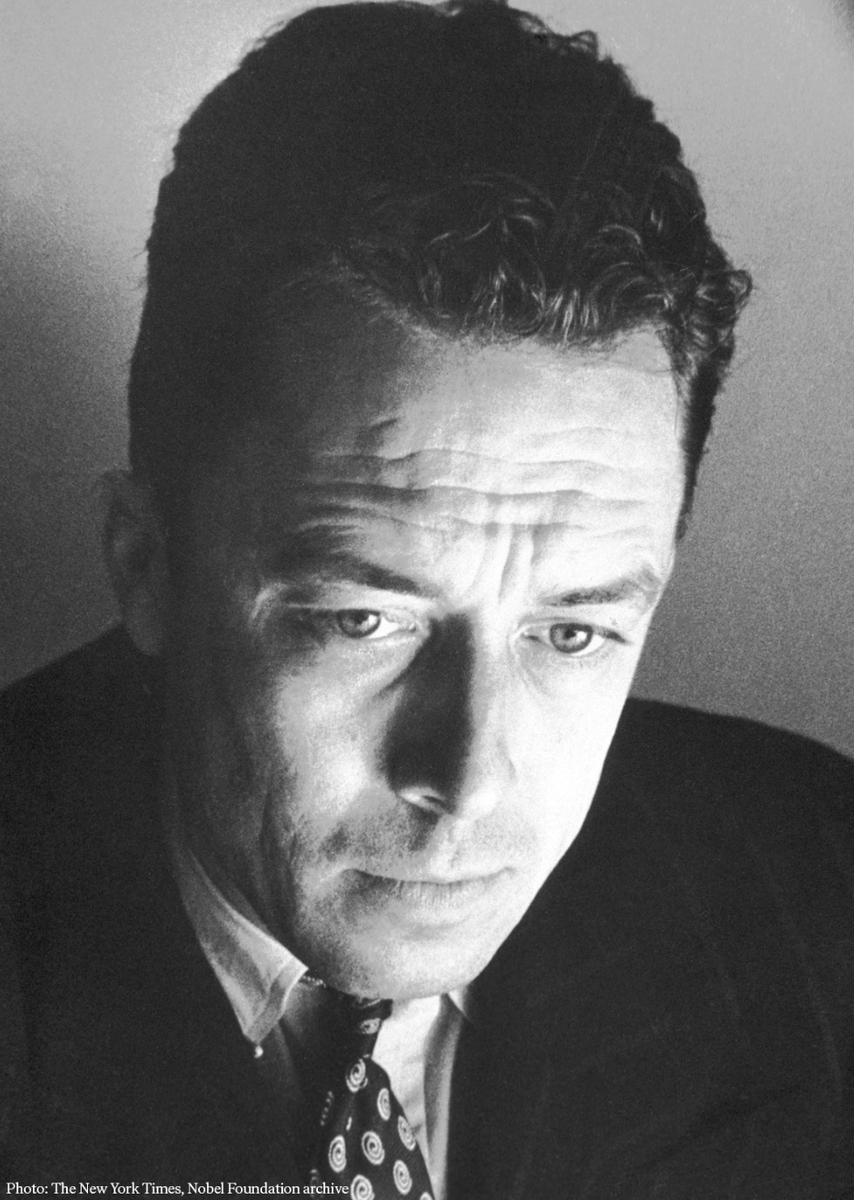
"Without you, without the affectionate hand you extended to the small poor child that I was, without your teaching and example, none of all this would have happened."
Albert Camus wrote these words in a letter to his elementary school teacher, Louis Germain, after being awarded the 1957 Nobel Prize in Literature. When the news arrived, Germain was the second person he thought of – after his mother.
Camus was born in Algeria to French parents, the second son of a poor family. His father died in World War I before Albert turned one. His mother, who worked as a cleaning woman, could not read or write. When Camus was still in elementary school, the family already expected Camus to leave school as soon as possible and take up manual work in order to contribute to the household income.
His teacher Louis Germain noticed his abilities and desire to learn. He convinced Camus's family that a secondary education could change the kind of work Camus would be able to find later in life. He included the young Camus in a small group of students preparing for scholarships and tutored them for several hours each day. With Germain's help, Camus obtained a scholarship and entered secondary school, and eventually went on to study at the University of Algiers.
Camus began his career as a journalist and an active member of an Algerian theatre group. In 1937, he published his first book, L’envers et l’endroit (The Wrong Side and the Right Side). His wider recognition came in 1942 with L’étranger (The Stranger), a novel that introduced the absurdity of life – a theme he returned to in other works. His other well-known works include the philosophical essay collection Le Mythe de Sisyphe (The Myth of Sisyphus and Other Essays, 1942), La Peste (The Plague, 1947), and La Chute (The Fall, 1956).
The Nobel Committee for Literature awarded him the literature prize "for his important literary production, which with clear-sighted earnestness illuminates the problems of the human conscience in our times."
Today we remember one of the world's greatest scientists: Marie Skłodowska Curie.
Curie dedicated her life to science. She was the first woman to be awarded a Nobel Prize, the first person to be awarded twice and is still the only person to receive the prize in two different scientific fields.
Curie died #OTD in 1934.