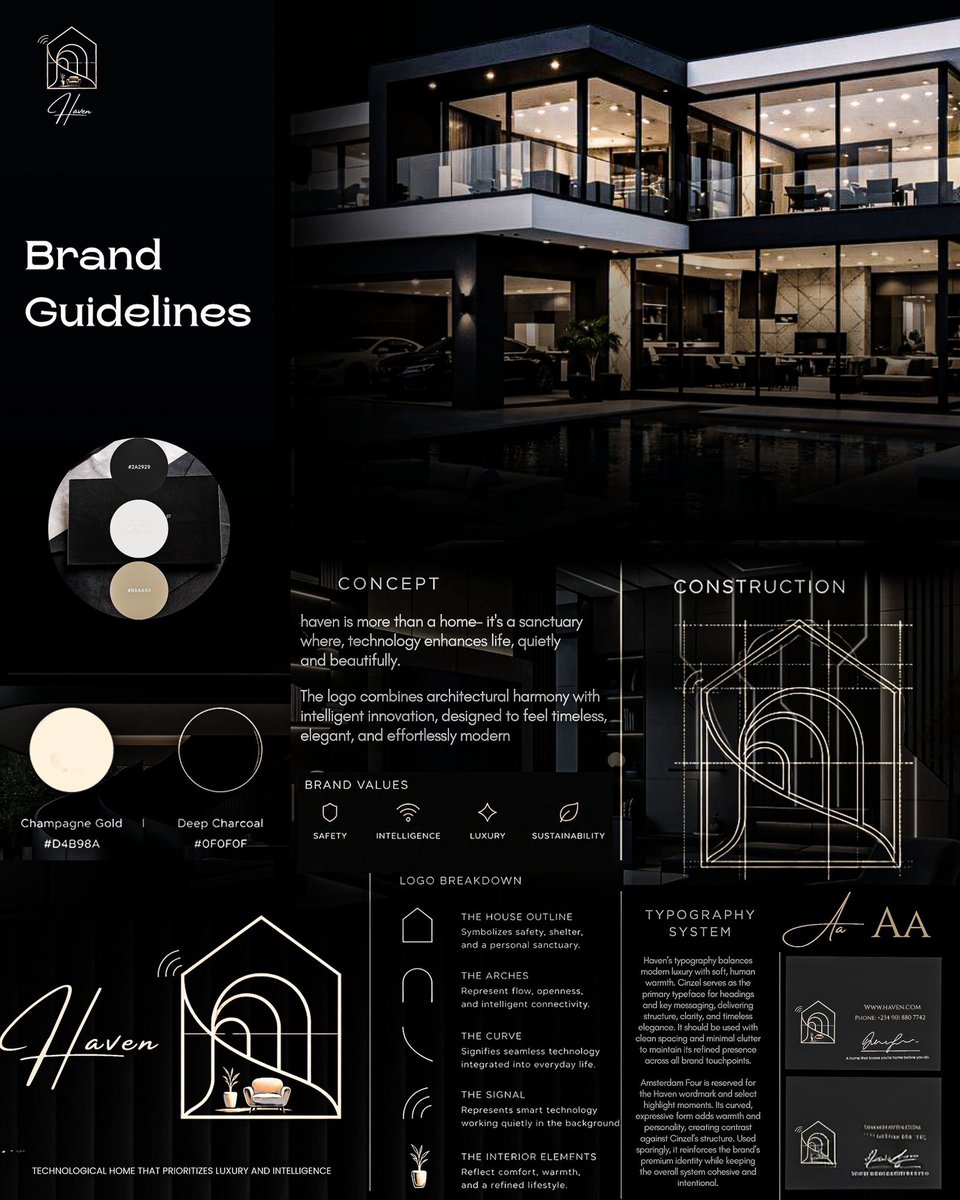
For Haven’s visual identity, I wrote the brief.
And the brief said one thing above everything else.
This home should ask nothing of you.
Not "here are the features." or "here is the app." Just, this home already knows you.
So when I sent it over I wasn't asking for a logo, I was asking for something that felt like walking through a door that was already open.
Dark background, gold lines. Basically a house that looks more like a sanctuary than a product.
Arches that feel like calm and a name written like a signature not a brand name.
That's what a good brief does.
It doesn't just explain the brand. It shows the designer exactly how it should feel to look at it.
@chiefutih created it visually
I spent weeks building a brand from scratch.
A smart home company with no app, little to no ads, no price list and lastly, no visible hardware anywhere in the house🙂↕️.
I called it HAVEN.
Let me walk you through how I actually built it because almost nothing I did is what you're "supposed" to do ⬇️
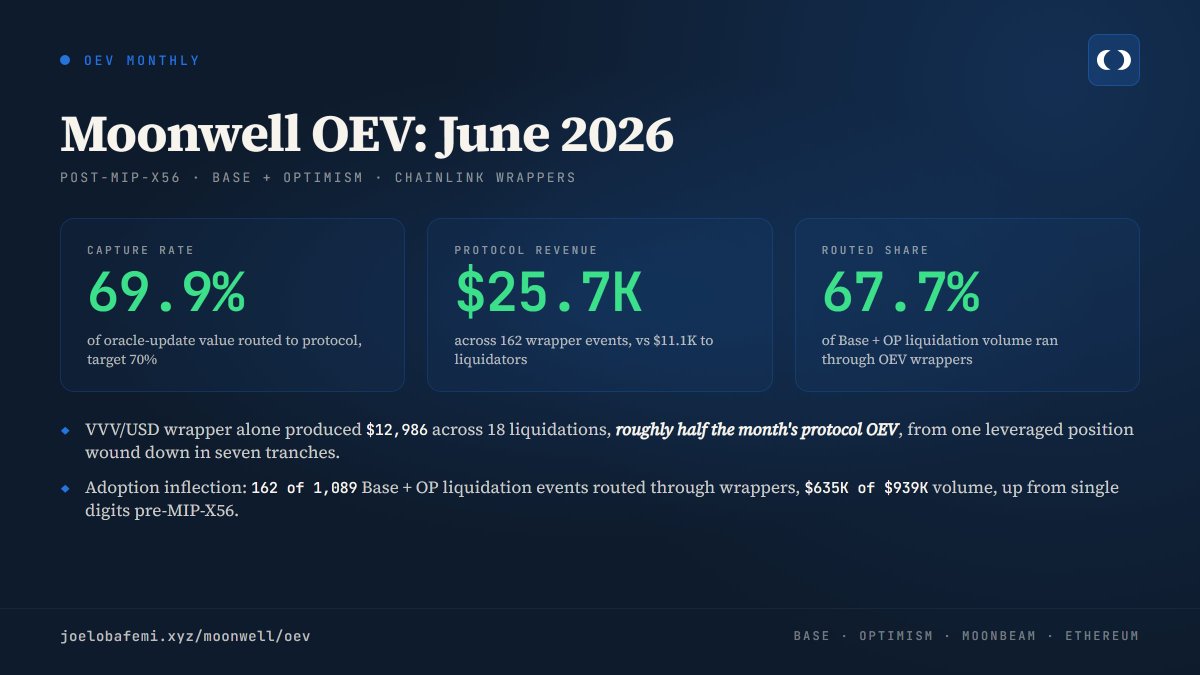
MIP-X56 improved how OEV value splits between Moonwell and searchers.
June tested it when a jump in volatility pushed liquidations past 1,000 events, the first high-volume read since the fix.
It came through cleanly, recapturing $25,727 of oracle-update value across 162 wrapper liquidations against $11,058 to searchers: a 69.9% capture rate, right on the 70% target the proposal set.
Seven of every ten dollars that liquidations unlock now stays with the protocol.
One wrapper, VVV/USD, produced $12,986 across 18 liquidations, more than half the month's protocol OEV, as a single leveraged VVV position was wound down in seven tranches. ETH, cbXRP, and BTC followed.
The bigger story is adoption as 67.7% of Base and Optimism liquidation volume ($635K of $939K, 162 of 1,089 events) now routes through the OEV wrappers, up from single digits before MIP-X56.
Cc: @LukeYoungblood
"She made $10k on Nestuge using TikTok ads."
"I 3xed my campaign money using TikTok ads."
"I got a role simply from TikTok ads."
You too can get similar results but the problem is you don't know what to do and how to do them.
Here's a quick fire system to help you create a profitable TikTok ad.
A thread 🧵
I've never seen a successful B2B company that said 'we work with everyone.'
The best ones pick a niche. 3-5 case studies with real metrics. A clear answer to 'who is this for?'
Niching down feels scary. But it's how you get found by the right people.
The litmus test for brand identity:
Remove your logo. Remove your name. Is it still obviously you?
If no, you don't have a brand identity. You have a logo.
Real brands have ownable colors, consistent type, visual patterns, and tone of voice.
Take OpenAI as an example, the launch of ChatGPT wasn’t technically a rebrand, but it repositioned how people perceived the company overnight. Suddenly, everyone had a new story to attach to the brand and that’s the real opportunity with a rebrand that founders sleep on.
A rebrand can be the best thing to happen to your brand if it's done right.
The hack is giving the market a fresh reason to pay attention.
A new logo or name means little,the story you tell around the change is what people remember.
Most founders fear rebrands. "Will we confuse our users?"
Wrong framing.
Rebrands are reasons to reconnect.
Your early users don't care about consistency. They care that you're building something worth following.
Use the rebrand as a story moment.