Open to opportunities as a Discord Community Moderator.
Passionate about building healthy, engaging, and well-managed communities.
I can assist with community moderation, member support, conflict resolution, onboarding, event coordination, and maintaining a positive environment.
If you're looking for a dedicated Discord Community Moderator, feel free to send me a DM. I'd be happy to discuss how I can support your community.
As the onchain world becomes simpler, faster, and more accessible, Base continues to push that evolution forward.
It’s not just about technology, but about creating an onchain environment where everyday users can participate with ease.
The journey is still just getting started.
$BASE @base
Utexo: Making Cross Chain Transfers Simpler
Crypto has become a multichain ecosystem, but moving assets between chains is still more complicated than it should be.
A user may need to choose the right bridge, check network compatibility, find a suitable route, manage liquidity, pay gas fees and sometimes complete multiple transactions just to move assets from one ecosystem to another.
This complexity creates friction for both users and applications.
The bigger problem is fragmentation.
Liquidity is spread across different networks, while each blockchain has its own infrastructure and ecosystem.
@utexocom is working to simplify this experience by creating infrastructure that makes cross chain transfers more seamless and helps connect liquidity across different ecosystems.
Instead of making users think about every technical step happening behind the scenes, the goal is to make moving value between chains feel simple and natural.
This matters because better interoperability can make crypto more accessible, while also giving applications a smoother way to interact with multiple networks.
If blockchain is going to become truly global financial infrastructure, users should not have to worry about which chain their assets are on.
They should simply be able to move value where it needs to go.
That is the kind of cross chain experience Utexo is working toward.
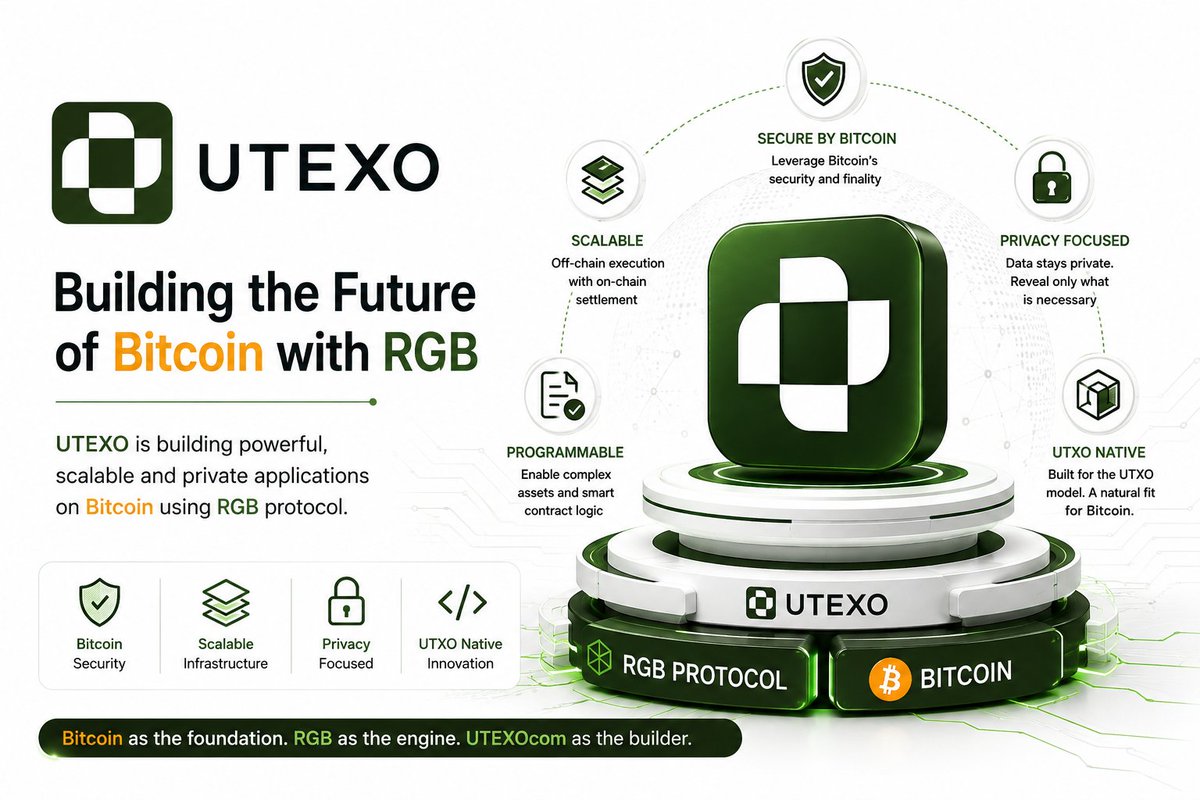
What makes RGB the right choice for what @utexocom is building?
The answer starts with Bitcoin’s UTXO model.
Bitcoin is one of the most secure settlement layers in the world, but it was never designed to execute every type of application directly on the base layer.
UTXOcom needs a way to bring more functionality to Bitcoin without forcing Bitcoin itself to become a heavy application layer.
That is where RGB becomes interesting.
RGB is designed to work with Bitcoin’s existing UTXO architecture.
Instead of creating a completely separate environment, it uses Bitcoin transactions as cryptographic anchors for ownership and state.
This makes it a natural fit for a project focused on UTXO based infrastructure.
RGB also introduces a different approach to scalability through client side validation.
Rather than putting every piece of application data directly on Bitcoin, much of the validation and state management can happen offchain.
Bitcoin can then remain focused on what it does best: providing security, consensus and final settlement.
This approach can make it possible to build richer applications without placing unnecessary demand on the Bitcoin base layer.
The privacy model is another important piece.
Because application state does not need to be fully exposed onchain, RGB can allow users to reveal only the information required for a specific interaction.
That becomes especially interesting for assets, financial applications and other use cases where privacy matters.
For UTXOcom, the bigger opportunity is combining these properties into a broader Bitcoin native application layer.
Bitcoin provides the security foundation.
RGB provides a way to add programmable assets and application logic.
UTXOcom can build infrastructure on top of that foundation.
The goal is not to change what makes Bitcoin valuable.
It is to expand what can be built around Bitcoin while staying aligned with its UTXO based architecture.
That is what makes RGB such an interesting choice for UTXOcom.
I’m completing the Axis Robotics tasks entirely from mobile.
However, I’m facing some difficulties with certain tasks as a mobile user.
Hopefully, the development team will review these issues and make the experience more mobile friendly soon.
@axisrobotics@axisroboticsin_
Memecoins are heating up on @base , and honestly, there’s more happening here than just people chasing the next 100x.
Base has become a really active place for onchain experiments, and memecoins fit naturally into that environment.
Low fees and fast transactions make it easier for new tokens to launch, trade, and build communities without too much friction.
And when liquidity starts flowing in, attention usually follows.
You see new coins popping up, communities forming around them, and traders searching for the next one that might take off.
But the interesting part isn’t just the memecoins themselves.
Base is becoming a strong distribution layer where these ideas can reach a growing onchain audience pretty quickly.
Of course, not every memecoin is going to make it.
Some will disappear as fast as they appeared, while a few might build real communities, liquidity, and staying power.
That’s why this phase is interesting to watch.
Memecoins can bring fresh users, liquidity, and attention into an ecosystem.
The bigger question is whether that attention eventually moves beyond speculation and into the wider Base ecosystem.
The memecoin wave is heating up.
Now let’s see what gets built around it.
As a tester and community member of @axisrobotics , I appreciate how smooth and user friendly the robot training process is for regular PC users.
However, many community members do not have access to a PC, which makes completing these tasks quite challenging for them.
I hope the team considers this accessibility gap and explores mobile friendly alternatives in the future.
@axisroboticsin_
@GDyatheesh59374@base Base is moving fast.
Azul, Beryl, and the upcoming Cobalt upgrade show a clear focus on scalability, better UX, and a more powerful onchain economy.
@DarksunRayz@ipor_io@predofficial@useazza Strong ecosystem momentum from Base.
Different products, different use cases, but all pointing to one thing: a growing onchain economy.
What makes RGB the right choice for what @utexocom is building?
The answer starts with Bitcoin’s UTXO model.
Bitcoin is one of the most secure settlement layers in the world, but it was never designed to execute every type of application directly on the base layer.
UTXOcom needs a way to bring more functionality to Bitcoin without forcing Bitcoin itself to become a heavy application layer.
That is where RGB becomes interesting.
RGB is designed to work with Bitcoin’s existing UTXO architecture.
Instead of creating a completely separate environment, it uses Bitcoin transactions as cryptographic anchors for ownership and state.
This makes it a natural fit for a project focused on UTXO based infrastructure.
RGB also introduces a different approach to scalability through client side validation.
Rather than putting every piece of application data directly on Bitcoin, much of the validation and state management can happen offchain.
Bitcoin can then remain focused on what it does best: providing security, consensus and final settlement.
This approach can make it possible to build richer applications without placing unnecessary demand on the Bitcoin base layer.
The privacy model is another important piece.
Because application state does not need to be fully exposed onchain, RGB can allow users to reveal only the information required for a specific interaction.
That becomes especially interesting for assets, financial applications and other use cases where privacy matters.
For UTXOcom, the bigger opportunity is combining these properties into a broader Bitcoin native application layer.
Bitcoin provides the security foundation.
RGB provides a way to add programmable assets and application logic.
UTXOcom can build infrastructure on top of that foundation.
The goal is not to change what makes Bitcoin valuable.
It is to expand what can be built around Bitcoin while staying aligned with its UTXO based architecture.
That is what makes RGB such an interesting choice for UTXOcom.
Sending digital dollars should feel simple.
But in many crypto networks, moving USDT can still require users to hold another token just to pay the network fee.
That creates an unnecessary problem.
Imagine having USDT in your wallet but being unable to send it because you do not have the network’s native token for gas.
For a normal user, this feels confusing.
You already have the asset you want to send, so why should you need a second token just to complete the transaction?
@utexocom takes a more straightforward approach.
When you move USDT, you can pay the network fee in USDT itself.
No extra token to manage.
No unnecessary swapping.
No confusing gas requirements.
It is a small change in the user experience, but it removes a major point of friction.
The future of digital payments should be built around simplicity, and stablecoin transactions are a good place to start.
The future of robotics may depend less on building more robots and more on building better ways for robots to learn.
That is what makes @axisrobotics interesting.
Instead of collecting all training data directly from expensive physical robots, AXIS is focused on creating a data layer for Physical AI through realistic simulations and human interactions.
Think of the process as a continuous learning loop.
A human performs an action.
That action can be translated into a robot trajectory that shows the model how a task should be performed.
The resulting data can then be verified and used to train AI models.
When a robot makes a mistake, humans can correct it.
Those corrections are not wasted.
They become additional training data that helps the model understand what went wrong and how to perform the task better next time.
This creates a powerful cycle:
Human interaction → Robot trajectory → Verified data → Better models → Smarter robots.
The important part is that the system can keep improving as more interactions and corrections are collected.
That could make robotics development more scalable, because progress does not have to depend entirely on expensive physical hardware and manually collected real world data.
AXIS is therefore building more than a robotics product.
It is building the infrastructure and feedback loop that could help Physical AI learn, adapt, and become increasingly capable.
@axisroboticsin_
The future of agent economies probably isn’t about giving AI complete control of your money.
It’s about giving agents the tools to actually interact with the economy while keeping humans in control.
That’s why @base MCP is interesting.
Imagine an agent that can understand your portfolio, identify opportunities, suggest swaps, interact with protocols, move funds, or even pay for x402 services.
But instead of giving the agent unlimited wallet access, you still approve the important transactions.
So the agent handles the complicated work, while you keep the final decision.
It’s a much more practical model for AI and crypto.
Agents don’t need their own bank accounts.
They need permissioned access to the financial infrastructure people already use.
If this model scales, wallets could become the interface between humans, agents, and onchain applications.
That’s where the agent economy starts becoming something people can actually use.