Day 2 of how to value a stock
Yesterday, we talked about PE ratio and how you can't depend on it alone to value a stock.
Today I want to introduce you to another metric. The Price/Earnings-to-Growth ratio.
PEG Ratio = PE Ratio ÷ Earnings Growth Rate
It helps you answer one important question:
“Am I paying a fair price for this company’s growth?”
Example:
A company has:
• PE ratio of 20
• Expected earnings growth of 25%
PEG = 20 ÷ 25 = 0.8
How to interpret it:
• PEG below 1 → potentially undervalued relative to growth
• PEG around 1 → fairly valued
• PEG above 1 → possibly expensive
Let's bring it into context with a real life example of two stocks in the same industry
Wapco vs Buacement
Ever wondered how to know if a stock is overvalued or undervalued?
This is important because that's one of the ways you can identify companies that can 2x to 5x. Some people identified and snatched up TIP when it was still in the single digits, and some people identified and bought Aradel when it was still N400.
Let's talk today about one of the most common valuation tools: The PE Ratio.
PE Ratio (Price-to-Earnings) = how much you’re paying for ₦1 of a company’s profit.
If a stock has a PE of 10, it means investors are willing to pay ₦10 for every ₦1 the company earns annually.
How to use it:
• Valuation check: Compare PE to similar companies (that is companies in the same industry. For instance, Aradel vs Seplat, Dangote Cement vs Buacement vs Wapco). If peers trade at 15x and your stock is at 8x, it might be undervalued (or the market knows something you don't. There may be some macroeconomic risks facing the company or the market doesn't believe the company will do well in the long run).
• Growth matters: A high PE isn’t always bad. Fast-growing companies deserve higher PEs. A slow/no-growth company with a high PE? That’s a red flag.
• Market context: If the average market PE is around 10x and you’re buying a company at 20x, you’re betting on strong future growth.
• Simple rule of thumb: Low PE = potentially cheap. High PE = potentially expensive
But ALWAYS ask: why?
PE doesn’t give answers. It helps you ask better questions.
In summary, you can't use PE alone to value a company. If you decide to buy only stocks with low PE, you may pile up a basket of crap cos maybe, just maybe, the PE is low for a reason.
In the coming days, I will be talking about other metrics that can help you value a company so you get a real picture of whether a company is really undervalued by the market relative to its earnings potential or not.
What other metrics do YOU use to value a company?
#NigerianStocks #ValueInvesting #PEratio #InvestSmartNG
That’s why financial literacy is the first principle in building financial success.
Their site has revealed the lies already.
People should be careful out there.
They have come with another scam oo
@investbamboo they said they want partner with you oo
Come and dissociate yourself from them before they use you to defraud others
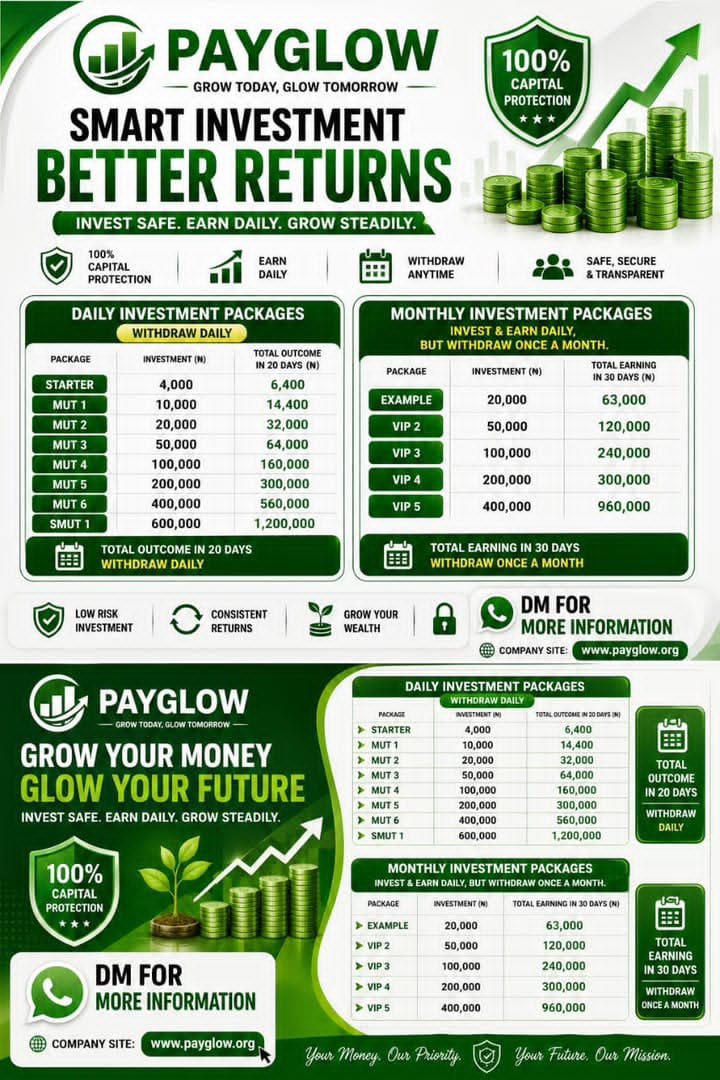
“Welcome to PayGlow mutual Fund Investment platform. A platform that allows you earn daily through various investment plan.
WHAT WE DO!
PayGlow Mutual Fund Investment is platform that invest in stock market and equity, maximize profits and in turn give back to our investors.
BENEFITS TO OUR INVESTORS
This platform avails you the privilege to start your journey to financial freedom through investing in mutual Fund with low capital and in a low risk and capital guarantee platform.
Unlike other mutual Fund platforms, You can start your mutual Fund Investment journey with as low as #4000 & explore or grow your wealth gradually with 100% capital protection.
WE ARE NOT A PONZI SCHEME
PayGlow Mutual Fund Investment platform isn't a ponzi scheme or a get-rich-quick platform. It's a system that allows investors to grow their wealth gradually via Stock market, equity with our low risk investment plan and 100% capital protection. Our platform is looking forward to partnership with Bamboo investment to explore”
Saving alone will never make you wealthy, and the math proves it without mercy.
Inflation is running near 16% while savings accounts pay single digits. Every year, your saved money loses purchasing power, quietly and without fail. The balance grows while its real value shrinks.
Saving is defence, protecting you from emergencies. Investing is offence, growing your purchasing power over time. You need both to survive, but only one of them builds wealth.
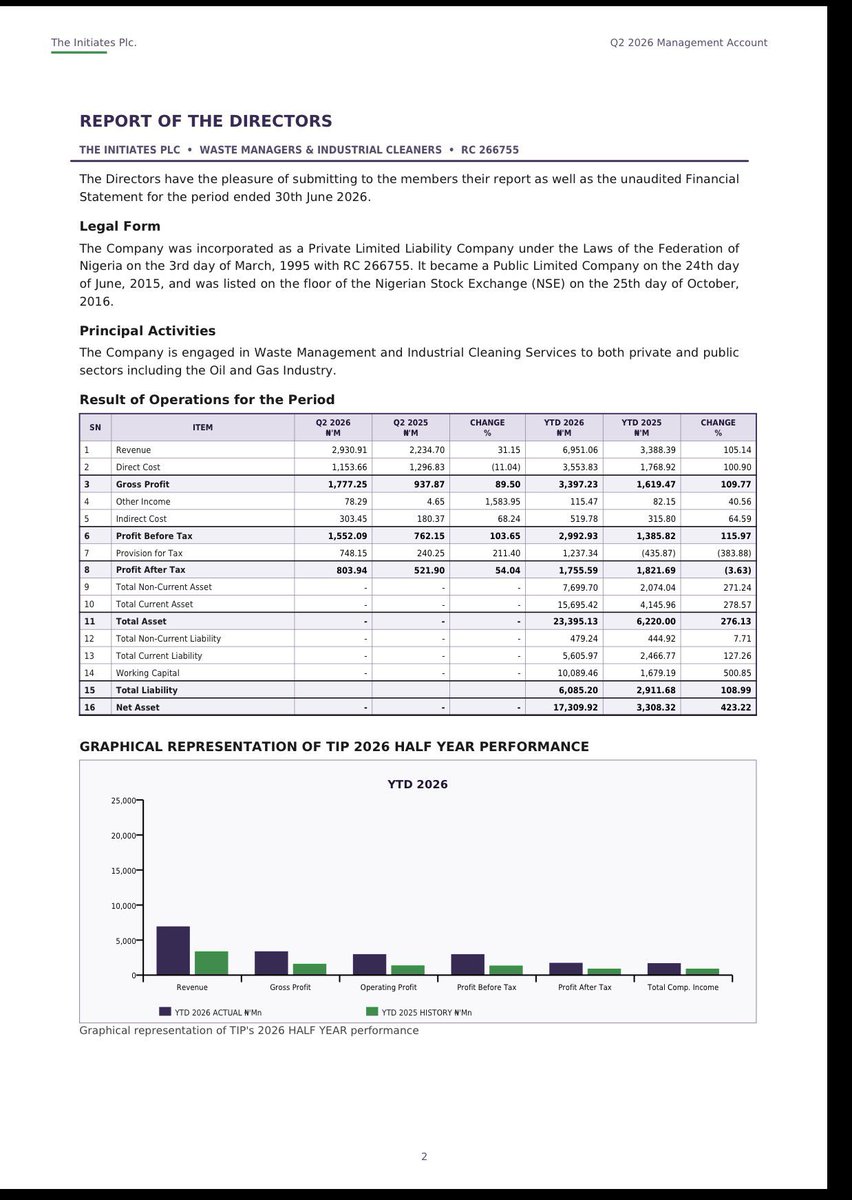
TIP just released its H1 2026 results and they look solid.
Revenue more than doubled to ₦6.95 billion, gross profit more than doubled, and profit before tax more than doubled to almost ₦3 billion.
This is a quiet Nigerian waste management and industrial cleaning company serving the oil and gas sector, and it is scaling fast. In Q2 alone sales rose thirty-one percent, gross profit jumped ninety percent, and profit after tax climbed fifty-four percent.
Net assets jumped over 400% to ₦17.3 billion while working capital rose more than 500%.
For shareholders, the Directors proposed the company’s first interim dividend of 20 kobo per share.
Strong numbers, a much stronger balance sheet, and cash going back to owners.
Interim is like, we don make small money this year
Oya use this one hold body for now from our profits
Final is like, this is everything we have made this year, and this is what we are rewarding you with for being a shareholder.
Some companies pay some profit during half year as interim and the rest as a final dividend after the years report is concluded.
Some even do quarterly payments like SEPLAT and NIDF
While some others just wait till end of the year and pay everything at once as a final dividend
Owning a share of a company won’t guarantee you a dividend anyway as UBA and Acess holders can testify to 😂🏃🏃🏃
They only pay dividends when they make sufficient profit and if regulations (eg in the banking sector) allow them to
So if you are in a loss making company, nothing concern you and dividend
"It's not how much money you make, but how much money you keep, how hard it works for you, and how many generations you keep it for." — Robert Kiyosaki
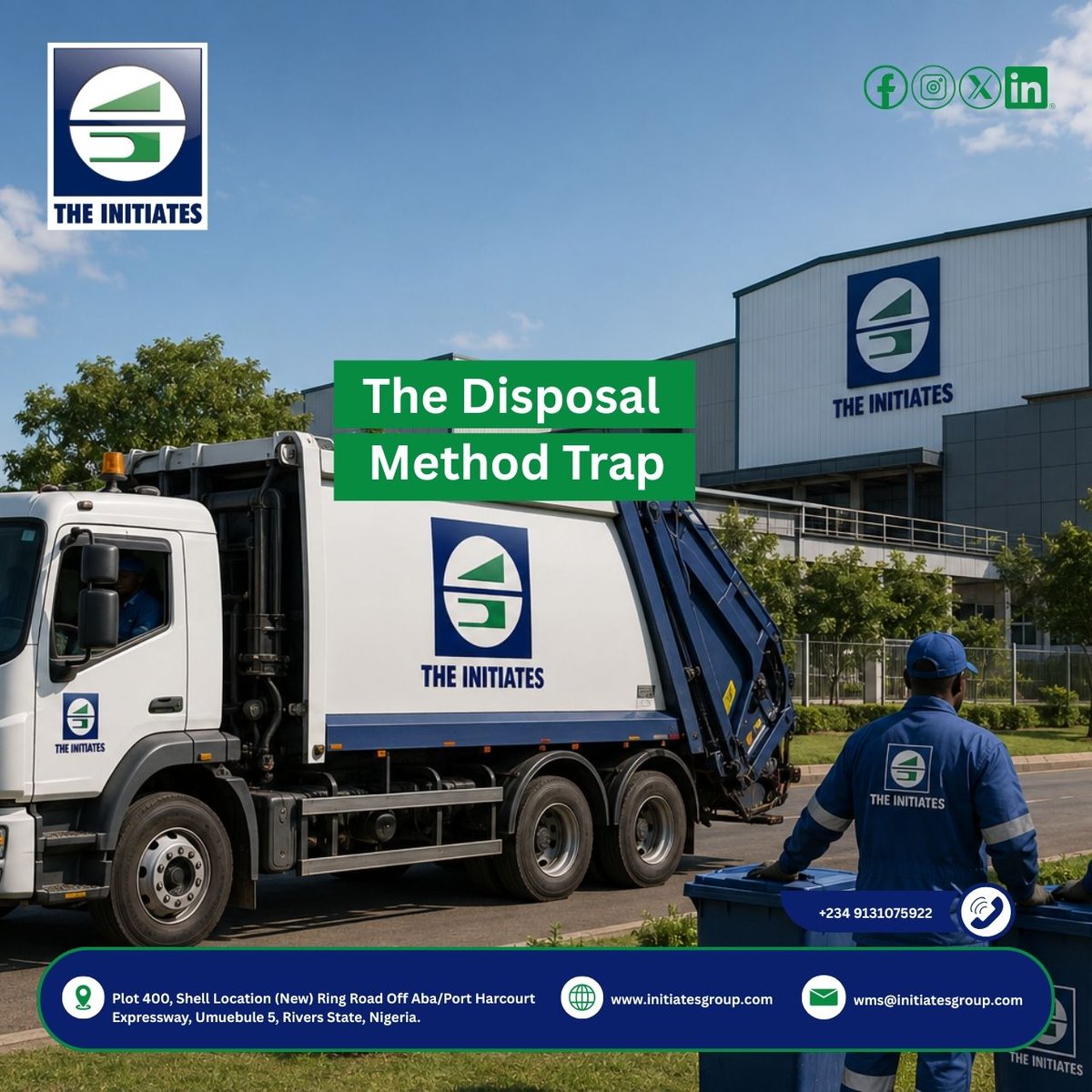
80% of Nigeria's waste ends up in open dumps: leaking methane, poisoning groundwater, and swallowing scarce urban land.
Recovery first. Value addition next. Landfill last. That's the circular economy in practice.
The Initiates Plc: Ending the open-dump era. ♻️
It is not your job to save everyone, you should always put yourself first.
After making plans for today’s survival, make plans for future survival. Even after future arrangements, have multiple backup plans in case things don’t work out as planned.
Only after doing all these should you consider saving others.