Does the labor market freeze because AI is too capable?
The enterprise stack is rapidly shifting toward agentic workflows, email and calendar copilots, back-office bots, and customer-ops automations.
Headlines about “AI replacing jobs” miss the core finding: workers welcome automation that reclaims time but resist automation that removes judgment, authorship, and accountability.
• 46% of tasks received a thumbs-up for automation, and the #1 reason (69%) was to free up time for higher-value work. The recurring theme across transcripts: “equal partnership,” not autopilot.
• The pushback clusters around three main fears, trust (45%), job replacement (23%), and loss of human touch (16.3%), precisely the ingredients that make fully automated decision-making feel unsafe.
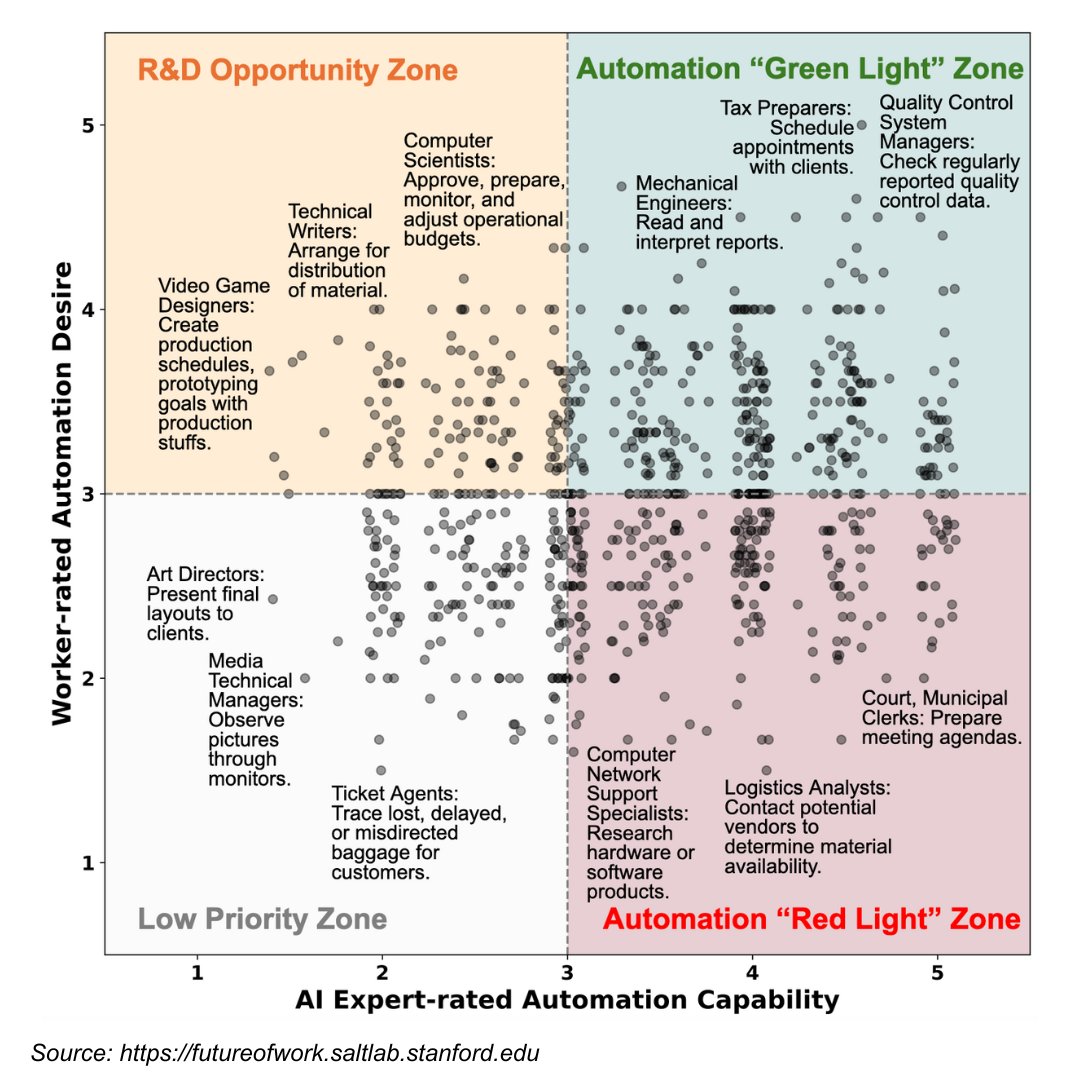
AI capability still faces sharp limits. In Arts, Design, and Media, only 17.1% of tasks earned positive automation ratings. Similarly, in the Automation “Red Light” Zone, tasks show high technical feasibility but low human desire for automation. These typically involve decision-making, accountability, and ethical complexity, areas where deployment warrants caution due to likely worker resistance and broader social backlash.
→ Curiosity, creativity, and moral judgment remain distinctly human assets.
In contrast, the R&D Opportunity Zone shows high worker demand but low AI ability, the ideal arena for innovation. Here lies the next wave of applied AI: tools for retrieval, structured note-taking, and workflow memory that enhance efficiency while preserving human agency.
Maybe it’s time we stop letting code decide for conscience. Guardrails need to come before the next wave of “whether we could” replaces “whether we should.”