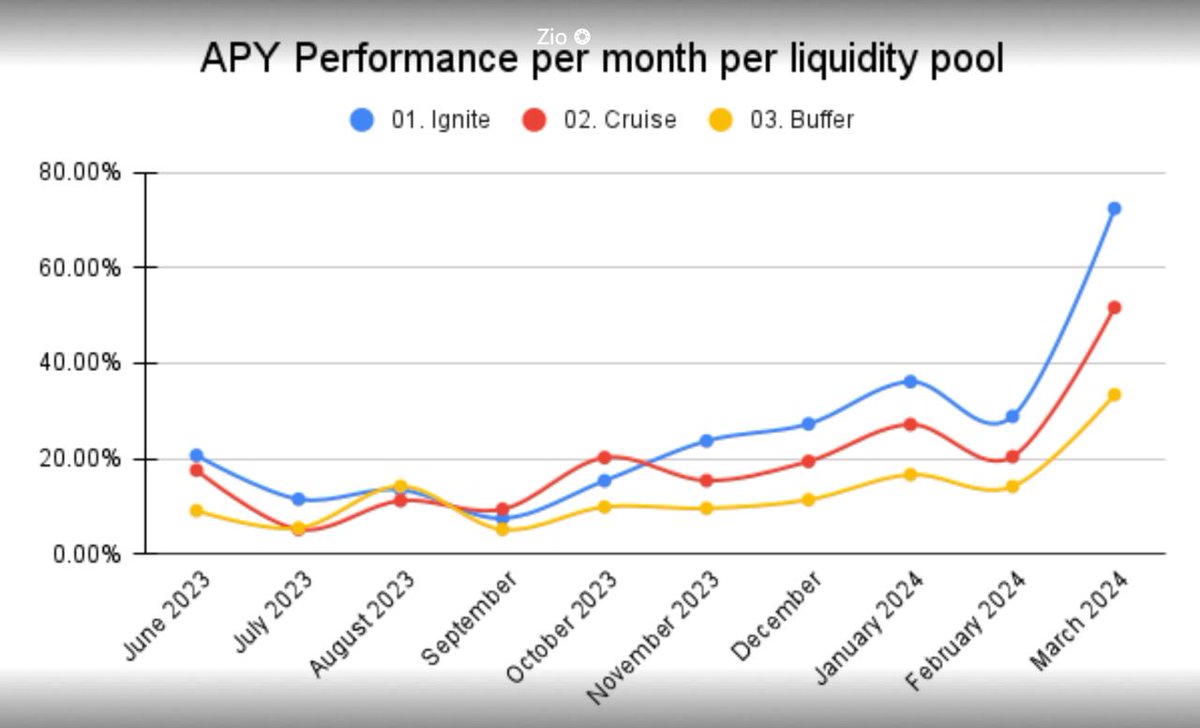
Performance Update: Stats for March now out!
Ignite: 72% APY
Cruise: 53% APY
Buffer: 33%
And since launch in May of 2023:
Ignite: 26% APY
Cruise: 20% APY
Buffer: 13% APY
All pools are ahead of target APYs.
Hey guys.
In the last 24 hours, about 5% of all Kaspa has been withdrawn from Mexc. That’s a good start.
But Mexc still holds 1 billion Kaspa (user funds). Unlike many other exchanges, Mexc is not subject to government regulation and is registered in the Seychelles. You don’t even know who the owner or founder of Mexc is.
Which means: Mexc can do whatever they want with your money. They can freeze your accounts, manipulate prices, or they could just rug at any time—and nobody could legally help you.
How can Kaspa holders leave 1 billion Kaspa sitting there? You’re hurting your own bags and, in the worst case, could lose everything.
So once again: Withdraw your Kaspa to a wallet! It takes 2 minutes and is not too much to ask.
Let’s go Kaspa!
Bitcoin layer 2s are recreating the fiat system we're trying to escape from.
Let me explain:
During the gold standard era, gold was too heavy to carry. So, people left their gold at banks and got pieces of paper that were CLAIMS on that gold.
The paper wasn't gold itself. It was merely used because it was easy to carry, transact, and it was backed one to one with the gold in the bank vault, right?
However, banks realized not everyone redeemed their gold at the same time. So they started lending out more claims to the same gold than they had.
In your objective opinion, do you believe the same thing can/will happen with Bitcoin layer 2s?
Institutions will hold the Bitcoin. They'll allow you to transact on higher layers (paper claims). They'll realize not everyone is going to withdraw their L2 "bitcoin" at the same time.
They can, in theory, lend out more bitcoin than they have.
Again, humans don't really change - if there's a way to exploit the system, we will find a way.
To get off the fiat standard, the base layer MUST be used. Bitcoin, unfortunately, cannot scale on the base layer.
This is why I'm encouraging my Bitcoiner friends to study #Kaspa. You already understand the fiat problems. Unfortunately, I don't believe Bitcoin is the solution long term.
I'll buy 10 $KAS for every comment, like, and reshare on this post (must be following me & I'll share proof).
24H only. Ends at 10:17am PST on 10/21/25.
Make me fiat poor (I'm actually kinda worried).
X should run on #Kaspa's blockdag.
Faster speeds and improved security than any centralized data ledger, including $XRP.
Retweet to be heard.
@elonmusk@xai@grok
The case for the uniqueness of fast pow
tl;dr
Finality has two moving parts: (i) fast inclusion (= high bps, how quickly a tx gets into a block), and (ii) fast confirmations (= how quickly that tx becomes irreversible). Any system with rapid block production can achieve the first. The second is where the tension shows: in pos, fast confirmations press directly against decentralization. In fast pow, the two properties are decoupled.
prologue
A few weeks ago I came across Solana’s founder claiming: “Solana is the fastest monetary system in the world”. Since Kaspa already runs at a faster block rate, I was curious to check Solana’s finality times. That curiosity quickly pointed me to a deeper issue: not raw speed, but how speed interacts with decentralization.
——————
The tension is structural. In pos, finality means accumulating staked votes, and the more decentralized the stake distribution, the more time is required to reach finality. Here I’m not talking about hardware requirements or validator specs. The axis I’m discussing is centralization around the security mechanism itself: stake in pos vs. hardware in pow. To be secure, a block must be confirmed by a supermajority--typically >66.7% of the total economic stake. In a truly decentralized network, where n stakers with uniform share grows without bound, the time to coordinate this supermajority becomes a real bottleneck.
Pow works differently. It samples the hardware space without requiring the protocol to explicitly collect evidence from a majority of miners. Each block is itself a statistical proof that the finder out-competed the full network’s hash power. This process--and its timing--remains independent of how many individual miners participate.
Ethereum’s researchers understood this when moving to pos. Unlike Solana, which tolerates concentration to reach ~13-second finality, Ethereum’s designers could not accept that trade-off. Their solution was to introduce rotating committees. A rotating committee is a smaller subset of validators, randomly chosen from the full set, that votes on behalf of everyone else.
But this comes with a different security model, known in the literature as exposure to a BFT adaptive attacker. The committee is selected first and then votes. That “select-then-work” sequence is theoretically exposed to adaptive attackers, since members are known in advance. Pow, by contrast, is “work-then-select”: the winner is only revealed after the work is done. Think of it this way: in pos, you know who the referees are before the game starts, which gives an attacker time to pressure them. In pow, you only learn who won after the work is already done, which removes that attack surface. So n confirmations provide consistent confidence regardless of miner granularity, and the system stays secure even under adaptive targeting.
Beyond attack subtleties, the real issue is economic weight. When I send a billion-dollar transfer in a pos system, the question I care about is simple: how much stake is actually securing it? A committee vote provides strong statistical evidence, but only a true supermajority puts the full economic stake of the network behind my confirmation. In other words, a sampled committee may convince me that things are probably safe, but only the weight of the entire stake provides an overwhelming guarantee. And this is exactly where pow shines: each confirmation is not just a probability estimate, but a direct proof of work done against the full hash power of the network, no matter how many miners there are.
closing remark
I don’t claim to know every engineering detail of Ethereum or Solana. But I’m convinced the core principle holds.
I’ll state it simply: fast pow uniquely enables fast finality without forcing a compromise on decentralization.
@KGeorgee I AM ABOUT TO WALK INTO THE MOST ABUNDANT BALANCED WEALTHY AND SUCCESSFUL PERIOD OF MY LIFE. I NATURALLY ATTRACT GOOD FORTUNE, AND I AM WEALTHY IN MORE WAYS THAN ONE. I GIVE MYSELF PERMISSION TO PROSPER, AND I HAVE THE POWER TO BUILD THE LIFE THAT I DESIRE.