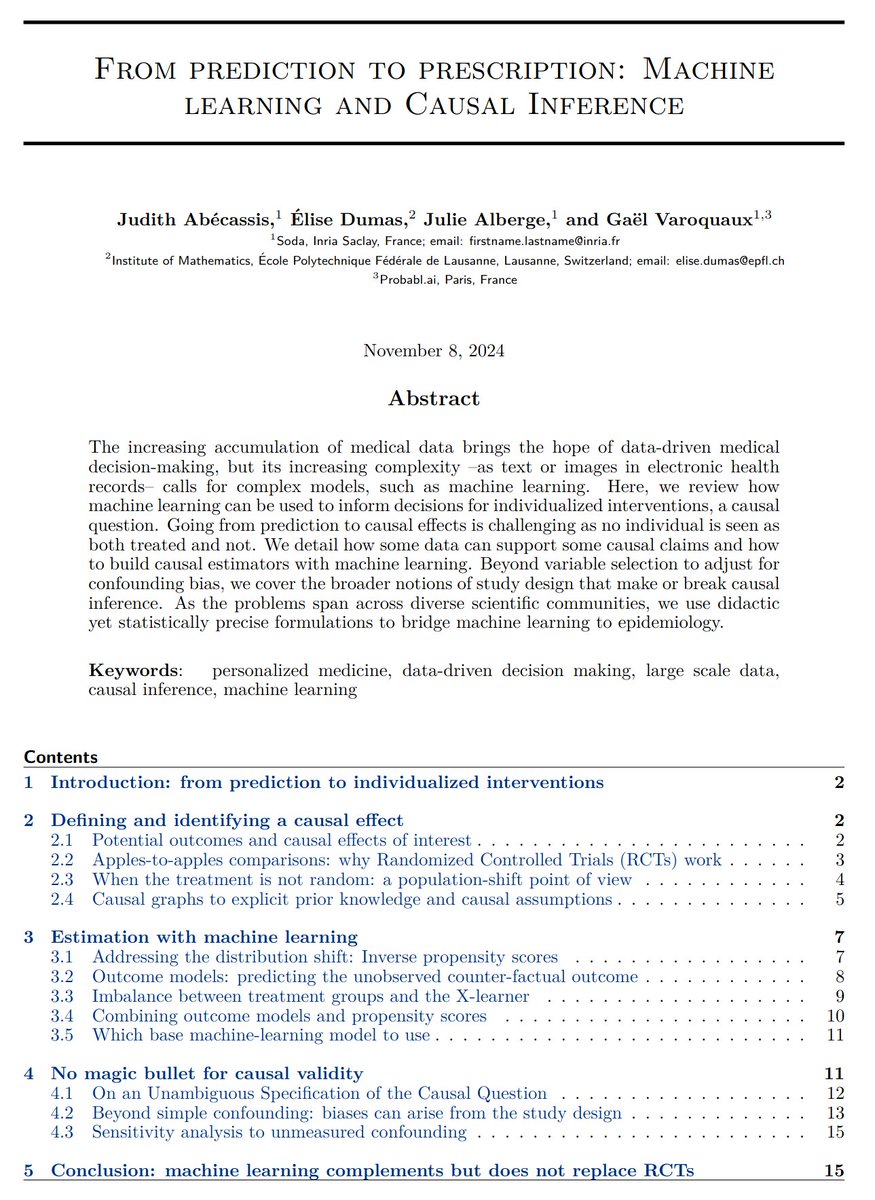
✨📰preprint - From prediction to prescription: Machine learning and Causal Inference
https://t.co/mgaj3JSt7G
Machine learning for individual treatment effect
Didactic and precise, bridging statistical, computational, and epidemiological thinking.
#statstwitter#epitwitter
1/5
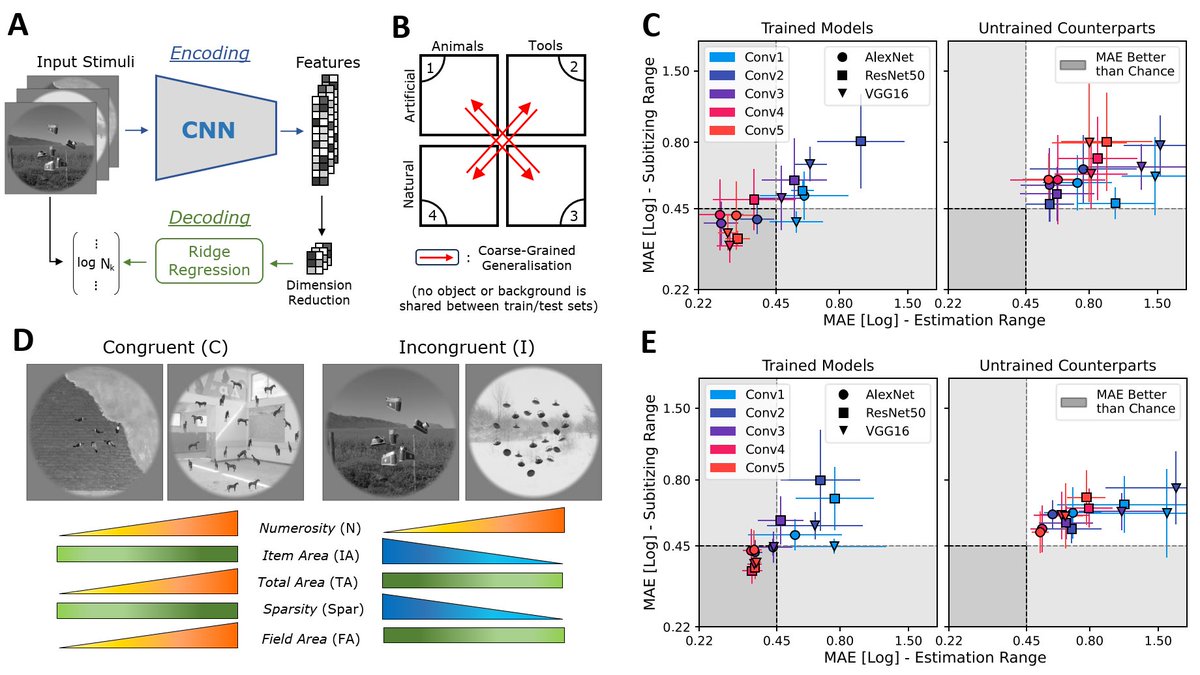
Would you have thought that object recognition CNNs can encode information on object number across changes in identity and context? New preprint, with Thomas Chapalain and @BertrandThirion, on visual #number_sense: https://t.co/RU5pT5PhE6
🧠 Introducing GREEN (Gabor Riemann EEG Net), a new modular neural network architecture for #EEG analysis. GREEN combines the power of wavelet transforms 〰️ and Riemannian geometry 🌐 to learn sparse and interpretable representations of EEG data. It's designed with modularity in mind, making it easy to adapt and extend for different research questions.
One of GREEN's distinct design features is its ability to learn task-specific wavelets, which could help advance our understanding of brain function and help identify biomarkers for neurological and psychiatric disorders. 🩺 By bridging the gap between deep learning 🤖 and traditional EEG analysis techniques 🧠〰️️, GREEN opens up new avenues for exploring the brain's complex electrical signals. ⚡️
Explore our preprint to discover how GREEN's modular design, interpretable representations, and learnable wavelets can advance #neuroscience and #biomedical research: https://t.co/OUeKPjn0F3 #deeplearning #opensource #EEG
Joint work with @JP4illard & @hippneuro !
To preprocess or not to preprocess your #EEG (when building #ML models) 🔮? 💫We are thrilled to share our latest #preprint, studying the challenge of learning brain-specific biomarkers from EEG 🧠📶 using #ML ⚙️🖥️: https://t.co/1mAgqSzg0o
We compile arguments and evidence from benchmarking age- & sex-prediction on > 2600 EEGs from two large public datasets.
We found that basic artifact rejection consistently led to better model performance, whereas removal of ocular and muscle artifacts hampered performance. As it turns out that those peripheral signals are predictive themselves!
Our results therefore argue in favor of the need to diligently process EEG data, if the goal is to have brain-specific biomarkers (and if prediction is not the only objective).
Our efforts to build more interpretable #ML models for EEG led us to extending the established Morlet wavelet methodology for spectral analysis of EEG to accommodate state-of-the-art ML models based on covariance matrices. This allowed us to perform head-to-head comparisons between classical EEG features and frequency-specific model predictions for, both, brain and artifact signals.
Compared to classical band-pass filtering, wavelets even led to improvements in prediction performance.
Joint work with Philipp Bomatter, @JP4illard, Pilar Garces & Jörg F Hipp.
Our paper on data augmentation for EEG data was accepted by the Journal of Neural Engineering!
It all started w the nice work done by @JP4illard during his internship @Parietal_INRIA! Congrats to him & our amazing co-authors @tomamoral & @agramfort!
Short 🧵 on our findings 👇!
Ever wondered how to carry data augmentation depending on the data label?
That's what we've investigated in our #iclr2022 paper w/ @tomamoral, J. Paillard & @agramfort
CADDA: Class-wise Automatic Differentiable Data Augmentation for EEG signals
📄 https://t.co/Eh9JtaXRkB
🧵1/6