Thanks for reading my #ScholarSunday Tweets! s/o to Benjamin Olken, if you want to read the whole article click here: https://t.co/5B2UkSvrDr! Finally, s/o to @Jess_Hoel!
If the scale of the project was larger, how do might the baseline corruption data and treatment effects change? Would individuals be more engaged in reducing corruption past a certain threshold of public goods theft?
In conclusion, external auditing is most effective for reducing corruption involving PUBLIC goods, such as public infrastructure. However, grassroots-level monitoring may be effective when there is little free-riding or PRIVATE goods involved, such as subsidized food.
The authors add that "the low probability of a formal prosecution and punishment suggests that higher punishments conditional on prosecution may be an effective complement to higher audit probabilities."
@Jess_Hoel Grassroots monitoring has shown huge free-rider issues with public goods. While people are more likely to be wary of corruption with personal costs, public goods theft went relatively unnoticed. Also, local-level monitoring can be captured by local elites gaining from corruption.
@Jess_Hoel Problems with Treatments and Policy:
Implementing auditing may show a larger reduction in corruption, but it has its faults. First, higher officials conducting audits are also prone to corruption. Second, this study shows that there are other forms of corruption, such as nepotism
@Jess_Hoel Participation HOWEVER, for both invitation and invitation + comment, saw a statistically insignificant and much smaller reduction than auditing. The reduction mostly came from wages paid, as people were more vigilant about personal income. Free-rider problem for material costs.
@Jess_Hoel Findings:
The Audit Treatment groups saw a statistically significant reduction in corruption by 8%, both from material costs (in which officials collude with suppliers for poorer quality and less quantity of gravel/rocks) and wages paid to workers.
@Jess_Hoel Data Collection: Engineers took samples from road projects and analyzed materials. Using material quality, local costs, and wages to workers paid, the study derived estimated costs. This was compared to the official reported cost, and the unaccounted money measured corruption!
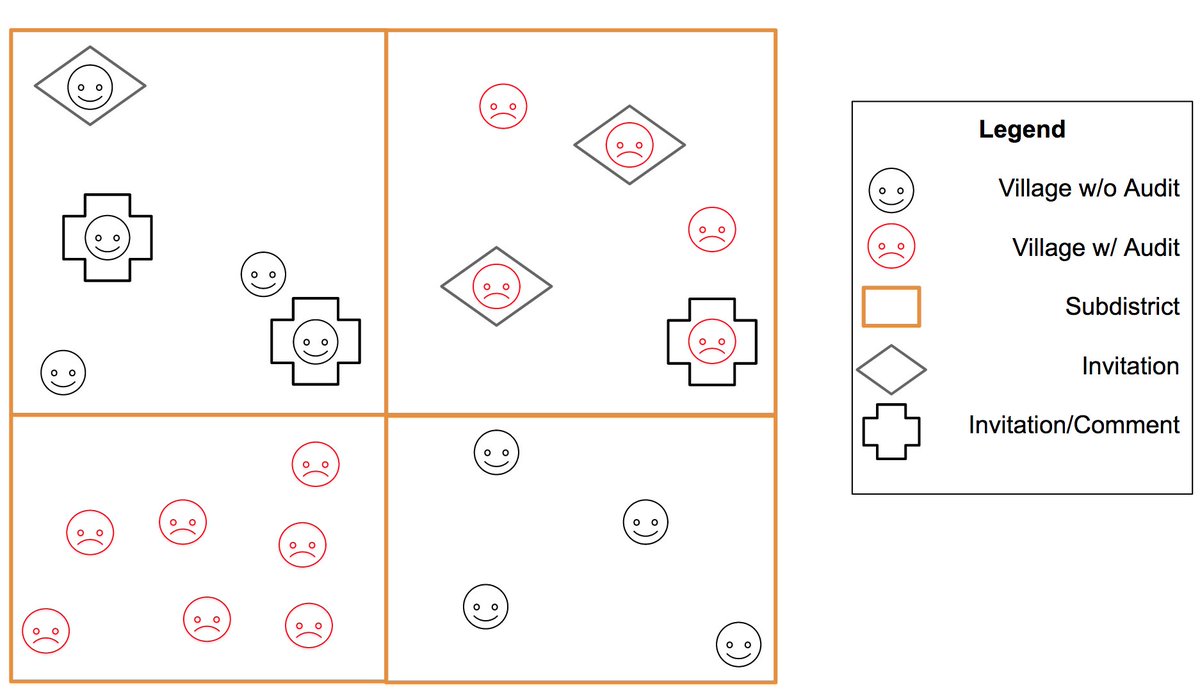
@Jess_Hoel 2 Types of Bottom-Up Treatment:
1. Invitation: Community accountability meetings, and invitations sent out to community
2. Invitation + Comments: Meetings + invitations with anonymous comment form
Both randomized at village level, INDEPENDENT of auditing randomization.
See image:
@Jess_Hoel Treatment:
Top-Down: chance of auditing for treatment villages 4%➡️100%. Two rounds of audits, 6 months & 1 year after start of project. Treatment was randomized at sub-district level to avoid spillover effects (news of neighboring village audits may affect behavior of others)
@Jess_Hoel Villages involved in the project were given a budget of ~USD 8,800, most of which went to surfacing dirt roads with gravel and rocks. However, baseline data showed ~24% of the budget was stolen by corruption. Corruption had 2 forms, wage and material quality manipulation.
@Jess_Hoel Setting: The study looked at 608 villages in East and Central Java involved in the nationwide village-level infrastructure project funded by loans from the World Bank for a period of a year from 2003 to 2004.
@Jess_Hoel Objective: determine which method is more effective in reducing corruption:
1 Top Down Approach -Auditing by higher-level gov't officials
2 Bottom Up Approach -Increasing grassroots-level monitoring by community members. Those benefitting from project will be more incentivized.
Wanted to discuss the paper Monitoring Corruption: Evidence from a Field Experiment in Indonesia by Benjamin A. Olken (2007). How do we create accountability for government officials and curtail widespread corruption? #IEatCC#ScholarSunday@Jess_Hoel
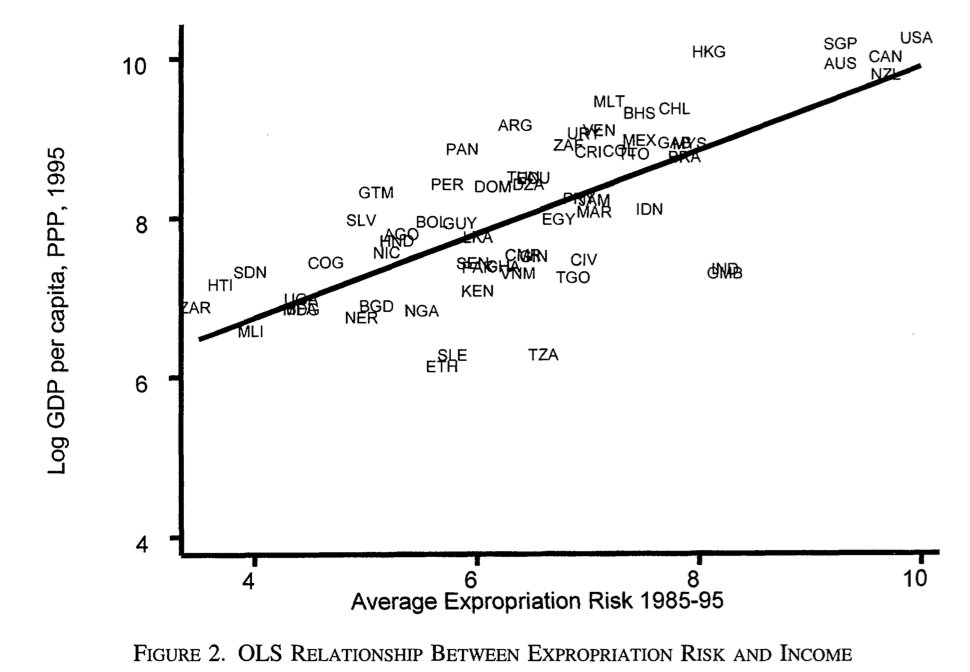
Question: If colonial powers were in fact responsible for setting up extractive institutions that have placed many countries in a position of massive disadvantage, do you believe that the former colonizers have an obligation to aid these countries' development today?
The finding is robust to controlling for other factors such as latitude, climate, disease environment, natural resources, soil quality, and ethnolinguistic composition.
The authors finally conclude that there is a high correlation between settler mortalities and European settlements; between settlements and early measures of institutions; and between early institutions and institutions today.