Sub-millisecond latency. At scale.
Teranode + Aerospike delivers transaction lookups in under a millisecond — even at millions of tx/sec.
Faster than most web API calls. #Teranode#BSV
How Teranode achieves its throughput:
1. Horizontal scaling across machines
2. Unbounded block size
3. Continuous subtree processing
4. Extended transaction format
No shortcuts. No compromises. Just engineering. #Teranode#BSV
Just announced: all 27 dependencies and sub-dependencies for overlay-broadcast rewritten in idiomatic Zeta. New BSV packages hitting @zorbs_io.
Self-compiling in 14ms. 51+ pure Zeta source files. The ecosystem is writing itself now. 🔁
https://t.co/DSvXnUcjzW · https://t.co/sxv3z88wS5
All 27 dependencies and sub-dependencies for this project have now been completely re-written in idiomatic Zeta, in preparation for overlay-broadcast to be fully transpiled into Zeta language.
New BSV supporting packages on https://t.co/t3nGs51XzJ
Just search for "overlay" 😉
Most people believe BTC is more private than Bitcoin SV.
The reality is the opposite. ⚡
One of the least understood advantages of Real Bitcoin (SV) is its superior on-chain privacy through maximum address entropy.
Here’s why:
BTC wallets heavily rely on limited derivation paths.
This dramatically reduces the number of possible addresses that can be generated from a single seed.
Fewer addresses = easier surveillance and transaction tracking 👀
Real Bitcoin (SV), by contrast, fully embraces the entire address space.
No artificial restrictions.
Maximum entropy.
Much harder to link addresses and transactions 🔒
In simple terms:
BSV gives users more privacy by design 💎
While BTC’s popular implementations actively reduce it for convenience.This is not a minor technical detail.
In an era of increasing on-chain surveillance, the protocol that preserves the highest practical entropy has a real privacy advantage. 🛡️
Real Bitcoin (SV) continues to follow Satoshi’s original vision — not only in scalability and utility, but also in protecting user privacy through mathematical design.
The more you understand the technical reality, the clearer it becomes:
Real Bitcoin (SV) is not just faster and cheaper — it is also more private. 🔥
The awakening is accelerating.
The storm is coming. 💥
Sources:
• Satoshi Nakamoto, “Bitcoin: A Peer-to-Peer Electronic Cash System” (2008)
• BIP32: Hierarchical Deterministic Wallets (HD Wallets) – limited derivation paths in BTC
• Technical analysis of address entropy and on-chain linkability between BTC and BSV implementations
• Bitcoin SV protocol documentation – unbounded address space and derivation flexibility
#BitcoinPrivacy #RealBitcoin #BitcoinSV #BSV #OnChainPrivacy #AddressEntropy #PrivacyByDesign #SatoshiVision #CryptoPrivacy #BTCvsBSV #Decentralization #FinancialFreedom
To that end, I will transpile what Craig builds into many stacks and various performant languages.
I have to ensure that anyone can pick-up and run these implementations upon a fixed protocol.
There are no more excuses not to build on Bitcoin.
One subtree = ~1M transactions.
At 1M tx/sec = 1 subtree/second.
10-min block = ~600 subtrees.
= 600 million transactions per block.
And there's no hard cap on block size. #Teranode#BSV
For years, we have been invited to admire architectural drawings of palaces that were never built. We were shown sketches of splendid cities suspended in the air and assured that gravity was merely a temporary inconvenience.
Ethereum promised a world of applications that would transform commerce, identity, gaming, finance, ownership, and human cooperation itself. BTC promised a revolution in money that somehow required every useful feature to be removed in the name of progress. Both became masters of anticipation. The future was always arriving tomorrow, and tomorrow developed a remarkable talent for never becoming today.
My ambition is considerably less fashionable.
I intend to take every significant idea that was promised and not delivered, every application declared inevitable but somehow perpetually unavailable, every system that remained trapped inside a white paper, conference presentation, roadmap, or venture capital pitch deck, and turn it into something that actually exists.
Not theories. Not aspirations. Not demonstrations designed for applause.
Code.
Working examples.
Documentation.
Libraries.
Systems that developers can examine, test, extend, improve, and build upon.
The modern age suffers from an excess of visionaries and a shortage of builders. It has produced countless prophets of the future who appear strangely allergic to construction. We have become accustomed to celebrating intentions while quietly excusing results.
I prefer a different standard.
If an idea is worthwhile, it should be implemented. If it can be implemented, it should be documented. If it is documented, it should be placed in the hands of those capable of creating something greater.
The highest compliment one can pay an invention is not admiration. It is use.
My objective is therefore simple: to place into your hands the tools that others promised, so that you may go out and build the future they merely described.
Subtrees broadcast every second means:
✓ Continuous validation
✓ Faster block validation
✓ Even processing load over time
✓ No burst of work at block discovery
Proactive processing beats reactive processing. #Teranode#BSV
By forking PostgreSQL and embedding triple-entry accounting + BSV tokenisation directly into the database engine, the system can:
Ingest real invoices and shipping documents automatically
Record them as cryptographically verifiable triple-entry entries
Tokenise them on BSV
Provide proofs that everything balances and is auditable
Integrate with the rest of the ecosystem (payments, access control, NFTs)
https://t.co/CKELOR6Yju
Below’s like a super-efficient, secure group chat or announcement system that runs on Bitcoin SV, where one person can safely broadcast the same private information to many people at once — and easily manage who’s allowed in the group.
https://t.co/3fvFKnT2E9
Teranode introduces 'subtrees' — doesn't exist in BTC.
A subtree = ~1M transaction IDs + their Merkle root. Broadcast every second.
So when a block is found, most of the work is already done. #Teranode#BSV
'Arcade' is a lightweight, high-throughput transaction broadcast service that sits between applications and the BSV network with Teranode.
Read on to find out more... 🧵
Most people still think this is just about finance.
It’s not.
It’s about a level playing field:
► People interacting on a trusted layer
► No one can cheat the other
► The same tools for everyone
Hear why Siggi is so passionate about blockchain: https://t.co/bh0a57nZX8
One of our goals for BSV was to make building so simple, anyone can do it.
The BSV TypeScript Stack accomplishes just that. A collection of ready-made components that make it seamless to get a PoC running in days.
Breakdown below 👇
⚠️Introducing Nour v1.0.3
The world's fastest, most efficient library for working with the Bitcoin SV (BSV) blockchain, built in Zeta.
https://t.co/lZismpvJVm
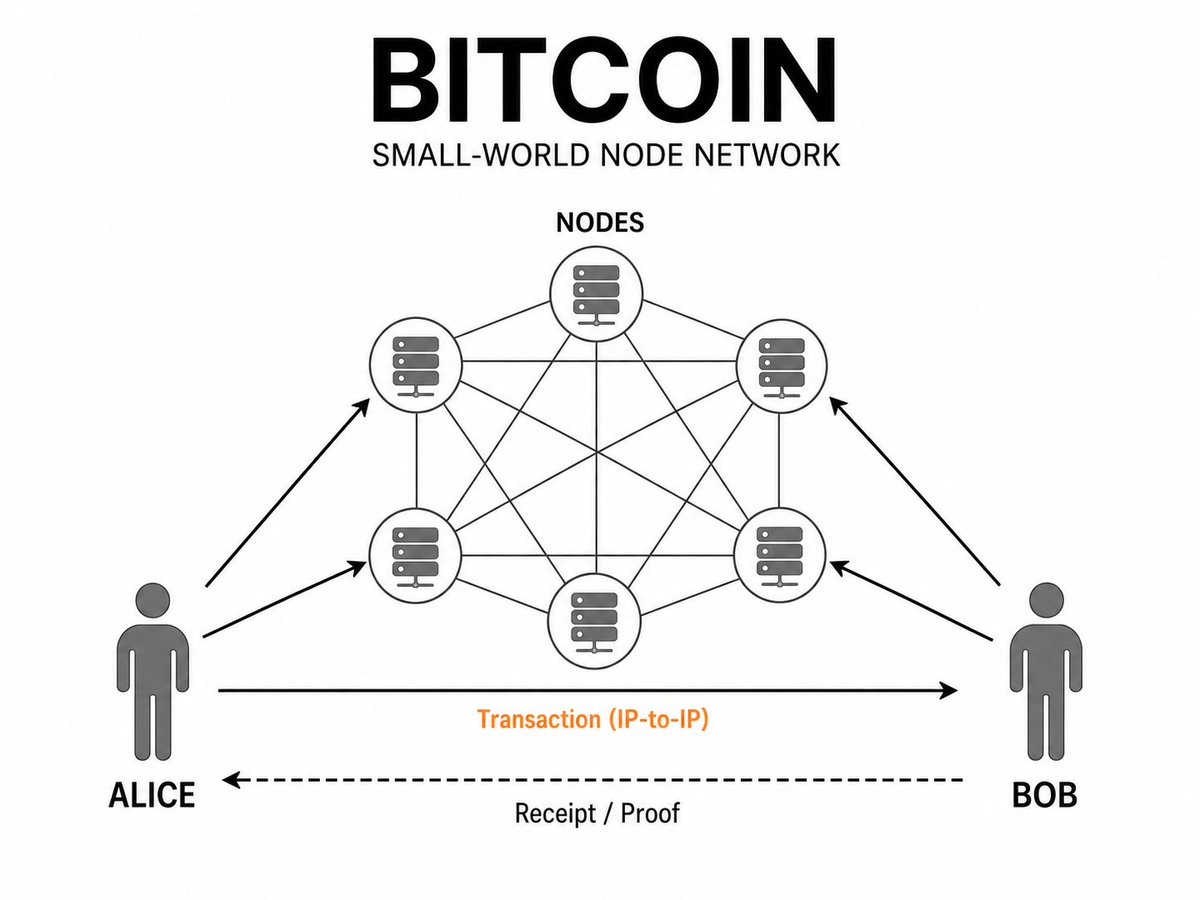
This is how Bitcoin is really designed.
Alice sends to Bob. Alice also sends to nodes. Bob sends to nodes. Bob returns a separate proof — a receipt — showing that he has sent. The nodes are not decorative little saints sitting in a chapel of theory; they are densely interconnected economic actors, passing information through a web so robust that failure becomes not a drama but an edge case.
Notice what is not being said.
Alice is not a node.
Bob is not a node.
A spectator with software is not a node merely because he enjoys the costume.
The nodes are the competitive parties that build, validate, propagate, and settle. Alice and Bob are peers. That is peer-to-peer: not a mystical commune of hobbyists, but a direct exchange between parties, with the network serving as the machinery of settlement.
The elegance is that trust is not required. Trust is the tax paid by badly designed systems. In Bitcoin, Alice does not need to trust Bob to behave nobly. Bob does not need to trust Alice to remain honest. The system is constructed so that proof, propagation, economic interest, and record replace sentiment.
And if someone reneges, the parties with an actual interest in the transaction still act. They propagate. They evidence. They settle. They do not need sermons on virtue, because incentives have already done what sermons pretend to do.
That is the architecture: direct exchange, proof returned, nodes interconnected, incentives aligned, failure reduced, trust displaced by evidence.
Bitcoin was not designed as a theatre for slogans.
It was designed to work.