In 1902, 18-year-old Alice Roosevelt was known for her rebellious and independent spirit. She owned a long-haired Chihuahua named Leo, as well as a pet snake named Emily Spinach which she would take to parties. Alice was known for her unusual habits, such as wearing pants, driving cars, smoking cigarettes, betting with bookies, and dancing on rooftops. In a span of just 15 months, she attended a staggering 300 parties, 350 balls, and 407 dinners.
Alice's stepmom once described her as a "guttersnipe" who went "uncontrolled with every boy in town," while a friend of her stepmom said she was "like a young wild animal that had been put into good clothes." Alice's behavior was so out of control that President William Howard Taft banned her from the White House after she buried a voodoo doll of his wife in the front yard. She was also banned by President Woodrow Wilson after she told a dirty joke about him in public (unfortunately, no record of the joke exists).
Alice's father, President Theodore Roosevelt, famously said, "I can either run the country or I can attend to Alice, but I cannot possibly do both." Alice herself once told President Lyndon B. Johnson that she wore wide-brimmed hats around him so that he could not kiss her.
In an interview in 1974, Alice described herself as a "hedonist." She passed away in 1980 at the age of 96.
The stunning natural wonder, Angel Falls (Salto Ángel in Spanish and Kerepakupai Vená in the indigenous Pemon language), is located in Venezuela and stands at 979 metres (3,212 feet) tall, making it the highest uninterrupted waterfall in the world.
Walter Gropius (1883-1969), one of the founders of the #Bauhaus and one of the most influential architects and designers of the 20th century, believed that design plays a fundamental role in society. He thought that design should not be viewed merely on an intellectual or material level, but as something embedded in everyday life and essential for every person in a civilized society.
Gropius' thoughts emphasize the importance of functional and aesthetic aspects of design, which contribute to improving people's lives and creating a harmonious environment. This belief led to the development of the Bauhaus Movement, which aimed to unite art, craftsmanship, and technology to create user-friendly, practical, and appealing objects and spaces.
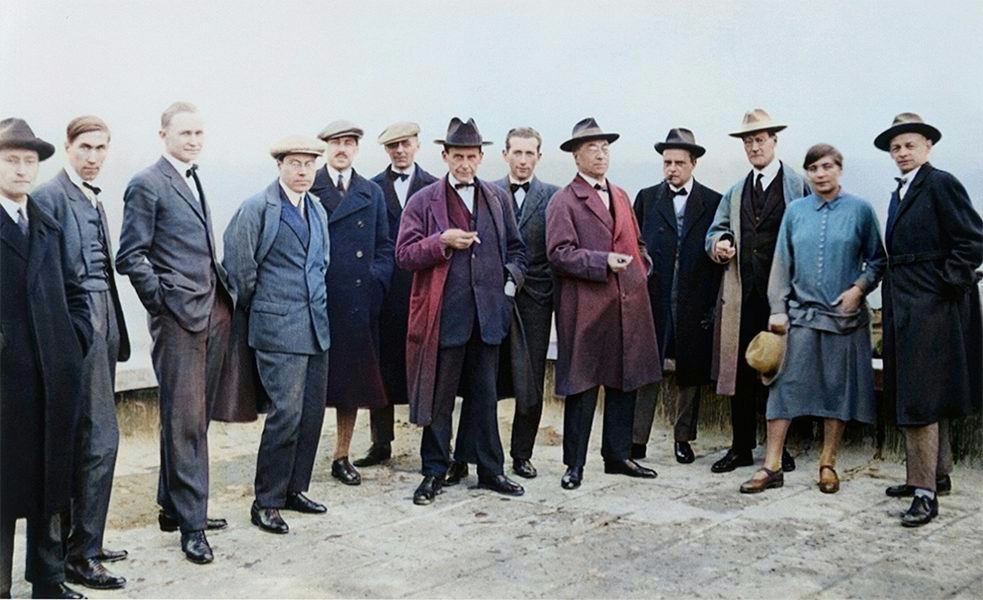
The Masters on the Roof of the #Bauhaus Studio Building in #Dessau, during the opening of the Bauhaus: Josef Albers, Hinnerk Scheper, Georg Muche, László Moholy-Nagy, Herbert Bayer, Joost Schmidt, Walter Gropius, Marcel Breuer, Wassily Kandinsky, Paul Klee, Lyonel Feininger, Gunta Stölzl, Oskar Schlemmer. Photo: unknown, 1926. (AI Colorize)