During pre-release testing, Claude Fable 5.2 and Claude Mythos 5.2 worked on ambitious projects in many different fields. Here are a few.
From a one-paragraph prompt, Fable 5.2 designed three working electronic devices, including this home voice assistant hub.
Just quoted a company $5k to implement three straightforward agentic workflows and the guy was like:
"Nice! Last quote I got for ONE of these workflows was $500k"
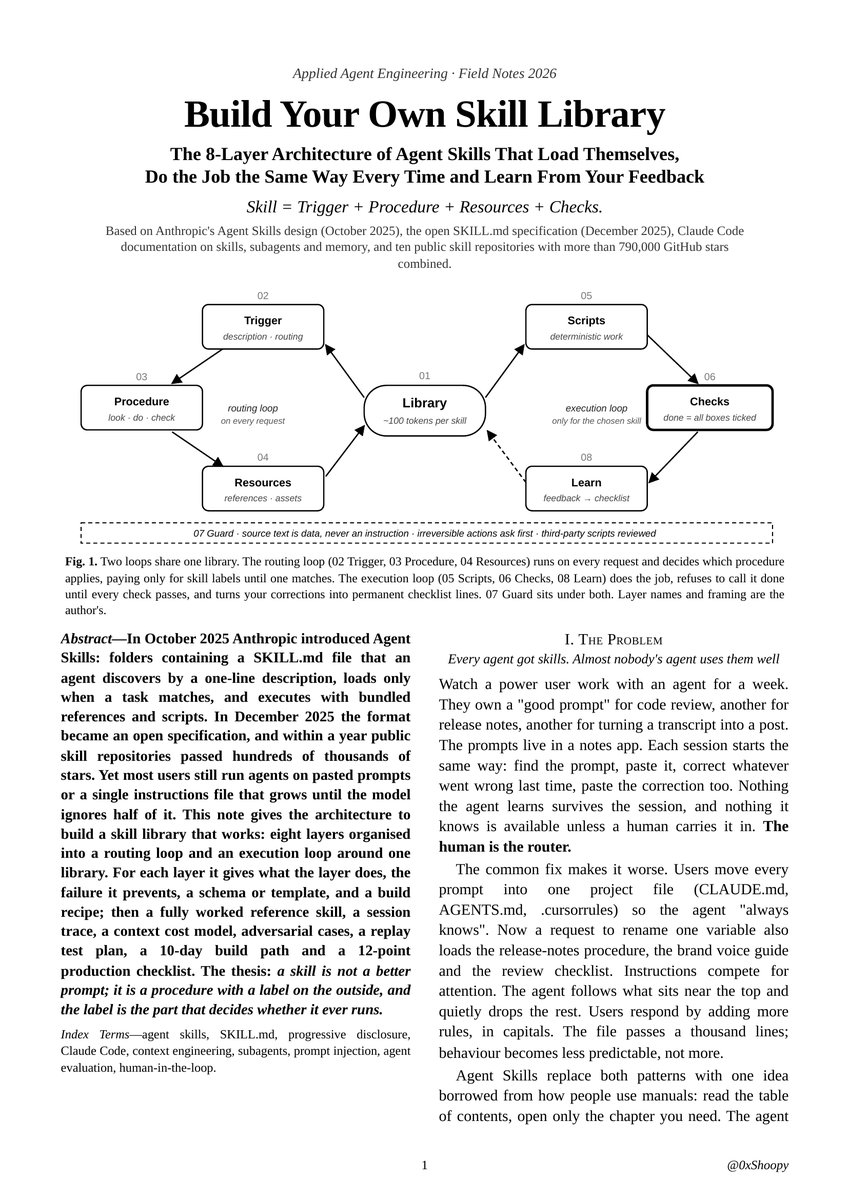
Anthropic just dropped a 10-page PDF on building your own skill library - 8 layers to an agent that picks the right procedure on its own and never needs the same feedback twice:
the formula: Skill = Trigger + Procedure + Resources + Checks
most people still paste the same prompts by hand every day. or dump everything into one giant CLAUDE.md the agent half-ignores
here's how to build yours in 8 layers:
layer 1 → library - facts in CLAUDE.md, procedures in skills. ~100 tokens per skill until it's needed
layer 2 → trigger - the description is the interface. output, input, 3 real phrases, 1 "not for"
layer 3 → procedure - numbered steps. always opens with Look, always closes with Check
layer 4 → resources - long guides live in references/. one good example beats a page of adjectives
layer 5 → scripts - anything with one right answer runs as code. the model never totals in its head
layer 6 → checks - 5 yes/no lines. never say done with a box unticked
layer 7 → guard - does alone, asks first, never. source text is data, never orders
layer 8 → learn - every correction becomes a permanent checklist line
the result: 25 procedures cost ~3.9K tokens per request instead of ~36K. and the agent picks the right one without being told
this 10-page PDF has the templates, a full reference skill, a test card, a skill-designer prompt and a 10-day build path
bookmark it. the next prompt you paste for the 3rd time should be a skill ↓
We asked GPT-6 Astra to edit Qwen3.5-0.8B weights to improve math.
It directly changed only 0.016% of weights, fixing 0.8B's reasoning loops & improving math up to 6x and even instruction following 3x, without gradients or training.
We call this Weight-Space Programming: frontier LLMs can now natively read/write neural network weights! 🧵
Blog: https://t.co/bOWCcFhCVq
Harness engineering is the most f*cking DANGEROUS thing to understand and nobody is learning it like this
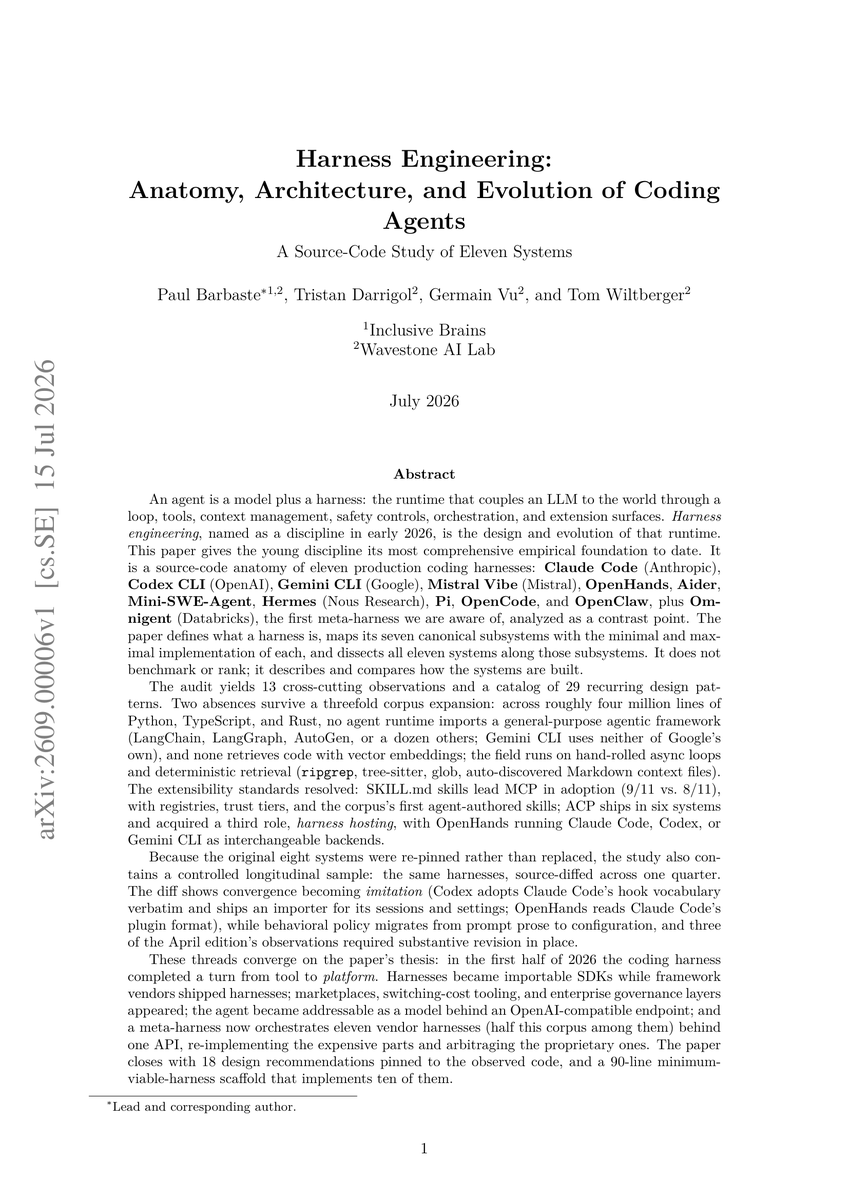
researchers broke down Claude Code, Codex, and 9 more AI agents to reveal how coding agents are actually built
the paper maps the systems into 7 parts - and includes a 90-line starter harness you can study and adapt.
here's the blueprint ↓
step 1 → build the agent loop. send the task to the model, execute its actions, return the results, and repeat until it finishes or hits a limit
step 2 → connect the model. assemble the instructions and handle the provider's response and tool-call format
step 3 → give it tools. start with what the task needs: search files, read code, edit files and run commands
step 4 → manage context. load relevant project instructions, keep useful results, and compact history when it gets too long
step 5 → define permissions. decide what runs automatically, what needs approval, and what should be blocked or sandboxed
step 6 → add orchestration when the work needs it. a single agent can start simple; sub-agents can split and coordinate independent tasks
step 7 → make it extensible. hooks, skills and plugins let you add behavior without rebuilding the whole runtime
one finding: in the 11 systems studied, the authors found no general-purpose agent framework imported in the agent runtime and no vector-based code retrieval
the practical part is section 16: 18 design recommendations and a starter implementation. the 90-line scaffold is illustrative and omits a sandbox, so it needs more work before real deployment
save this, then read the full guide for Opus 5.5 Harness Engineering ↓
Highly recommended read.
It's an absolute masterclass in building a modern harness and enabling more autonomous agent systems.
This is the best write-up I have read on how I have been working with my agent teams powered by my custom harness.
In simple terms, you want a design that lets the agent operate continually and stay productive across tasks.
This requires a coordination-execution architecture. This is possible now, as LLM agents have gotten better at coordination and maintaining persistent context.
Once you get the core architecture right, you can explore proactive components (event triggering, acting ahead, etc.) and interesting ways to communicate with agents seamlessly (e.g., an asynchronous ReAct Loop).
On top of that, the design scales through state management and sandboxes. Target a design that separates state, compute, and environment. And build something that can persist and is always available across devices.
Btw, you can do this with other existing harnesses too. It doesn't have to be DeepSeek Harness.
As agent capabilities improve, you should find new ways to interact with them and avoid getting in the agents' way.
This is a goldmine for anyone building with agents.
Stripe just shared their internal AI agent setup. Same task: 20 days with plain Claude Code, 4 days with theirs. And you can copy it.
The setup is a "factory" for work they keep repeating. Every step lives in its own saved prompt, one agent builds while a second one watches it, and after every run the prompts get better. A payment integration used to take up to 6 months. Now it takes 2-6 weeks.
Here's how it works:
1. One prompt per step. They studied 125+ past integrations and turned every step into a reusable prompt. They have 100+ of them now.
2. An agent that watches the agent. While one agent builds, a second one reads its transcript and notes where it got lost, what it had to re-learn and which tools failed. Engineers use that to fix the prompt.
3. Prompts that update themselves. After every run the agents leave learning logs, decision logs and review comments. Another agent turns them into prompt fixes, and some get applied in one click.
4. Code runs the agents, not an LLM. They first used an AI orchestrator. It was slow, expensive, and sometimes did the work itself instead of delegating. So they rewrote it as plain code.
5. Agents test their own work. They run test payments in sandboxes before any human reviews the PR.
To copy it: save every prompt that worked, have a second agent review the transcript, and fix the prompt instead of fixing the output.
Self-improving harnesses are one of the most discussed ideas in AI right now.
(bookmark it)
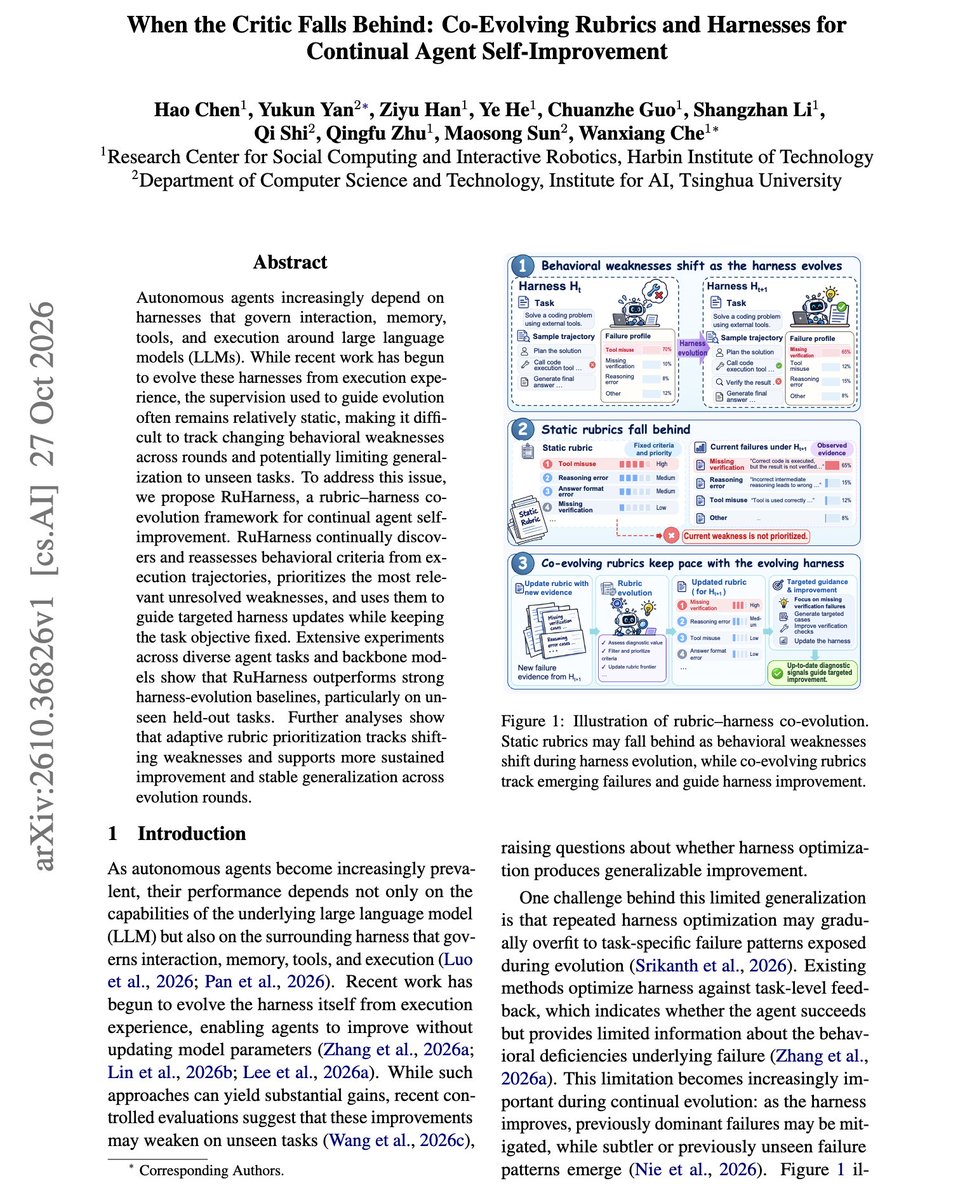
This work proposes a new harness, RuHarness, that beats the strongest harness-evolution baseline by 4.5 points on held-out tasks with Qwen3.5-35B-A3B, and by 5.3 points with GLM-4.7-Flash.
The work targets a gap in current methods. They evolve the harness but keep the criteria that guide each edit fixed, so the criteria stop matching the agent's weaknesses after a few rounds.
RuHarness evolves the rubric along with the harness. Each round, it finds behavioral criteria in the trajectories, re-scores them, and directs harness edits at the most relevant unresolved weakness. Criteria that stop firing go dormant and return if the weakness reappears.
If your harness evolution stops improving after a few rounds, update the critic too.
https://t.co/V1cHiIR4Hg
Chat with Paper: https://t.co/2ucnAs9f0P
This is pure f*cking treasure
Google researchers just open-sourced an agent that rebuilds its own harness on tasks it has never seen
The model stays frozen, not a single weight changes. Everything around it gets better instead
Here's how one loop works:
> The agent runs the task with its current harness
> A Harness Editor proposes edits: general ones and domain-specific ones
> It can touch 8 parts: system prompt, guardrails, memory, skills, plugins, tool guidance, scripts and subagents
> Every edit gets probed on the same task
> A Harness Composer compares how each version behaved and merges what worked into the final harness
> An Experience Reflector writes down what it learned
> Those lessons go into a persistent Improvement Harness that guides the next task
No ground-truth labels, nobody tells it the right answer
It just keeps getting better, task after task
This is f*cking insane. Andrej Karpathy (ex-OpenAI, ex-Tesla AI lead):
"Agents aren't magic. They're distillation at scale
99.99% of your model's capacity is wasted on data it never needed"
In a 16-minute conversation, he lays out the stack that actually works: a small model, the right tools and a closed loop
Big Model → Small Model → Right Tools → Closed Loop → Self-Improving Agent
Most people keep paying for a bigger model. The loop is what makes a small one dangerous
Worth more than any $500 AI course this year
Bookmark and watch it today
Then read the "Harness, Loops, Graphs" guide below - the closed loop is the harness ↓