Forward Deployed Engineer in Indianapolis. I ship the software that closes the last mile. Build log: learning AWS AI-DLC by building a Godot game on AWS.
Part 5 of learning AWS AI-DLC by building a game: inside one stage.
A stage isn't a prompt. A deterministic engine picks the one next move, the agent does it, and you approve. Eight steps, every time. #AIDLC
1 ask the engine 2 load the rules 3 questions 4 documents + diary 5 review 6 checks + learnings 7 approval 8 report.
The diary feeds the learnings, and the learnings become rules every later stage reads.
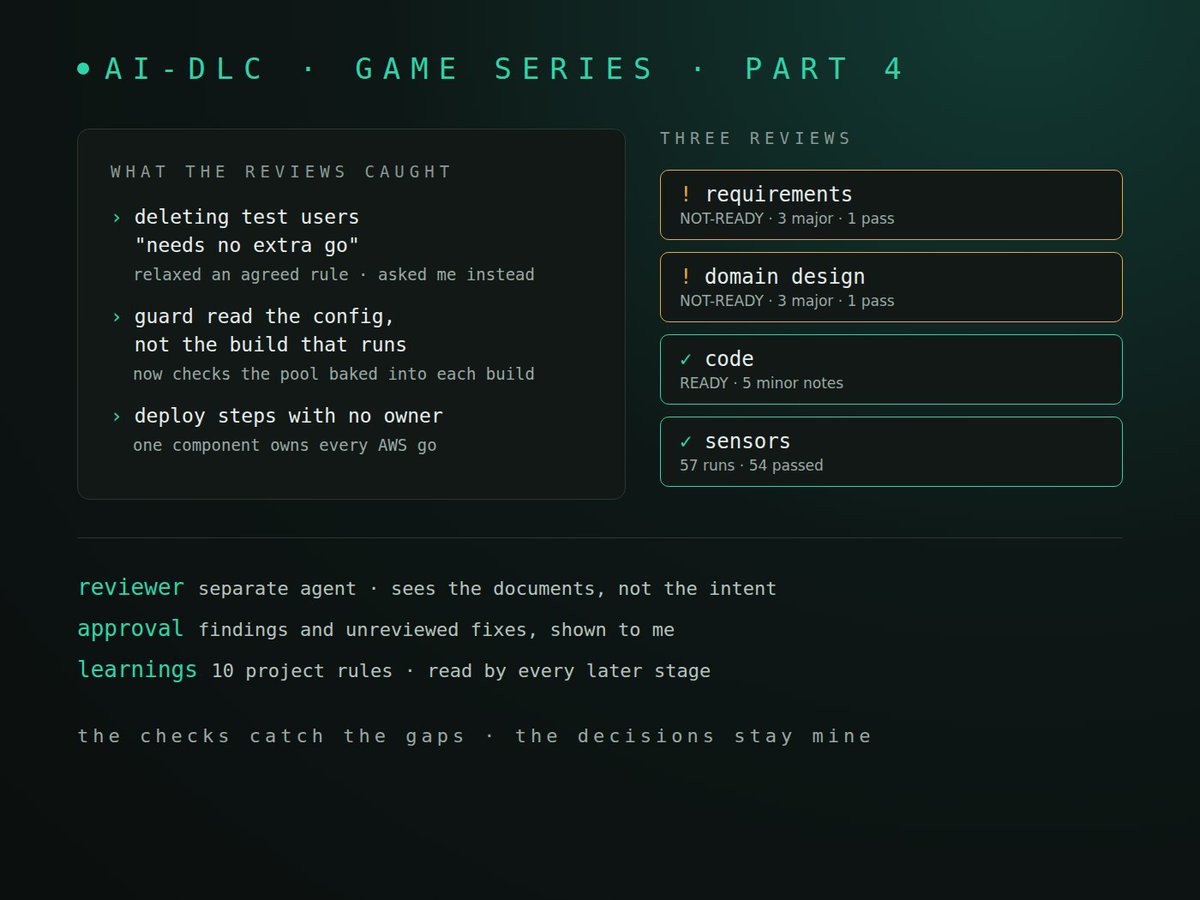
Part 4 of learning AWS AI-DLC by building a game: what the reviews caught.
Two of three AI reviews said NOT-READY. The best finding: my requirements had quietly relaxed a rule I'd agreed to less than an hour earlier. #AIDLC
The design review found a production guard that checked the config files, not the game build that would actually run. A copied build pointing at production would have passed. Now every build is checked before launch.
Part 3 of learning AWS AI-DLC by building a game: automated E2E tests.
One command signs a test player up with the real emailed code, signs in, and tries a wrong password on Linux, Chromium, Firefox and WebKit. 28/28 checks in 0.7 min. #AIDLC
The lesson: let the agent look before it asks. A read-only check of the AWS account found my DNS zone, so the mail stack wrote its own records and a manual step disappeared.
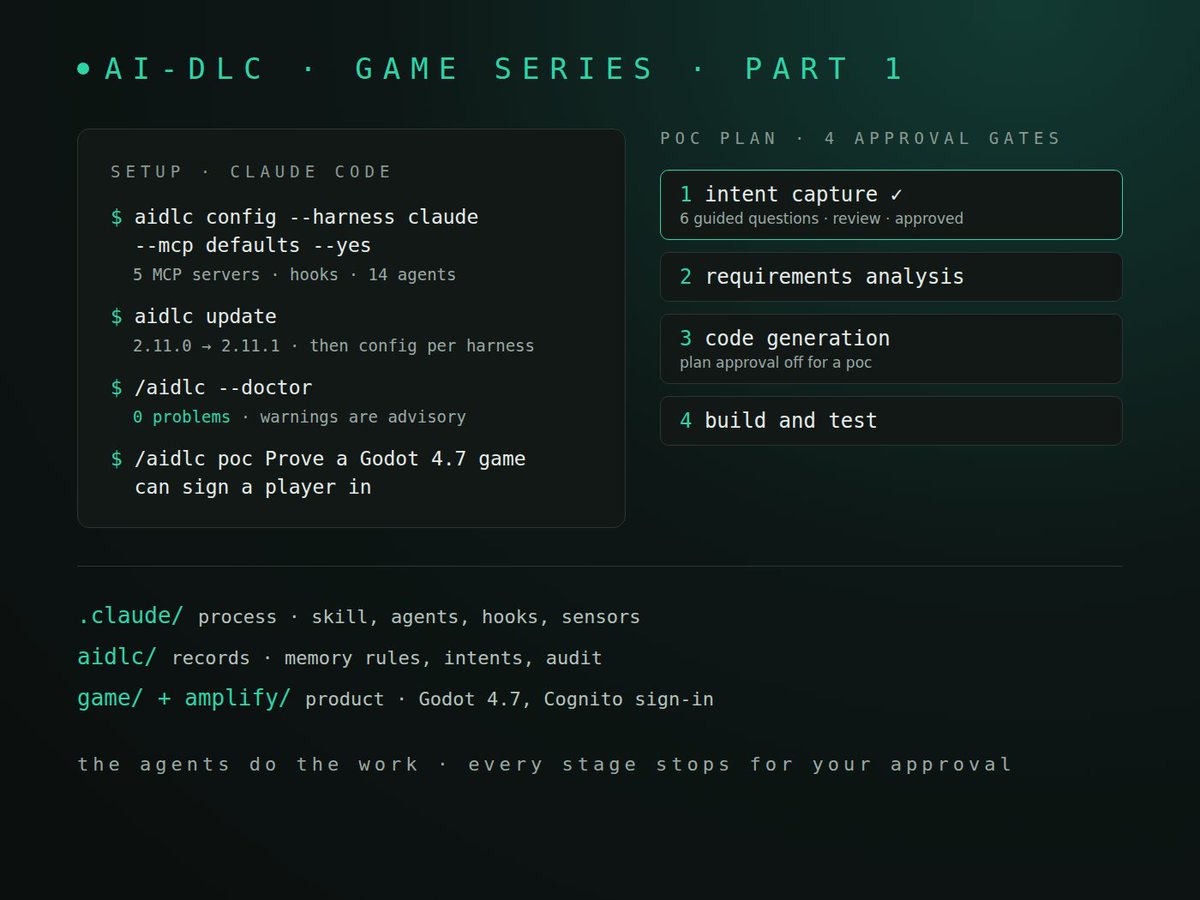
Part 1 of learning AWS AI-DLC by building a game: the setup.
The idea that made it click: the project has three layers. .claude/ is the process, aidlc/ is the records, game/ + amplify/ is the product. #AIDLC
The first run: install for Claude Code, update, run /aidlc --doctor until it reports 0 problems, then describe the work. I started with a small proof of concept, not the game.
I'm learning AWS AI-DLC by building a game: World Rift Conflict, in Godot with an AWS backend.
An agent does the work, every stage stops for my approval, and everything goes in a public build log. Five parts so far. #AIDLC
What surprised me most: the best review finding wasn't about code. My requirements draft had quietly relaxed a rule I'd agreed to less than an hour earlier. The reviewer caught it, and the agent asked me instead of guessing.
𝗡𝗘𝗪 𝗤𝗨𝗘𝗦𝗧 𝗜𝗦 𝗡𝗢𝗪 𝗟𝗜𝗩𝗘 🔭
We're excited to share our newest quest partnership with @influenceth
A boosted quest of 1,500 STRK is available for questers 👀
Complete the quest now 👇
https://t.co/DOYHFr4eE2
40 Deep #SEO Insights for 2023:
-In 2022, I told to focus on Natural Language Generation, and it happened.
-In 2023, F-O-C-U-S on "Information Density, Richness, and Unique Added Value" with Microsemantics.
I call the collection of these, "Information Responsiveness".
1/40 🧵.