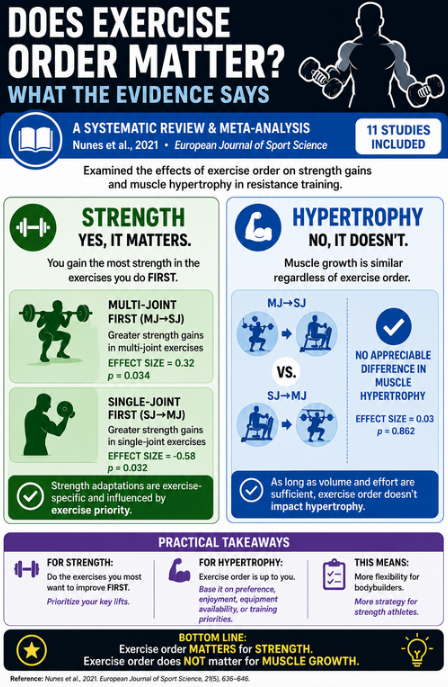
Common resistance training prescription is to perform multi-joint exercises before single-joint exercises. Our group, led by @joaonunesjpn, conducted a meta analysis to determine whether exercise order affects strength and muscle growth.
Results indicated that strength gains were greatest for exercises performed first in the workout. OTOH, muscle hypertrophy was similar regardless of exercise order.
There were some notable limitations. From a strength standpoint, all of the included studies assessed strength using repetition-maximum tests specific to the exercises performed in the study (e.g., if a squat was used in the workouts, 1RM testing was carried out in the squat). These results cannot necessarily be extrapolated to general strength, which would require testing a neutral modality (i.e., dynamometer).
From a hypertrophy standpoint, most studies measured muscles that were the primary mover in only one of the exercises being compared. For example, the biceps is the main target during curls but only a synergist during lat pulldowns. Thus, the finding that exercise order doesn't affect hypertrophy may simply reflect that performing an indirect exercise before a direct one doesn't impair growth. That said, the only study to directly compared exercise order when both exercises targeted the same muscle group showed similar hypertrophy irrespective or exercise order.
The general take-home from the evidence is:
For strength, prioritize the exercises you most want to improve by performing them early in the workout. However, it remains unclear whether exercise order influences the transfer of strength gains to broader functional tasks and activities of daily living.
For hypertrophy, exercise order appears to be largely a matter of preference, convenience, and individual training goals. That said, when training multiple muscle groups in the same session, it may be advantageous to prioritize lagging muscle groups. Mental focus and fatigue tend to decline as a workout progresses, potentially compromising training quality later in the session. Therefore, targeting less-developed muscles when you are freshest may help maximize the effectiveness of your efforts.
https://t.co/o1SmtgRebg
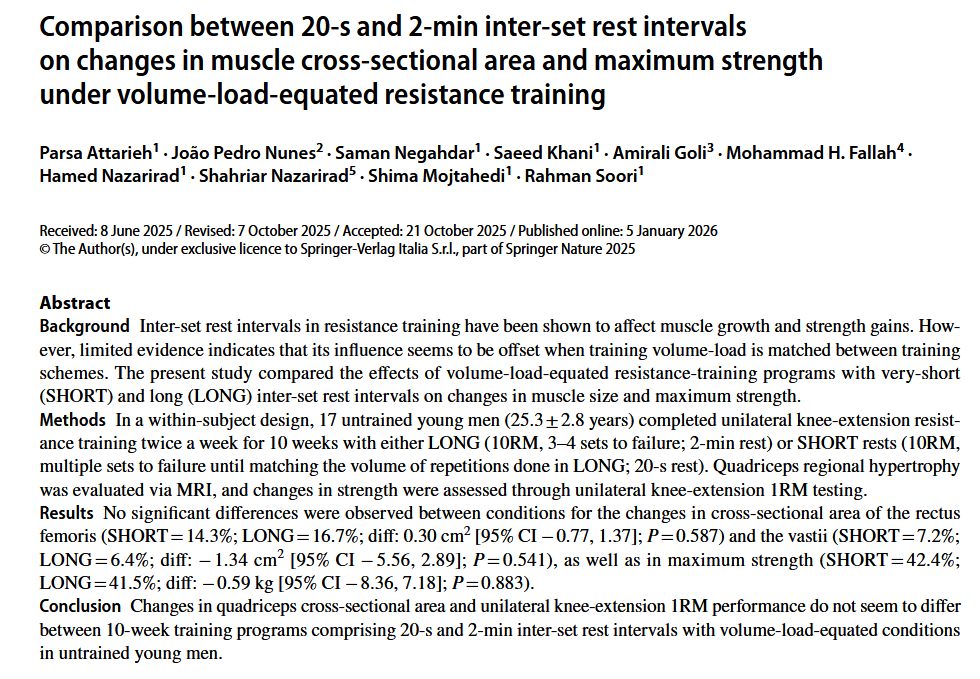
Comparison between 20-s and 2-min inter-set rest intervals on changes in muscle cross-sectional area and maximum strength under volume-load-equated resistance training
https://t.co/TSQeo60767
…here’s one commentary in response https://t.co/CSwGG1SW9a and our reply to it https://t.co/PqY1BrPxNw. Feel free to read and consider the evidence. And feel free to ask questions after reading 👍👌
Is eccentric exercise really a key stimulus for sarcomere addition? Here’s our comprehensive analysis https://t.co/hSWAHAX4w6. It triggered some nice discussions…
Hamstring injury mechanisms and eccentric training-induced muscle adaptations: Current insights and future directions.
@MaxAndrews100@GlenLichtwark
https://t.co/H9DStCoZt6
Great summary by @TonyBlazevich of our new paper in @JSHS_MedHealth on the stimuli required to increase skeletal muscle serial sarcomere number. 💪🔬
https://t.co/OS6V064tqn
Increasing serial sarcomere number (SSN) and thus fascicle length is highly sought after. Eccentric exercise (ECC) is often thought to be the best stimulus. But is this true? In our review, we pore over 150+ years of data to find out if we’re right https://t.co/y9ZCA8fIQJ 🧵1/14
Do bodybuilders pose symmetrically? Lateral bias analysis in mandatory poses of Mr. Olympia Classic Physique athletes.
@AJMarcori@ocklenBLOG
https://t.co/P9uVGiQN15
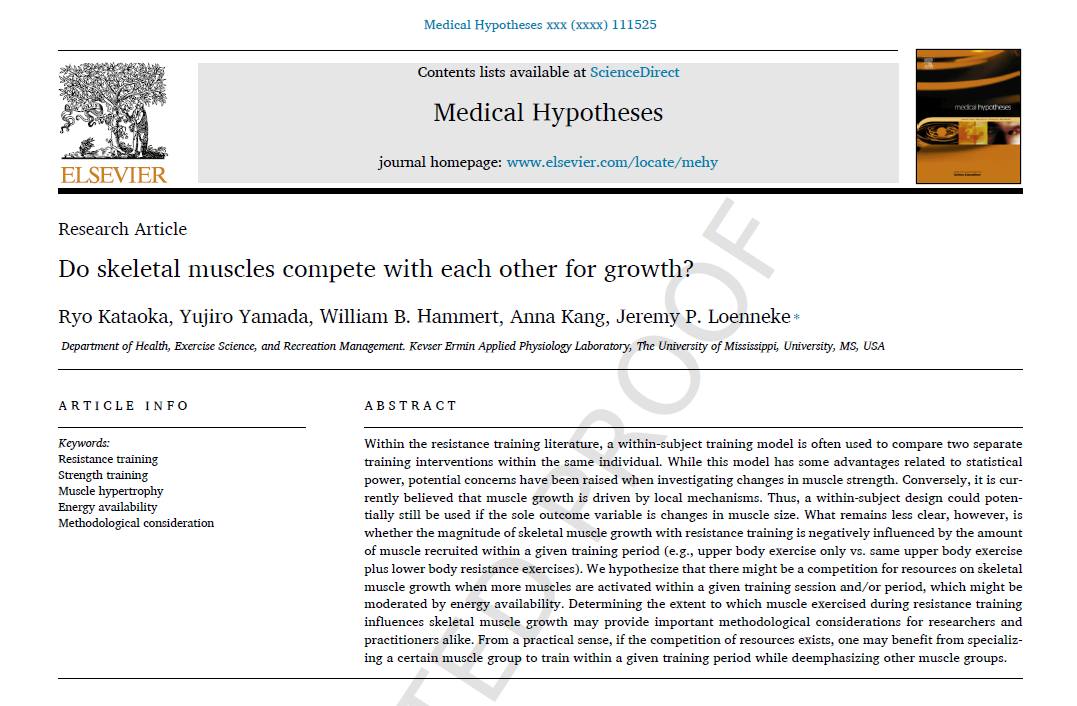
Do muscles compete with each other for muscle growth?
We discuss this idea, evidence for it, evidence against it, and how it might be tested in the future
#OleMissMuscle
Link: https://t.co/l7Z3afZNpr
📢 Active muscle stretch matters!
Eccentric contractions trigger history-dependent muscle properties that make up one third of the increased performance during SSCs. Find all details in our new paper @japplphysiol. Funded by @dfg_public.
@WolfgangSeiberl
https://t.co/i1m2vjtl7h
Undergoing a period in Verona under the supervision of @MonteA_biomech, with the amazing Paola Zamparo’s research group. Learning techniques and strengthening the collaboration between the Italian and the Australian groups. @TonyBlazevich. 🇮🇹🇦🇺+
We’re exploring the influence of muscle-tendon variable gearing behavior on metabolic efficiency, while comparing ~5min hopping under three loading conditions (BW, BW+15%BW, BW+30%BW). Muscle imaging, electromyography, kinetic and metabolic analyses. 📊
@JamesSteeleII Would be interesting to check in Brazil. "Publish or perish" begins at the sci-initiation undergrad, with the national scholarship program. After high school, our youth mostly goes for a bachelor rather than a short-term diploma. Not to mention the competition for MSc/PhD/Lect.
Fascinating findings that suggest muscle mass occurs by a reallocation of muscle proteins whereby hypertrophy in recruited muscles is supported by atrophy in non-recruited muscles! https://t.co/WaKWr2fhnA
Just pubbed: Our paper discusses the importance of assessing multiple sites along a muscle to get a complete picture of exercise-induced hypertrophy.
Kudos to @joaonunesjpn for spearheading the project 💪
https://t.co/mwcg3ydEvs