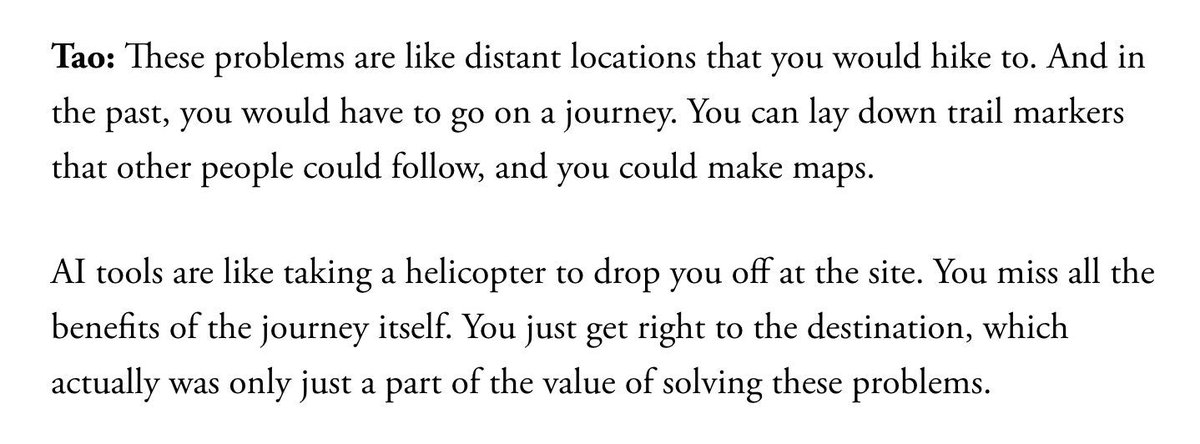
I love this metaphor from Terence Tao—widely considered the world’s greatest living mathematician—about one of the drawbacks of using AI to solve hard math problems. https://t.co/qOVNhfa2cC
The math on this project should mass-humble every AI lab on the planet.
1 cubic millimeter. One-millionth of a human brain. Harvard and Google spent 10 years mapping it. The imaging alone took 326 days. They sliced the tissue into 5,000 wafers each 30 nanometers thick, ran them through a $6 million electron microscope, then needed Google’s ML models to stitch the 3D reconstruction because no human team could process the output.
The result: 57,000 cells, 150 million synapses, 230 millimeters of blood vessels, compressed into 1.4 petabytes of raw data. For context, 1.4 petabytes is roughly 1.4 million gigabytes. From a speck smaller than a grain of rice.
Now scale that. The full human brain is one million times larger. Mapping the whole thing at this resolution would produce approximately 1.4 zettabytes of data. That’s roughly equal to all the data generated on Earth in a single year. The storage alone would cost an estimated $50 billion and require a 140-acre data center, which would make it the largest on the planet.
And they found things textbooks don’t contain. One neuron had over 5,000 connection points. Some axons had coiled themselves into tight whorls for completely unknown reasons. Pairs of cell clusters grew in mirror images of each other. Jeff Lichtman, the Harvard lead, said there’s “a chasm between what we already know and what we need to know.”
This is why the next step isn’t a human brain. It’s a mouse hippocampus, 10 cubic millimeters, over the next five years. Because even a mouse brain is 1,000x larger than what they just mapped, and the full mouse connectome is the proof of concept before anyone attempts the human one.
We’re building AI systems that loosely mimic neural networks while still unable to fully read the wiring diagram of a single cubic millimeter of the thing we’re trying to imitate. The original is 1.4 petabytes per millionth of its volume. Every AI model on Earth fits in a fraction of that.
The brain runs on 20 watts and fits in your skull. The data center required to merely describe one-millionth of it would span 140 acres.
Crawling isn't innate (unlike walking). Every baby must *invent* crawling, from scratch, using extremely little data, and no reference to imitate. Which is why different babies end up with different ways of crawling.
Sometimes people tell me, "you say AI isn't intelligent until it can invent, but most humans can't invent anything either!" -- in reality, we are all constantly inventing. Even babies are inventors. You couldn't navigate a single day in your life if you weren't capable of invention.
There’s a little voice in your head that when a track comes on on an album and doesn’t grab you that says “skip this track”. You should NOT listen to this voice. That’s my only real advice at 33.
In March 2023, Calcea Johnson and Ne'Kiya Jackson, two high school students, proved the Pythagorean theorem in a way that was previously thought to be impossible: using trigonometry.
In the 2,000 years since trigonometry was discovered, it has always been assumed that any alleged proof of the Pythagorean theorem based on trigonometry must be circular. In fact, in the book containing the largest known collection of proofs (The Pythagorean Proposition by Elisha Loomis), the author states that "There are no trigonometric proofs, because all the fundamental formulae of trigonometry are themselves based upon the truth of the Pythagorean Theorem."
However, that isn't entirely accurate. The authors came up with a new proof of the Pythagorean theorem that is based on a fundamental result in trigonometry—the Law of Sines—and they demonstrate that the proof is independent of the Pythagorean identity sin²x + cos²x = 1.
There's Always This Year, out 3/26/24. I am so proud of this book, and I feel very lucky that I got to write it. It would mean a lot to me if you would preorder it and also share it with folks who might be into it. Gratitude, always.
https://t.co/0LypPHmBRv
Beginning to understand why so many Americans are obsessed with trans issues and panicking about being replaced. They think there are 21x more trans people, 27x more muslims, 15x more jews, 5x more asians, 3x more black people, and 2x more immigrants than there actually are.