In 2015, Claudio Ranieri gave his Leicester City players bells for Christmas.
Little bells. Like the kind you'd find on a holiday wreath.
His message: "Dilly ding, dilly dong...wake up!"
It was a joke. A bit of theater from a 64-year-old Italian coach who had managed Chelsea, Valencia, Inter Milan, and Atletico Madrid and had never won a league title in his life.
The players laughed. The English press laughed harder.
Six months later, those same players were Premier League champions at 5000-to-1 odds. And "dilly ding, dilly dong" became one of the most recognizable phrases in the history of the sport.
You can't manufacture rallying cries.
Every company has tried.
Because a rallying cry isn't something a leader creates. It's something a leader reveals.
Ranieri didn't sit in a room and strategize about what phrase would unify his team.
He bought bells because they made him laugh, because he thought it might make his players smile, because joy was the environment he was trying to build.
The phrase came out of who he already was.
That's the only way it works.
The 2004 Red Sox called themselves "idiots." Not because a consultant told them the word would build cohesion, it was because Kevin Millar actually said it in the locker room and it was true.
The All Blacks sweep the locker room after every game. Not as a branding exercise. Because it reflects something they actually believe about themselves.
Your team's rallying cry already exists somewhere inside your culture.
In the way your people talk to each other. In the joke that lands every time. In the thing your best player does that nobody asked them to do.
The leader's job isn't to create it.
It's to notice it, name it, and get out of its way.
Vegas Golden Knights. 39 wins. Stanley Cup Final.
Twenty teams won more games during the regular season.
That stat is everywhere today.
And it perfectly illustrates what I keep coming back to about sports.
The scoreboard before the tournament starts is almost irrelevant.
What matters is who shows up.
The Golden Knights aren't a new story.
They've been telling this one since 2017 when they entered the NHL as an expansion team built entirely from players other franchises left behind in the expansion draft.
Other teams' castoffs. Other coaches' decisions to move on.
Their first coach, Gerard Gallant, had just been fired by Florida mid-season.
Their starting goalie, Marc-Andre Fleury, had won three Stanley Cups in Pittsburgh. Then the Penguins chose their younger goalie and asked Fleury to step aside. He agreed because that's the kind of player he is, and he ended up in an expansion city nobody thought could compete.
That team went to the Stanley Cup Final in their very first season.
Now they're back.
Here's what I think the lesson is...the one hiding inside the hockey story:
We're always making decisions about who gets the opportunity and who gets passed over.
Some of those decisions are right. Some aren't.
But here's what the Golden Knights have proven twice now: the player your organization moved on from is still a player. The person you decided wasn't the future might be exactly that, just somewhere else.
Culture doesn't care about your previous organization's opinion of you.
What you build in the new room is all that matters. The teams and companies that understand this go looking for the undervalued, the overlooked, the ones carrying a chip and something to prove.
They don't build rosters from the top of the market.
They build them from people who have been told no and decided that answer wasn't final.
39 wins. Stanley Cup Final.
You just gotta get in the dance.
@theblockspot
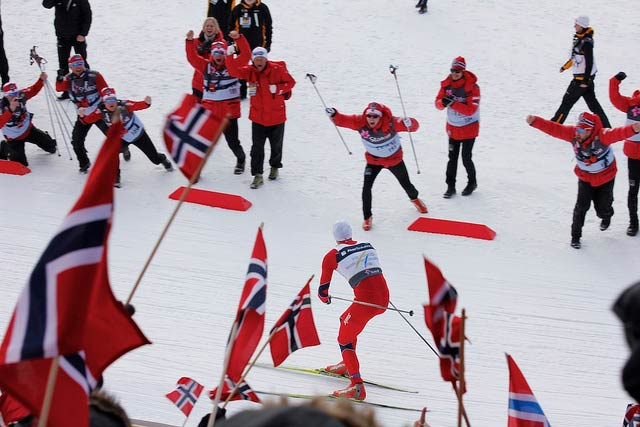
Norway consistently wins the most medals at the Winter Olympic Games, with a population of just 5.6 million people.
A big part of their success is how they treat youth sports—and it’s the opposite of what we do in the US. Here’s what we can learn from Norway:
1. Scorekeeping:
In the US: Youth sports tend to be hyper competitive even at early ages. Leagues almost always keep score.
In Norway: Scorekeeping isn’t even allowed until age 13.
Removing winners and losers keeps the focus on the process not outcomes. It keeps kids engaged longer because it minimizes pressure (and tears) and maximizes fun, learning, and growth. The goal isn’t to win a third grade championship. It’s to love sport and keep playing.
2. Trophies:
In the US: If you give everyone a trophy, you’re creating snowflakes who will never gain a competitive edge.
In Norway: Whenever trophies are awarded, they are handed out to everyone.
If getting a trophy makes young kids feel good, we should give them trophies. Maybe they’ll come back and play again next year!!
As for the creation of snowflakes with no competitive edge—Norway’s athletes are tough as nails and all they do is win.
3. Prioritizing Fun:
In the US: Far too often, the goal is to win.
In Norway: The national philosophy is “joy of sport.”
Youth sports in the US are driven by adults, ego, and money. Youth sports in Norway are driven by fun.
Only half of kids in the US participate in sports. The number one reason they drop out: because they aren’t having fun anymore. In Norway, 93% of kids participate in youth sports. Fun is the foremost goal.
4. Playing Multiple Sports:
In the US: There’s pressure to specialize early and play your best sport year round.
In Norway: Try as many sports as you can before specializing as late as college.
Norway encourages kids to try all types of sport. This reduces injury and burnout and increases all-around athleticism. It also helps promotes match quality, or finding the sport you are best suited for as your body develops, which is impossible if you commit to a single sport too early.
5. Affordability
In the US: There is increasingly a pay-to-play model with high fees for leagues, equipment, and travel. This excludes many kids from playing.
In Norway: It’s a national priority to keep youth sports affordable and therefore accessible for all.
Kids aren’t priced out, which creates opportunities for everyone to participate (and develop into athletes), regardless of their parents’ income level.
We could learn a lot from Norway:
In the US, 70% of kids drop out of youth sports by age 13. This not only diminishes an elite-athlete pipeline, but it also destroys an opportunity for healthy habits and all the character lessons kids can learn from sport.
In Norway, lifelong participation in sport is the norm. The goal isn’t to have the best 9U team. It’s to develop the best athletes. Those are two very different things. And Norway has the gold medals to prove it.