My girlfriend is an expert in Zero Knowledge Proofs because when I see her sulking, I can be 100% sure that I have done something wrong but I won't ever know what.
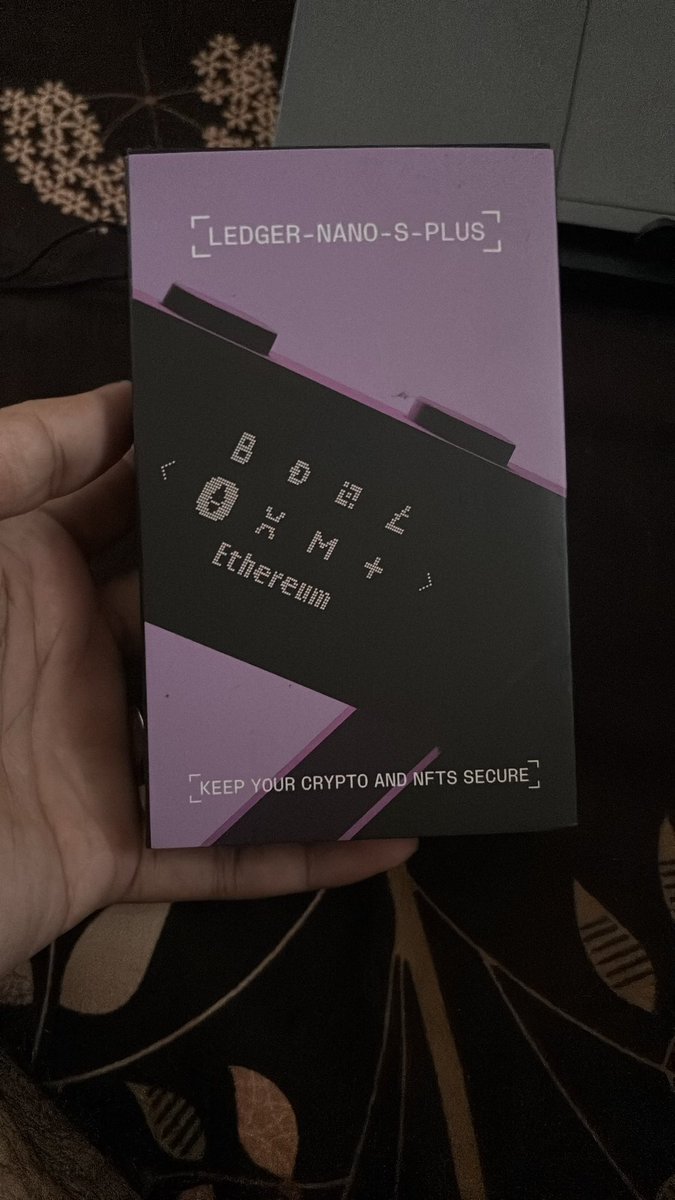
I bought my @Ledger from an official reseller @EtherbitHQ about a year ago
I store all my crypto in it and nothing has happened so far
But can someone please let me know if I’m actually safe?
It’s so stressful seeing all these posts about Ledger lately
Once Ledger finishes its internal investigation, the bare minimum I expect from them is a full breakdown of which countries, resellers, and platforms are safe or unsafe for Ledger devices bought in the last 24 months.
Fear of cryptography breaking yesterday.
Hardware wallet supply-chain attack today.
Now we just need Satoshi’s coins to move tomorrow to complete the holy trinity of 2016 FUD.
"The guys who bought our hardware wallet reseller company made us sign a contract so we do not warn anyone about the new owners before they can rug every customer's coin with the new compromised products"
LMAO
@katexbt@CryptoAwaz@cryptobilis The new management runs the account and made that post. We were legally bound by contract confidentiality to hold off on public announcements until Oct 19. We have no access to CryptoBilis accounts, backend, or operations.
The FUD:
Superintelligence will break cryptography, so move funds to fresh addresses while civilization collapses around you.
The reality:
Your coins are gone because the hardware wallet you got from a shady reseller has a spy implant reading your seed & texting it to the hacker
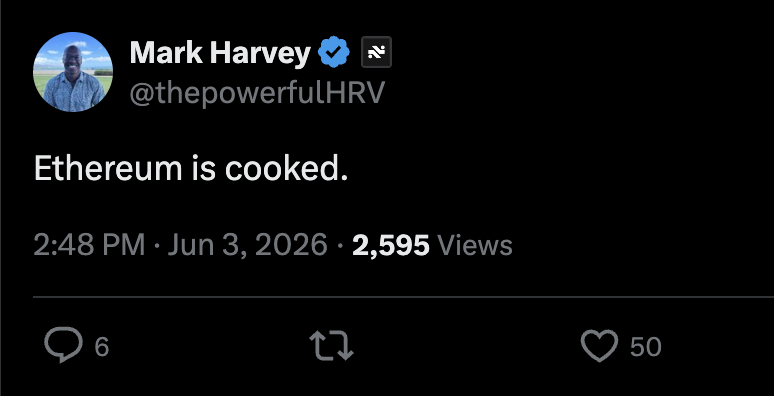
The funny thing about Justin Drake's post is that, in his mental framework, even “AI may break blockchain cryptography sooner than expected” is an ETH bull post.
He believes Ethereum is better positioned than most chains to go post-quantum/post-ECDSA.
99% just read doom.
Today I call upon the blockchain industry to calmly begin planning for "bunker mode". My personal recommendation is to set in motion a controlled mass migration of assets to fresh addresses, i.e. addresses whose pubkeys remain hidden behind a hash.
Holders, starting with large and sophisticated ones, should consider moving the bulk of their funds to addresses that have never signed a transaction. And when they do sign one, they should also move remaining funds to a new address (possibly generated from the same seed phrase).
Don't rush. While I believe there is cause for action a rushed migration would do more harm than good. Don't panic either. Moving assets to protected addresses is a simple, preventative step which does not require new cryptography or new wallets.
IMO it is now reasonable to brace for the possibility that ECDSA breaks before qday, in the worst case in months not years. By "break" I mean fast private key recovery (e.g. in one week) on available hardware (e.g. a large GPU cluster).
Recent days have been humbling for human mathematical intuition. Long-held, unquestioned hypotheses have fallen. This includes the n log(n) bound for integer multiplication and the 3SUM conjecture. In hindsight, May's unexpected disproof of the Erdős unit distance conjecture was our warning shot.
Yesterday's OpenAI drop made it clear that mathematical superintelligence is upon us. They say there are weeks where decades happen. We are about to live through weeks where centuries of mathematical progress happen. Could our magic 64-byte ECDSA signatures be too good to be true? Was it just security through obscurity all this time?
Elliptic curves feel especially vulnerable to superintelligence. Curves carry rich structure, with room for fancy tricks like Schoof, Frobenius, pairings. (By contrast, hashes are designed to minimise algebraic structure.)
Separately, as Ewin Tang can attest, an efficient quantum algorithm sometimes foreshadows an efficient classical one. We should be open to the possibility of a classical counterpart to Shor that breaks elliptic curves and RSA at once.
Also noteworthy is the striking under-representation of cryptographic breakthroughs among the 722 mathematical results OpenAI published. I've witnessed first-hand the US government censoring academic quantum cryptanalysis results. Backroom interventionism is my base case.
I urge large, sophisticated actors to lead by example. Project11's "risq list" (bitcoin-risq-list.projecteleven[.]com) is a great tracker of exposed BTC pubkeys. Binance, Bitbank, Robinhood, Bitfinex, and Tether have an opportunity to harden their cold storage. Next month I'll address institutions in London in a live Q&A (forum.ethereuminstitutional[.]org/london-2026).
Again, please do not rush. Wallets holding under 50 BTC enjoy partial cover from "Satoshi's shield", i.e. his 20K exposed addresses that hold 50 BTC each. Load-bearing signers like oracles and L2 security councils should consider rotating ECDSA pubkeys with every signed message and/or multi-signing with a hash-based schemes like SPHINCS.
Exiting bunker mode safely will require post-AI cryptography. My inclination is to go all-in on hash-based cryptography and avoid structured mathematical assumptions entirely, whether from curves, lattices, or isogenies. A single battle-tested hash (e.g. from the SHA or BLAKE families) yields plausible post-AI security.
The Ethereum roadmap on strawmap[.]org fully embraces hash-based cryptography with end-to-end formal verification as a response to the quantum threat. Those timelines must now be revisited and accelerated in light of mathematical superintelligence. I'll be pushing for maximum defensive acceleration.