We’re releasing a broad range of new mathematical results produced by an internal frontier model.
We’ve been consulting with the independent Advisory Group on Mathematics and Artificial Intelligence at the Institute for Advanced Study, and we have drawn on their advice and public recommendations to inform how we release these results.
https://t.co/7N6TPlft1P
Just finished my first JAX/Haiku model! It's an auction learner, based on a GAN inspired architecture (by @jrahme0, Sami Jelassi and S. Matthew Weinberg) https://t.co/1gQJIrbtr9
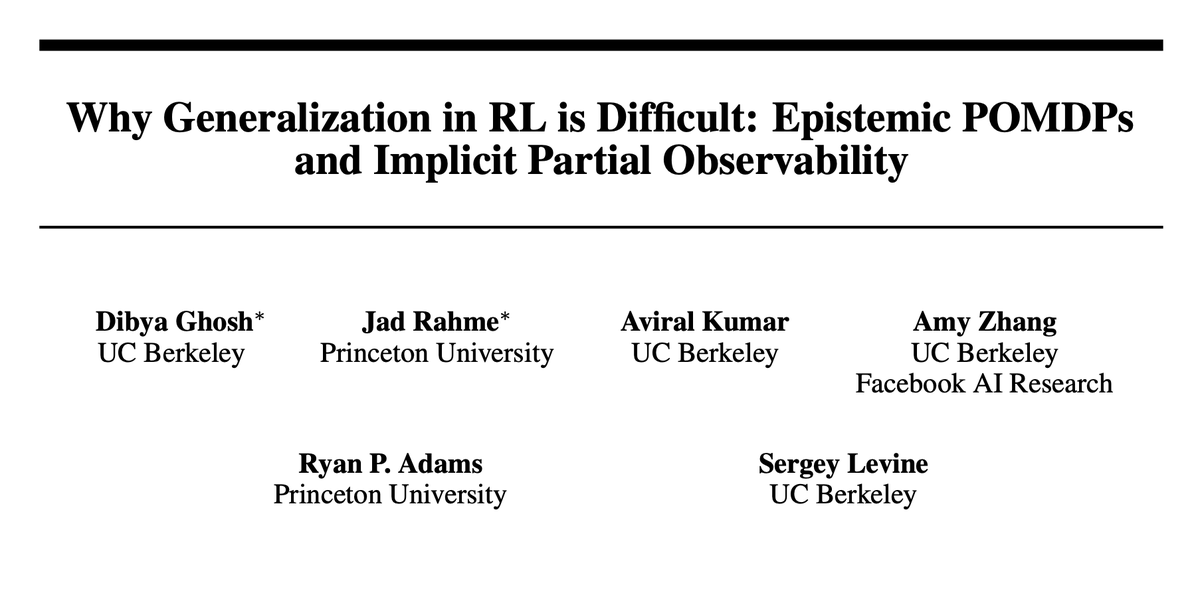
Empirical studies observed that generalization in RL is hard. Why? In a new paper, we provide a partial answer: generalization in RL induces partial observability, even for fully observed MDPs! This makes standard RL methods suboptimal.
https://t.co/u5HaeJPQ29
A thread:
Fresh on ArXiv! https://t.co/KY9tnogl6Z
TL;DR: Standard RL algos are sub-optimal for generalization. Why? When generalizing from limited training scenarios,the fully-observed env implicitly becomes partially-observed, necessitating new algos and policies to generalize well (1/n)
Generalization in RL is hard. Limited interaction with the environment turns a fully observed MDP into an implicitly partially observed one we call the "Epistemic POMDP". This viewpoint helps!
If you want to learn more, check out our new paper: https://t.co/vJI5a3QGkr
My student Jad Rahme just arxiv'ed a fun take on planning and RL from the point of view of statistical physics. (Bellman recursions on partition functions -- it's too bad the name "Z-learning" is already taken!) https://t.co/XRaTOkY06V
Excited to share my first paper https://t.co/NIQKMiOGln ! Revisiting Reinforcement Learning through the lens of Statistical Physics. Work with @ryan_p_adams.