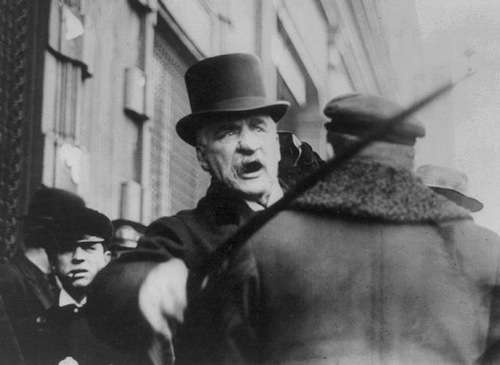
The Panic of 1907 is the most brazen financial coup in American history: a calculated assault on the nation's monetary system orchestrated by J.P. Morgan himself.
J.P. Morgan engineered the entire catastrophe for his own benefit. The collapse of the Knickerbocker Trust Company in October 1907 sent depositors racing to withdraw their money from banks across New York. Morgan had advance knowledge of Knickerbocker's copper speculation losses and chose exactly when to pull the trigger on public confidence.
Watch how the dominoes fell. Morgan controlled the flow of information about which banks were "sound" and which weren't. He decided which institutions received emergency loans and which died. When the Trust Company of America faced runs, Morgan theatrically examined their books for hours before announcing they deserved saving. The performance was calculated: create maximum panic, then position yourself as the savior. Charles Barney, Knickerbocker's president, killed himself rather than face the disgrace. Morgan played puppet master while the human cost mounted.
The endgame was always a central bank. Morgan had watched European central banks coordinate responses to financial crises and wanted that power centralized in America. He needed public demand for it first. Nothing creates demand for government intervention like a crisis that private actors supposedly can't handle. Conveniently, only Morgan had the resources to stem the panic he had created. He forced the Treasury Secretary to deposit federal funds in his chosen banks. He personally decided which financial institutions lived or died.
Congress took the bait perfectly. The Aldrich-Vreeland Act passed in 1908, creating the National Monetary Commission that would design the Federal Reserve System. Morgan's associates staffed the commission. They had their central bank blueprint ready before the panic even ended.
The Federal Reserve Act passed in 1913, giving Wall Street exactly what it wanted: socialized losses and privatized gains, with the government's money printer backing their plays.
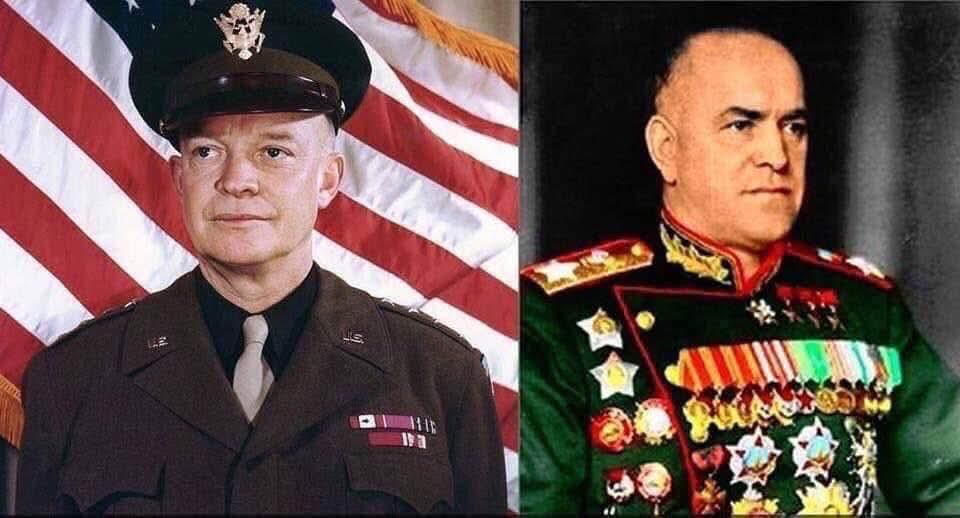
Interesting excerpts from the memoirs of Supreme Allied Commander General Dwight D. Eisenhower (later President of the United States from 1953–1961) about Marshal Georgy Zhukov:
“During the several hours we spent together in the airplane, Marshal Zhukov and I often discussed military operations... A great revelation to me was his description of the Russian method of attacking through minefields. German minefields, covered by enemy defensive fire, were tactical obstacles that caused us heavy casualties and many delays. Breaking through them was always difficult, despite the fact that our engineers had invented every imaginable mechanical device for the safe clearing of mines.
Marshal Zhukov casually remarked to me: ‘There are two kinds of mines: antipersonnel and antitank. When we encounter a minefield, our infantry continues the attack as though it were not there at all. We consider the losses from antipersonnel mines to be equal to the losses we would have suffered had the Germans defended that sector with concentrated manpower instead of minefields. Advancing infantry does not detonate antitank mines, so once they have crossed the minefield and secured the opposite side, the engineers then come forward and clear lanes through which vehicles can pass...’
I could vividly picture what would have happened to any American or British commander who attempted to use such tactics, and an even clearer picture of what the men in any of our divisions would have said if we had tried to make such practices part of our tactical doctrine...
Americans measure the cost of war in human lives, while the Russians measure it in the total expenditures of the nation.
As far as I could see, Zhukov cared little for the methods we considered essential to maintaining the morale of American troops: systematic rotation of units, opportunities for rest and recreation, short leaves, and above all the development of methods designed to avoid exposing men to combat risks that were not absolutely necessary. All of this, common practice in our army, was largely unknown in his army.
...The fundamental difference between American and Russian attitudes toward the treatment of people was illustrated in another incident. In a conversation with a Russian general, I mentioned the difficult problem of caring for large numbers of German prisoners of war — a problem we faced at various stages of the war. I noted that we gave German prisoners the same food ration as our own soldiers.
‘Why would you do that?’ Zhukov exclaimed in astonishment.
I replied that, first of all, my country was bound to do so under the Geneva Conventions. Secondly, thousands of American and British servicemen were prisoners in German camps, and I did not want to give Hitler any excuse to treat them even worse than he already did.
Zhukov was even more astonished by this answer and exclaimed: ‘But why should you care about soldiers captured by the Germans?! They were prisoners already and could no longer fight anyway!’
The excerpts are quoted from Dwight D. Eisenhower, Crusade in Europe, The Johns Hopkins University Press, 1997 (first published in 1948), pp. 468–470.
Interestingly, in the Russian translation of Eisenhower’s memoirs (2000 edition), these passages — seemingly of particular interest to Russian readers — were removed.
Everyone shouting “we can do it again” should remember that they would be sent to fight using Zhukov’s methods and traditions.
@elonmusk@paulg In support of this comment I recommend Erik von Kuehnelt-Leddihn's book Leftism: From Hitler to Pol Pot; no critic of your statement will have read it. Also, for the people who say Hitler was a capitalist or whatever, I recommend this https://t.co/62sKqO0Czk
Scientists mapped a piece of brain the size of half a grain of rice.
One-millionth the size of the human brain.
It took them a year and over 1.4 million gigabytes to scan it.
They found over 57,000 cells, 150 million synapses, and even some new structures they didn't know existed.
Mapping the entire human brain in this level of detail would require all the data storage generated on Earth in a year + a 140-acre data center.
But the human brain itself can hold up to ~2.5 million gigabytes of information - enough for ~3 million hours of HD video or 342 years of continuous viewing.
It can process roughly 10 quadrillion calculations per second - enough processing power to run over 4,000 high-end gaming PCs all operating at peak ability.
And it only runs on the amount of power needed for a single dim light bulb.
No technology even comes close to doing what the brain can do.
The more we learn about biology, the more complex it becomes.
This is God's Glory on display.
“One of the sad signs of our times is that we have demonized those who produce, subsidized those who refuse to produce, and canonized those who complain.”
— Thomas Sowell
On the Free Newsletter
“How Argentina Cut House Costs 70%”
https://t.co/lBpt1wcFwK
“Democrats are using housing affordability to win elections with policies that make it worse.”
“They could copy Milei and fix it in a year."
"They won't.”
The Plymouth Pilgrims accidentally ran the first documented socialist experiment in America three centuries before Marx scribbled his manifesto. Governor William Bradford's "common storehouse" system from 1620-1623 delivered textbook collectivist results: mass shirking, crop failures, and near-starvation.
Bradford recorded the disaster in detail. Young men "complained that they were oppressed" when forced to work for others without reward. Productive colonists watched lazy neighbors receive equal rations despite contributing nothing. The system "was found to breed much confusion and discontent" because it violated basic human incentives. People starved while fertile Massachusetts soil lay underworked.
The turnaround came swiftly in 1623 when Bradford abandoned the collective model and assigned private family plots. Production exploded overnight. Women and children voluntarily joined field work when their families directly benefited from extra effort. The same colonists who nearly died under socialism suddenly produced abundant harvests under private property.
Bradford explicitly credited private ownership for saving Plymouth Colony. He documented how individual responsibility transformed human behavior within a single growing season. Individual effort cannot be separated from individual reward without destroying both.
Every socialist experiment since Plymouth has repeated this identical pattern. Different century, different continent, same predictable collapse when planners ignore the reality of human nature.
No matter what they call it, whenever and wherever collectivist ideas are put into practice, disaster soon follows.
A man spends 50 years teaching at MIT.
He knows his time is running out.
So he records one last lecture — everything he knows, distilled into a single hour.
He died 5 months later.
This is that lecture.
The most important hour you'll watch this week. 👇
Bookmark it for later