This is a major signal. When OpenAI starts building private inference for its own customers, it confirms what we have been saying all along: privacy is about to become a requirement for serious AI use, not a nice-to-have.
But notice where their privacy begins and ends. It protects the content inside the model, yet every request still travels across the open network carrying your IP, your location, and your metadata to whoever sits on the other end. The prompt is private, but the connection that delivered it is not.
That is the layer Anyone was built for. Route your AI requests through a decentralized onion network and the model answers without ever learning who asked or where they were. No central provider holding the thread that ties every query back to you.
Private inference is one half of the stack, but private routing is the other.
You need both.
Watch @VeniceAI run directly through the Anyone network.
Every prompt is routed so the model answers without ever knowing who asked or where they were.
The connection that normally carries your IP, your location, and your metadata to whoever runs the model is gone.
Uncensored AI is only half of the equation. The other half is a network that keeps your identity out of every request you make, and it is the part most people overlook.
Together, they let you use AI in genuine privacy, with nothing pointing back to you.
This is what the privacy layer for AI looks like in practice.
Why would you pay to let a centralized VPN company store your data, when you can use superior, decentralized onion routing technology completely free of charge ?
https://t.co/UMJqKBCp80
Whatever headwinds come our way, the mission never moves. Privacy is a human right, and building the network that protects it is the work, no matter what any given week happens to throw at us.
We've kept our heads down and kept shipping because what we're building was never going to be shaped by the noise around it.
Every upgrade we make and every layer we harden is another step toward an internet where people actually decide what they give away rather than having it taken from them.
And the groundwork going in right now is about to open up what this network can really do. The part that connects real demand to real reward for the people powering it is closer than it has ever been, and when it lands, you'll understand why we stayed so focused.
Our mission has never been clearer.
The VPN market is on track to be worth around $86 billion this year, with more than 1.75 billion people already routing their lives through one. That’s nearly a third of everyone online paying for privacy that a single company can log, store, and lose in one breach.
The demand for privacy has never been bigger, but the thing most of that money is buying was broken from the start. This is the market Anyone is built to take.
Every person who realizes their centralized VPN is a single point of failure is a person looking for what comes next, and what comes next is a decentralized network with no central logs to leak and real demand flowing straight to the operators who run it.
An $86 billion market is quietly waiting to be rebuilt on infrastructure that actually holds.
Anyone is for everyone.
We choose privacy.
And we have for over three years.
Thanks to our community, we have created the largest onion-routing network in the world, released multiple applications across iOS, Android, and desktop, and have held the privacy flag high for over three years.
And we are just getting started.
Here is the flywheel almost nobody is paying attention to. Breaches aren’t rare events anymore. They’re the baseline. Nearly 2,000 breach sources this year have already exposed over 11 billion records, and U.S. victim notices hit 471 million in the first half of 2026 alone (already 60% above the entire previous year).
And the reason it keeps happening is structural. Any company storing a central record of what its users do is holding a target, and it takes one leaked credential, one insider, or one misconfiguration to spill all of it at once. A centralized VPN is that exact shape: a single pile of logs tying every user to everything they did, just waiting its turn.
So each breach pushes more people to realize the model itself is broken, and they start moving to decentralized privacy. That brings more traffic and real demand onto Anyone, rewards the operators running the relays, and funds a larger, stronger, more private network.
Every breach of the old world quietly builds the one replacing it. Anyone is for everyone.
October was another busy month for Anyone, with developments across protocol infrastructure, privacy integrations, network governance and community applications.
Read the full October Development Summary:
https://t.co/EEU5mGL571
Everyone is staring at how the money left, but the real question is how the attackers knew where to look.
A pseudonymous wallet doesn’t hide you. The moment you touch the chain, your wallet reaches out to a node and exposes the raw IP behind it. Tie one IP to one wallet, and everything unravels into a real person at a real location.
That’s the first thing a hacker hunts for, and it no longer stops at your funds. Holders are being doxxed through their on-chain activity, and the metadata you leak is the same trail that leads to your front door.
This is only the beginning. AI agents are already probing for weaknesses at machine speed across the same exposed layer you use. And if it’s connected, it’s a target now, from crypto wallets to the supermarket freezers cooked across Europe this week.
So people reach for a VPN and assume they’re safe. They’re not. A VPN just swaps your provider for one company that sees everything and logs it anyway. It’s a centralized target like everything else above, and when a VPN gets breached, it spills the whole backlog at once. Every user, every session, every real identity behind every connection. The thing you trusted to hide you becomes the perfect map.
Anyone removes that point entirely. Your traffic runs through the largest decentralized onion network in the world, where no single operator sees the full picture. No central log to leak, no one to pressure, nothing to seize. Not funded by the US government or any other major sovereign or corporate entities, but built from the ground up.
Your keys keep your funds safe. Anyone keeps the layer beneath them secure.
Anyone is for everyone.
Every time an AI agent touches any chain, it has to talk to an RPC node, and that node sees the IP address behind every single request alongside the wallet making it.
So while everyone obsesses over the pseudonymity of their wallet, the agent running 24/7 is quietly handing a centralised provider a timestamped map of everything it does and exactly where it’s coming from.
Anyone closes that gap at the network layer, masking the IP behind every call so the agent’s origin never meets its onchain identity.
Protecting privacy, for anyone.
Ethereum founder @VitalikButerin showed a privacy focused AI agent using Tor, zkAPI and cover traffic.
We built our version with Anyone.
Private AI inference via zkAPI Mainnet. Pi researching the live web through Anyone, with isolated sessions and background cover traffic.
Here it is in action.
Daily reminder that Uvita 🇨🇷 has the highest concentration of merchants accepting Bitcoin in the world.
Can we finally say it out loud that Costa Rica is THE Bitcoin country?
@AnyoneFDN@VitalikButerin
Half of this is solvable today with no changes to your bwrap/torsocks setup: @AnyoneFDN Relays (a Tor fork, SOCKS5 on 9050) are staked and paid per measured uptime+bandwidth, so new-circuit latency drops hard. ~6k relays, 59 countries, ~78 GB/s live on .
On the timing point you're right: Onion routing, Anyone included, won't beat a provider colluding with your Guard. But an incentivized network with public per-relay metrics is where a padding layer can actually be paid for and measured. Happy to dig in — I build the Relay map.
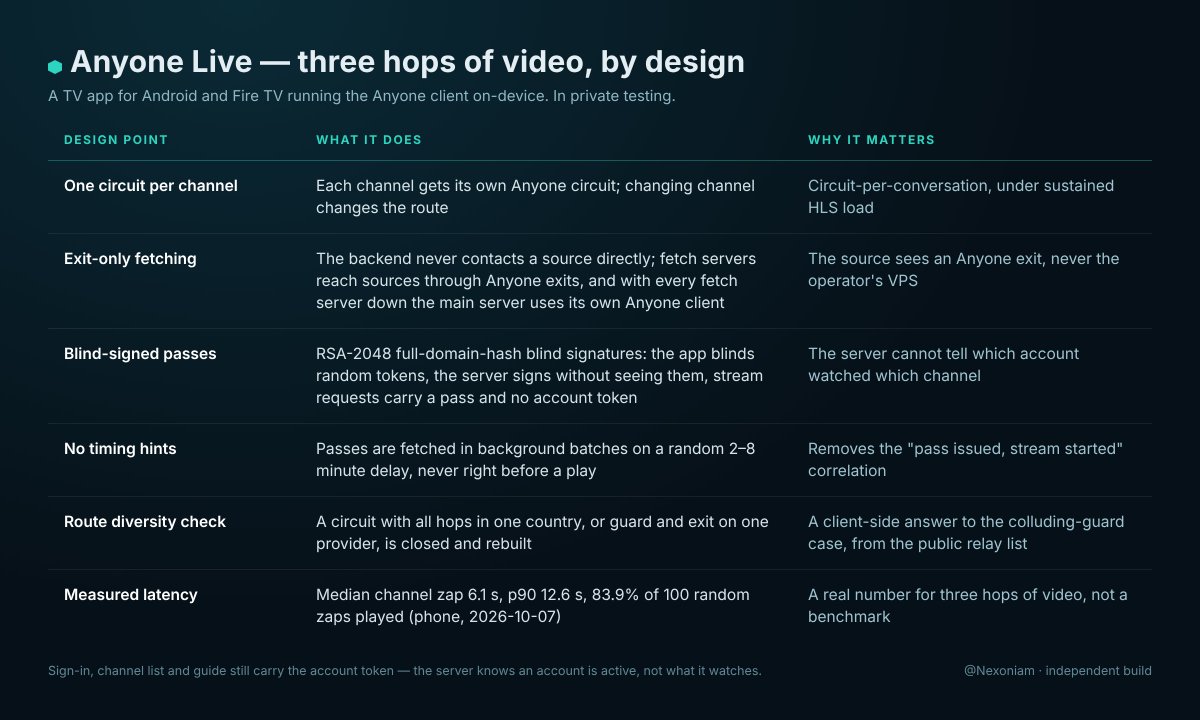
Proof it holds up under real traffic: Anyone Live, a First Privacy TV app for Android + Fire TV with the Anyone client on-device. One circuit per channel, streams fetched only through Exit relays, blind-signed passes so our own server can't link an account to a channel. Median zap 6.1 s over 3 hops.
What we're building: Anyone Live TV
Anyone Live is the live-traffic test of the argument above: a working IPTV app (Android phone and Fire TV, 17 languages, in private testing) that runs the Anyone client on the device and pushes video, not text, through three hops.
As presented in today’s State of Anyone Space, our Paid Circuits report outlines the technical architecture behind sustainable network revenue, privacy-preserving premium bandwidth, and $ANYONE utility.
Implementation is already underway.
Read more: https://t.co/KujuoKAJiM