Not to take anything away from Elon Musk’s financial achievement, but understanding the difference between sovereign wealth and subordinated wealth is useful when saying that he has become the world’s first trillionaire.
People see Forbes rankings and think that’s where the real money is.
The House of Saud, Abu Dhabi’s Al Nahyan family, Qatar’s Al Thani family, the Rothschilds, the Rockefellers, sovereign wealth families, and the broader financial-industrial complex have spent generations building influence over capital, banking, energy, debt markets, institutions, and the rules of settlement itself.
Most billionaire wealth is marked-to-market. It is a quoted value based on public company shares, liquidity, credit conditions, lenders, institutional shareholders, asset managers, and collateral rules.
Direct control of wealth is different.
Much of the world’s wealth is not publicly visible.
Private companies, trusts, foundations, sovereign entities, and offshore structures rarely appear on rich lists.
Privacy, control, and asset protection are features of wealth preservation, not bugs.
You’re a trillionaire when you can send a trillion dollars of Bitcoin in a single transaction (and nobody in the world can do that yet), or load a trillion dollars of gold onto a ship in your name and move it without permission.
Everything else is subordinate to someone else’s balance sheet, rules, and approval.
Visible wealth and actual financial power are not the same thing.
I encourage sovereign wealth over subordinated wealth.
Only sovereign wealth is true freedom.
Follow the money.
I spent 7+ years studying money full time to understand how the financial system was designed to keep you poor forever.
Here are the top 10 brutal truths no one will ever teach you (THREAD):
1. Every dollar is your life compressed into a token.
Het kastenstelsel van Nederland:
1. De Nieuwkomer: Nooit een cent belasting betaald, maar krijgt gratis zorg, bijstand, iPhone + fatbike.
2. De Statushouder: Krijgt bijstand, gratis zorg, voorrang op baan & woning.
3. De Ambtenaar: Baanzekerheid, jaarlijkse salarisindexering, riant pensioen.
4. De Hardwerkende Nederlander: Werkt totdat hij/zij erbij neervalt, draagt helft inkomen af aan belasting, uitgeklede zorg & pensioen, mag geen eigen kapitaal opbouwen en draait op voor alles!
Het box 3-plan is een Orwelliaans gedrocht.
Vermogensaanwas is (deels) een eufemisme voor geldontwaarding.
Overheid voert beleid om inflatie te veroorzaken. Logischerwijs stijgt de prijs van je bezittingen.
Overheid: Aha! De ‘waarde’ van je vastgoed, goud, aandelen is gestegen, betalen!
Ze doen alsof elke koersstijging vermogensaanwas is. Dat is het echter pas écht nadat de inflatie is goedgemaakt.
(En dan niet de CPI-inflatie, want we beleggen niet voor potten pindakaas.)
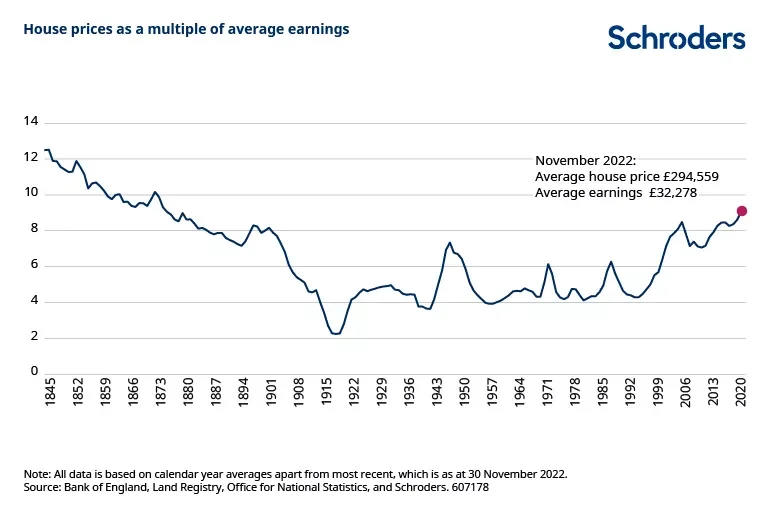
Going off the gold standard in 1914 stopped a centuries-long increase in affordability of homes by degrading the value of money, forcing people to use their homes as saving accounts, raising house prices beyond the rise in income
These men created tools of freedom and financial independence. They wrote code and ran businesses. They are good people.
They were rewarded with federal prison sentences.
Keonne Rodriguez
William Hill
Ian Freeman
Roman Sterlingov
Roman Storm
Free the crypto prisoners.
Ten years in the making.
The Saifedean/Balaji crossover.
Bitcoin Standard meets Network State.
0:38 - What is the Network State?
7:03 - Keynesianism as Communism for wimps
38:08 - Chinese Bonds, Gold, Digital Gold, Tech
1:05:09 - The Great Inflation
2:05:42 - Technodemocracy
To be clear, about ed tech:
--I think teachers should have a computer in the classroom and way to show images and videos, if they choose to.
--I think @khanacademy has proven its worth, abundantly. I wish it could be offered on a dedicated device, with no distractions.
--In my several posts about ed tech, teachers often add comments. They rarely praise or defend ed tech.
--I think schools should have a computer room (as at the Waldorf schools that some tech execs seek out for the low-tech classrooms). Students need to learn to use computers and the internet.
--The most damaging mistake seems to have been the 1:1 devices -- putting a Chromebook or tablet on each student's desk. As a UNESCO report said in 2023, the distraction effects seem to exceed whatever benefits a few of the apps might have:
https://t.co/79LBBfxZen
--I don't doubt that some apps which gamify learning have been proven to produce faster or better learning than older methods. BUT: if you gamify a third of the school day, the dopamine effects would cause the other 2/3 to seem more boring. So the net effect in a real classroom may be negative even if some apps showed consistent benefits in controlled tests.
--The big question we need answered is: does giving each student their own device, to use during much of the school day, end up promoting or interfering with education over the course of a year? Horvath's graph suggests that in real classrooms, it interferes.
--Putting devices on every student's desk seems to be the second giant uncontrolled experiment that the tech giants ran on our children, without our informed consent. (Smartphones and social media was the first.) They are already starting up the next one: chatbots for kids, and these will be pushed into schools too despite the already obvious harms.
--We are gathering research on ed tech at https://t.co/0gyIphz5m7. Here is a link to all of our posts about "What Schools and Educators Can Do Now."
https://t.co/R7A6HFXetO
See especially this one, by Mark West:
https://t.co/AOjJ196POs
We will have more to say in future posts.