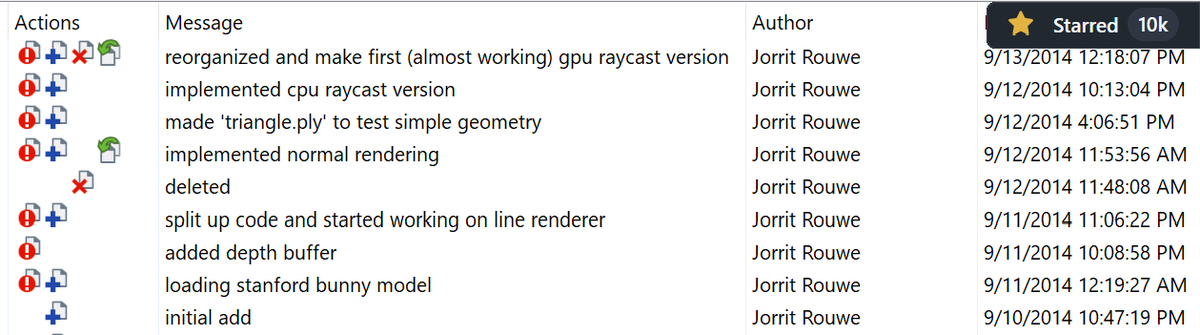
@dzmitryj_ Unfortunately the GPU raycasts never made it because the overhead of going to the GPU and back was too much at the time. Someday they will be back though!
Jolt Physics just hit 10K GitHub stars! What started in 2014 as a CPU vs GPU ray casting experiment became a full physics engine in 2021. Seeing what you’re building with it is amazing. Thank you!
@BattleAxeVR It references your original shape, so no triangles are duplicated. If you use non-uniform scale on CompoundShapes then it may create a new CompoundShape, but whatever is in the CompoundShape will not be duplicated.
@BattleAxeVR About the convex hulls: PhysX is using 'convex decomposition' (creating multiple convex hulls). Jolt only creates a single convex hull. You'll need another library to do the decomposition, e.g. https://t.co/mv2YWonX2O
@BattleAxeVR There is the JoltViewer, but it doesn't connect over a socket like PVD does, it reads from a file that you can produce with DebugRendererRecorder. I usually just draw physics object in the game window using the DebugRenderer.
@BattleAxeVR What's wrong with the convex hull generation code? Send me the points that cause issues and I'll take a look. (Note that I did a tweak to the generator this week)
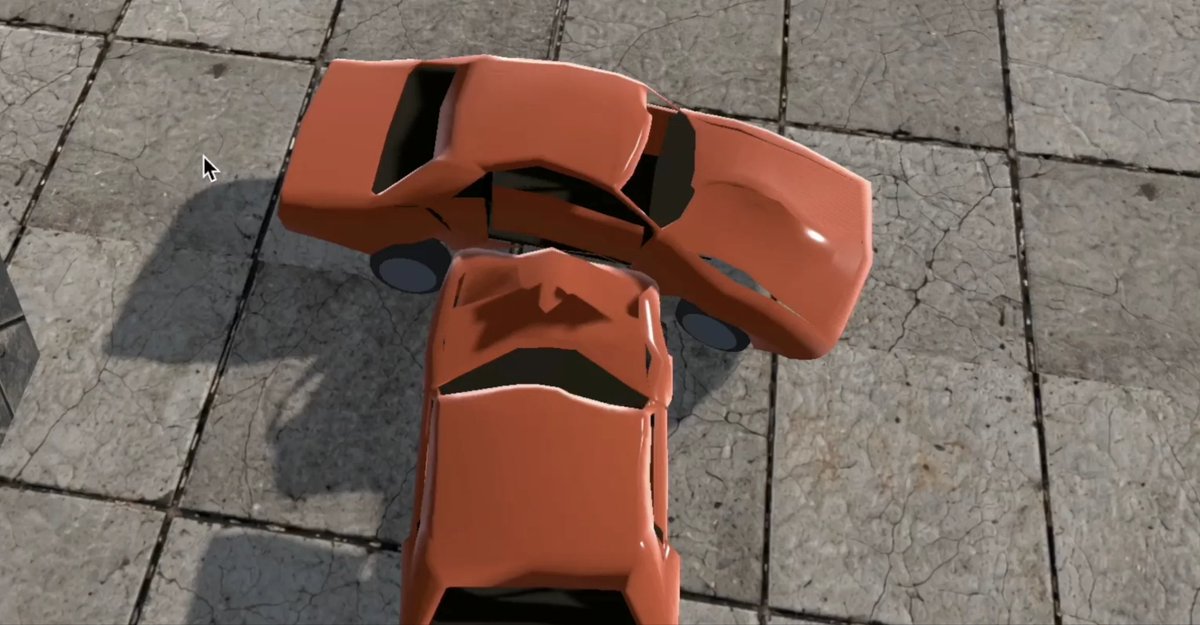
Early prototype of a real-time, physics-driven car deformation system built in Godot on top of Jolt Physics.
All deformation is computed at runtime (no pre-baked damage), and it runs in real time on older mobile hardware.
Video: https://t.co/tv9IKXAjpJ
@mannyn83 > Does Jolt want to create the program from it's own shader source?
CreateComputeShader(const char *inName, ...) passes in a name. Where you get the shader from is up to you. The default DX12 implementation uses mShaderLoader to load hlsl, Vulkan/Metal load compiled shaders.
@mannyn83 I did attempt to make that abstraction in a way that is hopefully easily integrated (with DX12, Vulkan and Metal implementations): https://t.co/iLohd1Io3t. Let me know what you think of it.
@datgame The 4ms is measured on GPU, the CPU part is about 0.1 ms (broad phase collision detection + setting up compute jobs). And it is indeed one way: physics objects affect the hair, but the hair doesn't affect the physics objects.
@datgame If you're talking about how fast it runs: Currently 4 ms on my 5070 Ti laptop GPU with the sim running at 360 Hz. I have to further optimize it though.