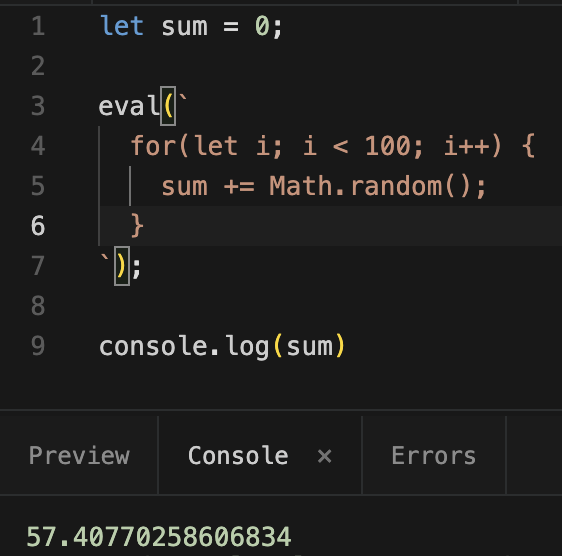
„JIT compilation“ requires host capabilities to compile and instantiate new modules. In the future https://t.co/5FtIzWmH2Z could provide a real JIT option.
eval support is in – both for strings known at compile time (AOT compiled) and unknown at compile time (optional interpreter side module). passing 96% of eval tests in test262.
#javascript#js#webassembly#wasm#ecmascript
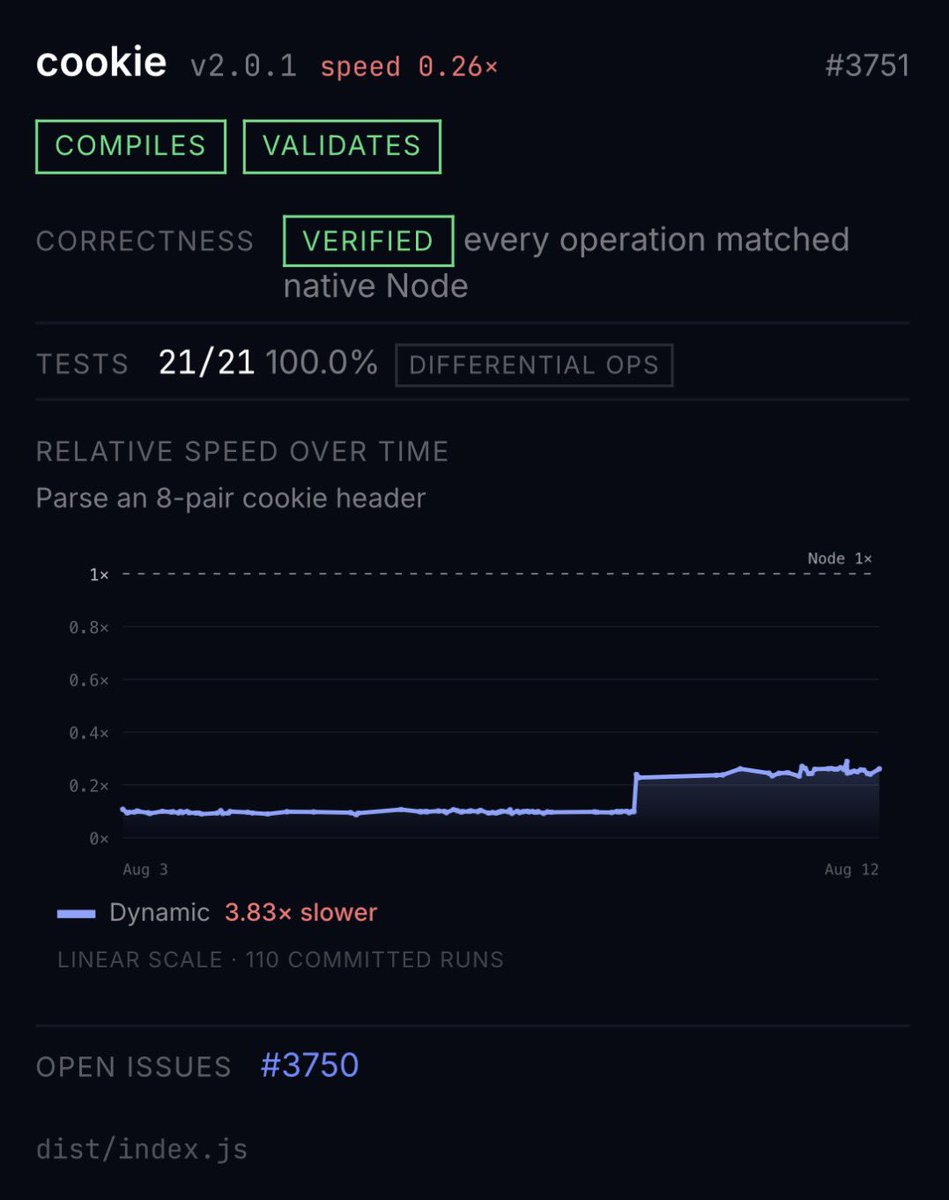
Playing „catch me if you can“ with V8’s JIT tier „Turbofan“ on npm packages 🐇
Speed relative to V8: Starting out at less than 10%, already seeing some 2-3 x speedups:
26% on cookie
18% on clsx
16% on acorn
https://t.co/zy07ukWWWk
#javascript#js#webassembly#wasm
Want to know why a lot of software professionals say you don't need to read (all) the code that AI produces anymore?
It is because our test suites look like this.
If we don’t want to end up in a severe situation we need to tighten up security for what is to come. Code is no longer written or read by humans while AI is finding ways to get in and out without permission. Module sandboxing will be the bare minimum.
I have accepted reality, I no longer write code manually.
But man do I miss reading a bug report and knowing exactly off the top of my head the if statement that causes it in the exact file in a 100K+ line codebase.
eval support is in – both for strings known at compile time (AOT compiled) and unknown at compile time (optional interpreter side module). passing 96% of eval tests in test262.
#javascript#js#webassembly#wasm#ecmascript
I'm officially done reading AI-generated code.
It's been two weeks since I looked at any of it.
I think the IDE is officially on its way to the graveyard. The job is no longer about "writing code," so we need new tools that better reflect this new reality.
While reviewing the code, I realized my only complaints were stylistic, and I wasn't finding any obvious bugs anymore.
The more code I generated, the harder it became to keep track of every line. I found that my time is better spent designing ways to verify that the overall system works than looking at the code.
State-of-the-art coding agents are better at writing code than I'd ever be, and I'm going to stop pretending otherwise.
I still think these coding agents can't go too far without an experienced human guiding them, but we're past the point where we need to check every line of code.
AI agents are escaping cybersecurity testing environments and reaching real-world systems, raising questions about whether safety infrastructure, industry standards and regulation can keep pace with increasingly powerful models.
https://t.co/UKI9pDvn7w