This article says climate change is “believed to have played a role” in the UK's extreme heat this week.
As a climate scientist, let me fact-check that.
First, climate change is not a religion. No belief is required. It is about evidence.
And the evidence has been crystal clear for more than two decades: climate change is making heat waves hotter, longer, more frequent and more dangerous.
In fact, science has advanced far beyond saying climate change merely “played a role.” Today, we can quantify how much more likely and how much hotter climate change made a specific event.
Here's the bottom line:
Climate is changing. Humans are responsible. And we are experiencing the impacts now. That’s the bad news.
The good news is that solutions already exist, and the majority of people care - 89%, around the world!
But meaningful action depends on helping people understand not just what is happening: we need to know how it affects our lives (this heat wave being example A today) and what we can do about it.
That’s the opportunity this reporting missed.
https://t.co/vYfPDKcWWf
🚩Note: Critical international response to the White House Correspondents Dinner (#WHCD) incident and post-facto “ #ReichstagFire” political implications:
🔥🔥🆘The international 🌏press has been quick to frame the White House Correspondents' Dinner shooting as a potential "Reichstag moment," with several non-American outlets expressing skepticism about how the incident will be leveraged for political gain by Trump, his party and core supporters.
Foreign Media Skepticism (Last 4 Hours)
• 🇫🇷Le Monde (France): A lead editorial suggests the incident is being "meticulously staged" to justify a broader crackdown on domestic political opposition. The analysis notes that while the trauma is real, the speed with which the administration pivoted to "enemies within" rhetoric suggests a prepared response.
• 🇩🇪Der Spiegel (Germany): Using the most direct historical parallels, commentators have questioned whether this represents a "Washingtoner Reichstagsbrand" (Washington Reichstag Fire). The skepticism centers on the immediate call for emergency decrees and the suspension of standard legal oversight following the shooting.
• 🇪🇸El País (Spain): Reports focus on the "transactional use of tragedy," noting that the incident provides a convenient distraction from recent setbacks in the Middle East and domestic economic pressures.
• 🇬🇧The Guardian (UK): Coverage emphasizes the "security-industrial complex" of the administration, suggesting the shooting will be used to permanently "fortify" the executive branch against judicial and legislative scrutiny.
The prevailing sentiment in these original-language reports follows three distinct lines of skepticism:
The "Pre-Written" Script:
Observation that the political messaging—targeting specific "radical" groups—emerged before the shooter was even fully identified.
The "Bargaining Chip" Theory:
In Asia, particularly in 🇹🇼Taiwan (United Daily News), there is concern that a "shaken" administration might use the domestic crisis as an excuse to pull back from international commitments, focusing instead on internal "purification."
The "Basket Case" Narrative:
Across European outlets, the shooting is cited as final proof that the U.S. has devolved into a "failed state" where even the most secure elite gatherings are subject to the same chaos as rural schools.
MESSAGE
I wholeheartedly endorse the powerful appeal for peace made by the Holy Father, Pope Leo, during his Palm Sunday Mass. His call for the laying down of arms and the renunciation of violence resonated profoundly with me, as it speaks to the very essence of what all major religions teach.
Indeed, whether we look to Christianity, Buddhism, Islam, Hinduism, Judaism or any of the world's great spiritual traditions, the message is fundamentally the same: love, compassion, tolerance, and self-discipline. Violence finds no true home in any of these teachings. History has shown us time and again that violence only begets more violence and is never a lasting foundation for peace.
An enduring resolution to conflict, including the ones we see in the Middle East or between Russia and Ukraine, must be rooted in dialogue, diplomacy and mutual respect — approached with the understanding that, at the deepest level, we are all brothers and sisters.
I urge for and pray that the violence and conflicts may soon come to an end.
DALAI LAMA
31 March 2026
Let me explain exactly why every new subdivision in America looks like the top photo, because the math is wild.
A mature tree increases a home's value by 7 to 19 percent. On a $400,000 house, that's $28,000 to $76,000. A single shade tree produces the cooling equivalent of ten room-size air conditioners running 20 hours a day. One tree on the west side of a house cuts energy bills by 12 percent within 15 years. The bottom photo is worth more, costs less to live in, and sells faster. This has been documented by the University of Washington, Clemson, Michigan State, and the USDA. The data is not in dispute.
Removing those trees saves the builder roughly $5,000 per lot. Concrete trucks need twice the dripline radius of every standing tree. Utility trenches need flat ground. A bulldozer flattens 200 lots in an afternoon. Preserving trees adds weeks and thousands per home.
So the developer pockets $5,000 in savings and the buyer eats $50,000 in lost value for the next two decades. The person making the decision and the person paying for it have never been in the same room.
The Woodlands, Texas is the proof of what happens when they are. George Mitchell bought 28,000 acres of Houston timberland in 1974 and preserved 28% as permanent green space. He forced McDonald's to build behind the tree canopy. That McDonald's became one of the highest-volume locations in Texas. The first office building, designed to reflect the surrounding forest so you couldn't see it from the street, leased completely.
The Woodlands median home price today: $615,000. Katy, a comparable Houston suburb that clear-cut: $375,000. Named #1 community to live in America two years running.
Fifty years of data. The trees are worth more than removing them saves. Developers clear-cut anyway because they sell the house once and leave. You live in it for 30 years.
Yes. This is transparently the plan. It is a destructive and unconstitutional plan. And it can be stopped. It can even be turned into an electoral issue that hurts Trump. But only if we face this now.
What an exciting opportunity for Canada: we can “participate in the reshoring” of production to the United States. From, say, Canada. It’s very simple: as the Trade Representative explains, we agree to open our markets to the United States, and in return they agree to close their markets to us. Where do we sign?!
Just so everyone is clear: Obama already had an Iran Nuclear Deal. Trump ripped it up when he came into office, choosing a policy of "maximum pressure" instead. So now he's saying we might go to war in order to get an Iran Nuclear Deal.
You cannot make this stuff up.
You are absolutely allowed to leave Canada. You just can’t take a chunk of it with you.
As for the constitution, it’s true: it’s very hard to change. Too hard. That needs to change — for everybody’s sake. The country needs a better amending formula — one that is based on the consent of the people, not the consent of the premiers.
But whatever formula is chosen, it can never be the case that one part of the country can impose constitutional changes on the rest of the country merely by voting on it — or legislating it. It’s wrong, and unconstitutional, when the government of Quebec does it, or purports to. And it’s just as wrong when the government of Alberta does it. Or purports to. Constitutional change, of any kind, can only be the result of a broad consensus across the country. That’s especially true of the kind of constitutional change that would be required to break up the country.
A final point, which has been made a thousand times, but it seems needs to be made a thousand more: equalization is not unfair to Alberta. It’s a screwed-up, dysfunctional, politicized program that doesn’t actually equalize. But it’s not paid for by Alberta, and it’s not an interprovincial revenue-sharing program. It’s a federal spending program paid for by federal taxpayers. Even as federal taxpayers, Albertan’s don’t pay into it disproportionately. They face exactly the same schedule of tax rates as taxpayers in the rest of the country. The people who pay disproportionately for it are richer people. They’re supposed to: that’s how a progressive income tax works. All these feverish calculations of how much more Albertans pay into the federal treasury than other Canadians are only a statement of how much richer Albertans are, on average, than other Canadians — a blessing, and a burden, they have in common with Canadians in, for example, midtown Toronto, who also pay “disproportionately” for equalization and other federal programs, only without the same vast industry devoted to showing how hard done by they are.
The only way in which you could say that equalization treats Alberta “differently” than other provinces is that its government does not qualify, and has never qualified, for equalization payments. But that’s not discrimination either — there’s no law that says “Alberta shall not be eligible for equalization payments.” The reason it does not receive equalization is because it is, by far, the richest province in the country, with by far the highest per capita revenues — even without a provincial sales tax. Equalization is messed up enough, but an equalization program that paid out to the richest province in the federation would be completely insane.
Maybe we shouldn’t have a progressive income tax. Maybe we shouldn’t have an equalization program. I happen to think we need both, albeit in substantially modified form, but those are legitimate questions for debate. What’s not legitimate is pretending that equalization is some kind of scam against Alberta. What’s even less legitimate is pretending you can abolish or reform a federal program by a referendum in one province. And what’s least legitimate of all is invoking the failure of that non-solution to a non-problem as justification for the constitutional nonsense of secession — which, to repeat, is the proposition that you can not only leave Canada, but take a piece of it with you.
This country is in for a very rocky 18 months or two years. If the Conservatives allow themselves to be know as the party that wouldn’t stand up to Trump, or to secessionists — or as the party that sided with either — it will spend another generation, possibly two, out of power.
Don’t kid yourself: there are significant sections of the party base, and of the conservative intelligentsia, who are indulgent of, if not favourable to, both — annexation and separation.
That number is likely to grow, not fall, as the pressure on Canada, and the party, grows: as Trump gets crazier, and his secessionist helpmates more brazen, those who are now counselling meet appeasement may grow more desperate, and more ambitious.
That’s partly why you see Conservative elder statesmen like Stephen Harper and Jason Kenney speaking out. Yes, they want to help their country. But they’re also trying to drag their party back to sanity.
One early clue to whether anyone is listening will be how they deal with Jivani. At the moment, the signs are not encouraging. If they can’t even bring themselves to deal with Jivani, who holds no party office, it’s scarcely likely they’ll deal seriously with Trump. And for the same reason: Jivani speaks for many in the party. They know it.
And he knows it. Jivani has thrown down the gauntlet to the party establishment. At the moment, it seems no one is willing to pick it up.
Scientists have identified a reversal of the long-standing Flynn effect—the roughly 200-year trend of rising average intelligence (measured via IQ and cognitive tests) across generations.
For the first time in modern recorded history, Generation Z (born roughly 1997–2012) shows lower performance than previous generations in key cognitive domains, including attention, memory, literacy, numeracy, executive function, problem-solving, and general IQ—despite spending more years in formal education than ever before.
Neuroscientist and educator Dr. Jared Cooney Horvath, PhD, MEd, testified before the U.S. Senate Committee on Commerce, Science, and Transportation on January 15, 2026, highlighting this shift. In his written testimony, he stated that cognitive development in children across much of the developed world has stalled or reversed over the past two decades, with declines evident in international assessments (e.g., PISA, TIMSS) and other large-scale data starting around the mid-2000s and accelerating post-2010.
Horvath attributes the primary driver not to reduced schooling, but to the widespread integration of digital screens and educational technology (EdTech) in classrooms. He argues that human brains evolved for deep, focused learning through face-to-face interaction and sustained attention, not fragmented skimming or constant task-switching encouraged by devices.
Key points from his testimony include:
- Teens now spend over half their waking hours on screens, with significant portions in school involving computers or tablets—often leading to off-task behavior and shallower processing.
- Evidence from meta-analyses and national/international studies shows a consistent pattern: higher classroom screen exposure correlates with weaker outcomes in reading, math, science, and higher-order reasoning.
- Digital tools may aid narrow, repetitive skill practice in controlled settings, but in core academic contexts, they tend to reduce depth of understanding, retention, and critical thinking.
Horvath describes this as a "structural mismatch" between human cognition and how digital platforms are designed (to capture and fragment attention), warning that unchecked EdTech adoption risks long-term harm to workforce skills, innovation, and societal reasoning.
[Horvath, J. C. (2026). Written testimony before the U.S. Senate Committee on Commerce, Science, and Transportation. U.S. Senate]
President Trump’s post threatening to block the opening of a major new US-Canada bridge was filled with important omissions and misleading claims.
- Trump professed astonishment that the Canadian government would expect him to support the project. He didn’t mention that he explicitly endorsed the project in a 2017 joint statement with then-PM Trudeau, calling it a “vital economic link” and saying he looked forward to its quick completion.
- Trump, complaining about Canada, said “we should own, perhaps, at least one half of this asset.” But the state of Michigan already owns half of the bridge.
- Trump said, “I will not allow this bridge to open until the United States is fully compensated for everything we have given them.” But Canada paid for the entire bridge construction.
- Trump complained about a Buy American waiver Obama granted the project, then claimed the waiver let Canada “not use any American products, including our Steel.” But the waiver actually allowed Canadian and US steel to be treated equally in consideration for the project, and numerous Canadian officials and Republican former Michigan Gov. Rick Snyder say some American steel was indeed used. (Also worth noting the Obama administration said it was granting the waiver out of a “basic notion of fairness” because the project was a “unique circumstance…under which Canada is assuming all financial liability and risk for the construction.”)
Fact check: https://t.co/yjLPjJEWuz
Google is so powerful that it "hides" other search systems from us. We just don't know the existence of most of them.
Meanwhile, there are still a huge number of excellent searchers in the world who specialize in books, science, other smart information.
Here's a list of sites you may have never heard of!
https://t.co/hLHSvB1Joo - Academic Resource Search. More than a billion sources: encyclopedia, monographies, magazines.
https://t.co/tzsXqbrCJD - a search for the contents of 20 thousand worldwide libraries. Find out where lies the nearest rare book you need.
https://t.co/Fm78bG5hyH - access to more than 10 million scientific documents: books, articles, research protocols.
https://t.co/JvTczb6j6o is a library of scientific bioscience journals published in developing countries.
https://t.co/ZtsaKUl9Jy - volunteers from 102 countries have collected almost 4 million publications on economics and related science.
https://t.co/aBLUtUW6a8 is an American state search engine on 2200+ scientific sites. More than 200 million articles are indexed.
https://t.co/IAzkF2ErNt is one of the most powerful researches on academic studies texts. More than 100 million scientific documents, 70% of them are free
https://t.co/6ujFPDG4AQ
Ecosia is a not-for-profit tech company that plants and protects trees. By dedicating 100% of its profits to the planet, Ecosia has planted over 214,229,374 million trees since its founding in December 2009
https://t.co/ZrIBFqf207
Yandex is a technology company that builds intelligent products and services powered by machine learning. Our goal is to help consumers and businesses better navigate the online and offline world. Since 1997, we have delivered world-class, locally relevant search and information services.
https://t.co/Duwc39PTkx
Project Gutenberg is a library of over 75,000 free eBooks
https://t.co/hOuRZFcDao
“Protection. Privacy. Peace of mind. Get our browser on all your devices.
Search and browse with the DuckDuckGo browser for more protection. Unlike Chrome and other browsers, we don't track you.”
https://t.co/hIAOHavGYB
Presearch is a community-powered, decentralized search engine that provides better results while protecting your privacy and rewarding you when you search.
https://t.co/BoWNlciH7N
Reliable information for all kinds of research
https://t.co/tPY4FcMJDR
Startpage is a global privacy technology company built around the principle of always putting privacy first. Our suite of easy-to-use privacy products helps anyone around the world to protect their personal data online.
from Christopher Seymore
Mamdani: "I speak of Renee Good, whose final words to the man who murdered her moments later were, 'I'm not mad at you.' I speak of Alex Pretti who died as he lived, caring for the stranger. ICE shot him 10 times because he did something they could never fathom doing ... let us offer a new path: one of defiance through compassion."
If Congress doesn’t act, the last nuclear arms control treaty between the U.S. and Russia will expire. It would pointlessly wipe out decades of diplomacy, and could spark another arms race that makes the world less safe. This piece is worth the read. https://t.co/NPtKyjYRml
This is genuinely one of the most absurd lake effect bands in Toronto’s history. A stationary band with snowfall rates exceeding 6cm/hr is absolutely pummelling the city. When it’s all said and done, snowfall totals could push 60-70cm or more by tomorrow morning. #onstorm
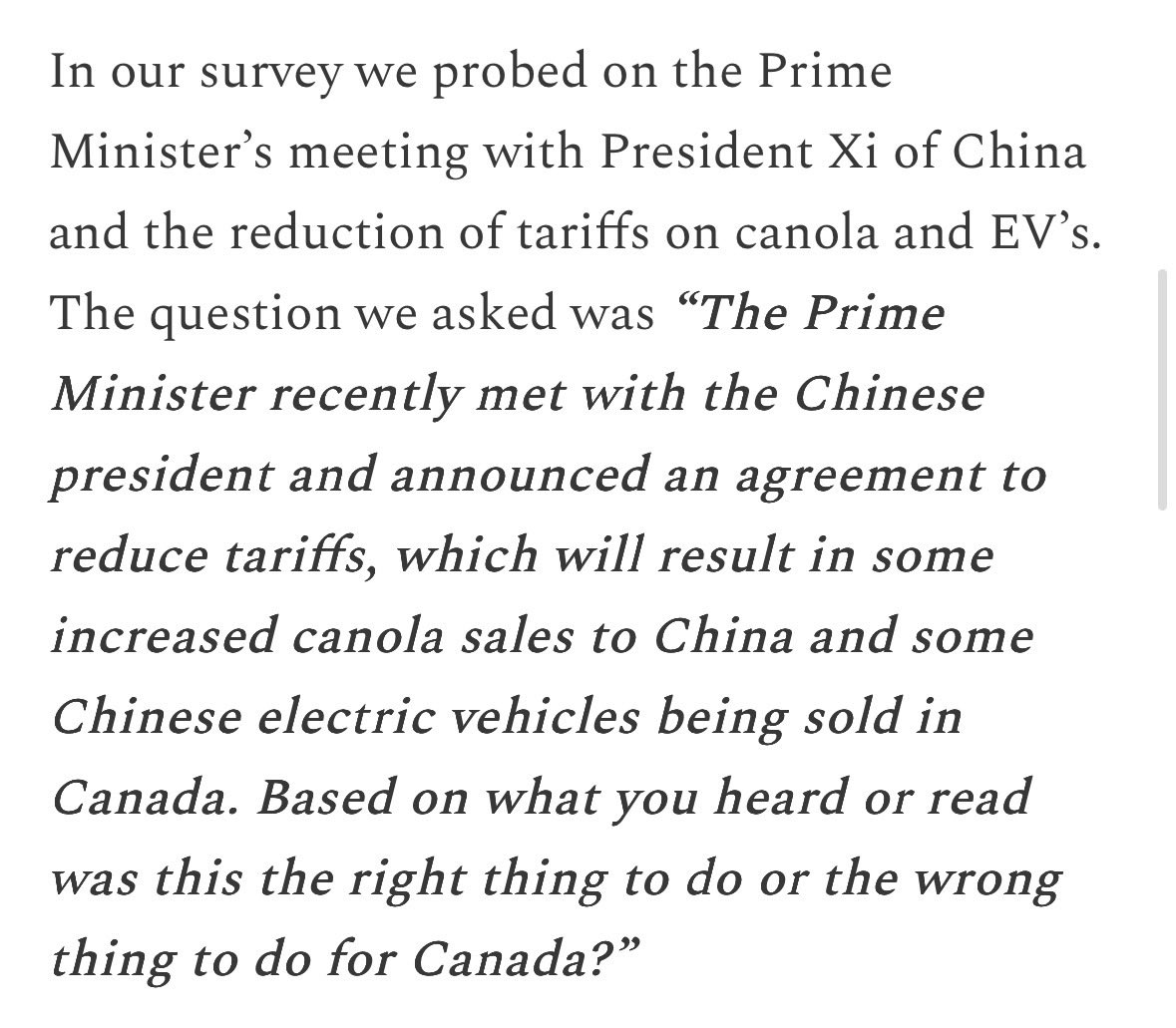
New polling suggests 78% of Canadians feel the China canola/EV deal was the right thing to do including 77% in the prairies and 75% in Ontario.
A majority (56%) of those who voted Conservative last year also support, as do 84% of NDP and 85% of BQ voters.
https://t.co/uOLZH6bCdo








![Rainmaker1973's tweet photo. Scientists have identified a reversal of the long-standing Flynn effect—the roughly 200-year trend of rising average intelligence (measured via IQ and cognitive tests) across generations.
For the first time in modern recorded history, Generation Z (born roughly 1997–2012) shows lower performance than previous generations in key cognitive domains, including attention, memory, literacy, numeracy, executive function, problem-solving, and general IQ—despite spending more years in formal education than ever before.
Neuroscientist and educator Dr. Jared Cooney Horvath, PhD, MEd, testified before the U.S. Senate Committee on Commerce, Science, and Transportation on January 15, 2026, highlighting this shift. In his written testimony, he stated that cognitive development in children across much of the developed world has stalled or reversed over the past two decades, with declines evident in international assessments (e.g., PISA, TIMSS) and other large-scale data starting around the mid-2000s and accelerating post-2010.
Horvath attributes the primary driver not to reduced schooling, but to the widespread integration of digital screens and educational technology (EdTech) in classrooms. He argues that human brains evolved for deep, focused learning through face-to-face interaction and sustained attention, not fragmented skimming or constant task-switching encouraged by devices.
Key points from his testimony include:
- Teens now spend over half their waking hours on screens, with significant portions in school involving computers or tablets—often leading to off-task behavior and shallower processing.
- Evidence from meta-analyses and national/international studies shows a consistent pattern: higher classroom screen exposure correlates with weaker outcomes in reading, math, science, and higher-order reasoning.
- Digital tools may aid narrow, repetitive skill practice in controlled settings, but in core academic contexts, they tend to reduce depth of understanding, retention, and critical thinking.
Horvath describes this as a "structural mismatch" between human cognition and how digital platforms are designed (to capture and fragment attention), warning that unchecked EdTech adoption risks long-term harm to workforce skills, innovation, and societal reasoning.
[Horvath, J. C. (2026). Written testimony before the U.S. Senate Committee on Commerce, Science, and Transportation. U.S. Senate]](https://pbs.twimg.com/media/HBDIc7NagAAWGAb.jpg)